How to Evaluate Systems Thinking
Systems thinking is a discipline, not a diagram. Read how to evaluate it, a worked decision example, a claim-status table, and where the method fails.
Systems thinking is frequently invoked as a badge of sophistication, with the result that almost any flowchart is called systems thinking. The Wikipedia entries on systems thinking and decision-making draw a sharper line: one is a way of understanding how structure produces behaviour over time, and the other is the act of choosing among alternatives. The real problem is deciding whether an analysis genuinely uses systems thinking or merely borrows its vocabulary.
Direct answer: Evaluate systems thinking by asking whether it identifies feedback, delays, and the structure that produces behaviour over time, and whether it changes a decision. The decision-making source supplies the test: a systems analysis that never alters a choice has not demonstrated its value, however tidy the diagram.
The mechanism of evaluation is to look for observable markers in the reasoning rather than impressions of sophistication.
Delta: This article adds an observable-markers test beyond the sources: it maps systems-thinking markers to a decision-quality check, with claim status explicit.
The mechanism
Wikipedia describes systems thinking as a holistic approach concerned with how the parts of a system interrelate, how behaviour emerges over time, and the context in which the system operates. It is contrasted with reducing a problem to isolated components. Its vocabulary includes feedback loops, delays, nonlinear responses, and stocks and flows. The underlying claim is that structure produces behaviour, so changing an outcome requires understanding the structure that generated it. The practical consequence is that a single-cause explanation is usually an incomplete account of a recurring problem.
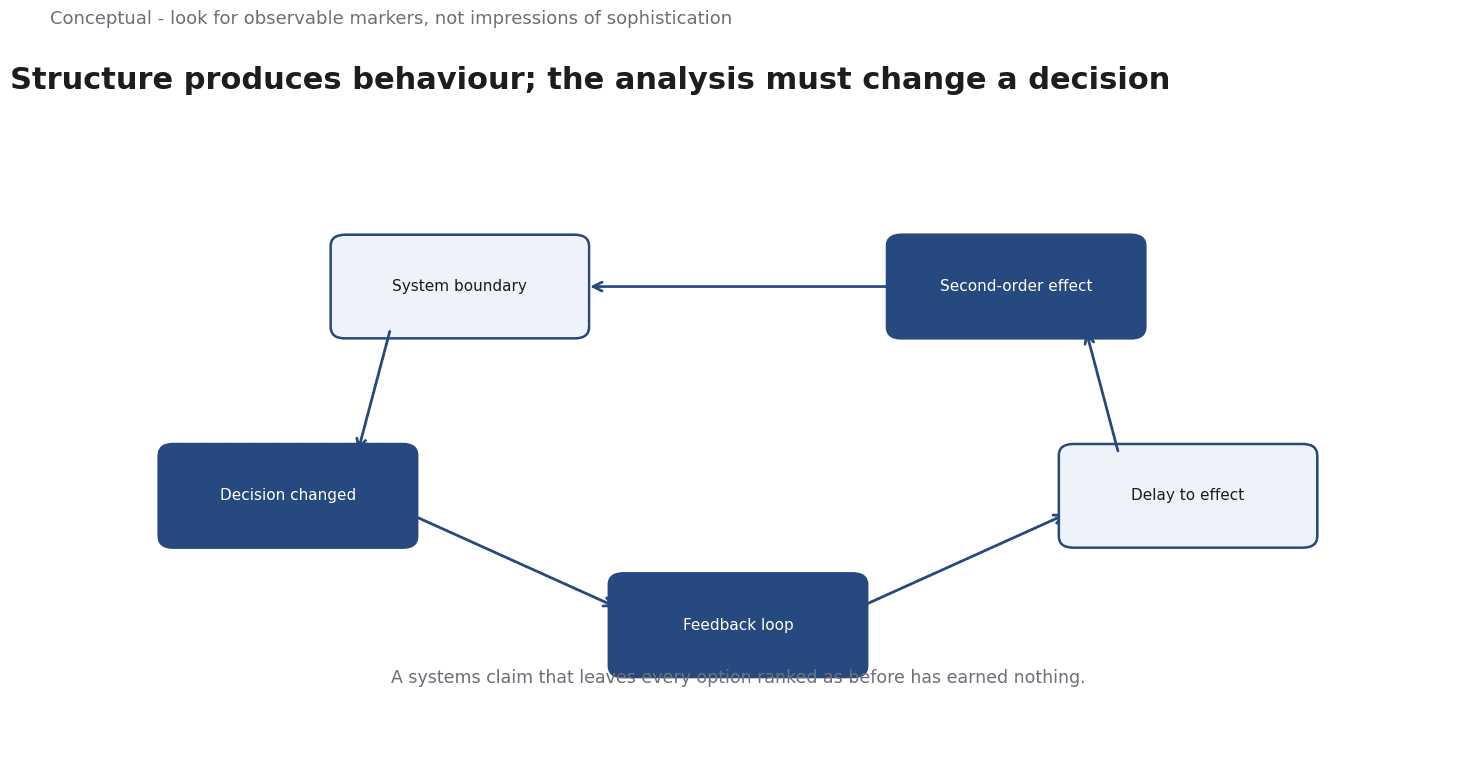
Decision-making, the second source, is the process of selecting a course of action from among alternatives. Wikipedia's treatment covers rational models and the constraints on them, including bounded rationality and the role of criteria, information, and alternatives. The link between the two sources is the decision itself: that is the point where analysis becomes consequential. An elegant account of feedback loops that leaves every option ranked exactly as before has not earned its place in the decision, and evaluation should say so.
Does the analysis name a feedback loop instead of a single culprit? Does it account for the delay between an action and its effect? Does it consider second-order consequences and state where the system boundary sits? These are checkable properties. A writer can claim to think in systems while offering a linear story, and the markers are what let a reviewer separate the two without arguing about intent.
The synthesis is to map those markers to decision quality. The claim that these markers improve decisions is a reasonable inference from combining the two sources, not a direct statement of either. Marking it as inferred keeps the test honest: it is a method for reading an analysis, not a result that the sources report. It also identifies where the test could fail, namely when a decision is good for reasons unrelated to the structure of the analysis.
A worked example
The following is hypothetical and illustrative. A team proposes a fix for a recurring delivery problem and calls its analysis systems thinking. The first check is feedback: does the analysis identify a self-reinforcing loop rather than naming one person or tool as the culprit? The second check is delay: does it account for the lag between adding capacity and seeing throughput improve? The third check is boundary and second-order effects: does it state which parts of the workflow are in scope and what a change might do to downstream quality? The outcome is that the first proposal targets a symptom and is rejected, while a revised proposal that adds feedback from downstream quality passes and changes the chosen action. The scenario is invented; the concepts come from the sources.
Evidence status
| Claim | Status | Source | Verified | Recheck when |
|---|---|---|---|---|
| Systems thinking focuses on interrelationships, feedback, and behaviour over time | source-reported | Systems thinking (Wikipedia) | 2026-11-18 | Entry is substantively revised |
| Decision-making models range from rational choice to bounded rationality | source-reported | Decision-making (Wikipedia) | 2026-11-18 | Entry is substantively revised |
| Observable systems markers can be mapped to decision quality | inferred | Derived from the sources | 2026-11-18 | Decision context or criteria change |
The first two rows are claims the sources make. The third is a test assembled from them, not a finding of either entry, so it is marked inferred. Its usefulness depends on the decision being evaluated, and it should be rechecked when the criteria or context change. The table keeps that dependence visible so that the test is not treated as universal.
What it cannot do
Systems thinking cannot guarantee a correct decision. A feedback map is a simplified representation, and a simplified representation can omit the factor that matters most. Wikipedia's account describes a way of understanding interrelationships and behaviour over time; it does not claim that any given model is complete or that following it produces the best outcome. An analysis can pass every marker in this test and still lead to a poor choice because an external shock or an unmeasured constraint dominated the result. Evaluation should therefore judge the quality of the reasoning, not promise the quality of the outcome.
The hidden cost is time and complexity. Mapping loops, delays, and second-order effects takes effort, and in a fast-moving decision the delay can be more expensive than the error it avoids. There is also a social cost: a detailed systems account can overwhelm a room and become a way to defer a choice. The decision-making source treats choosing among alternatives as the task, and an analysis that postpones the choice indefinitely has failed that task even if its diagram is accurate. Good evaluation asks whether the analysis clarified a decision or replaced it.
If the system is defined too narrowly, feedback that drives the problem sits outside the picture and the analysis blames an internal cause. If it is defined too broadly, everything becomes connected to everything and no action is actionable. Confirmation bias compounds this: a team can select the loops that support a preferred option and ignore the ones that challenge it. The markers in this test make such omissions easier to spot, but only if the reviewer is willing to ask what lies outside the diagram.
The boundary is between understanding structure and making a choice. Systems thinking describes how parts interrelate and how behaviour emerges; decision-making describes how a choice is made among alternatives. Neither substitutes for the other. A decision can be sound without a full systems analysis, and a thorough systems analysis can be ignored by the person who decides. Confusing the two leads teams to expect a diagram to decide for them, or to dismiss a decision because its analysis was not elaborate. Keeping the roles separate makes evaluation fair to both.
Because real systems change, an analysis goes stale. Loops shift, delays lengthen, and new actors enter, so a map that was accurate when a decision was made can mislead the next one. That decay needs an owner and a review condition. The sources explain what systems thinking and decision-making are, but they do not set a schedule for revisiting an analysis. Establishing one locally is what keeps the method a living input to choices rather than a diagram that was impressive once.
The counterargument that systems thinking is only a mindset is fair for small problems with obvious causes and incomplete where feedback and delay determine whether a recurring issue actually changes.
A decision test
- Name the decision the analysis is meant to inform.
- Check whether it identifies feedback rather than a single cause.
- Look for explicit treatment of delays between action and effect.
- Check that second-order consequences are considered.
- Verify that the system boundary and context are stated.
- Confirm that the analysis changes at least one option or criterion.
- Assign an owner and a review condition for revisiting the map.
The test converts an abstract label into checkable properties of a piece of reasoning. Each step asks whether a marker is present and whether it touches the decision, and the final steps keep the analysis current. A passing analysis is not a guarantee of a good outcome; it is evidence that structure, delay, and consequences were examined rather than assumed.
For further reading, see Decision Memos That Survive Review.
References & Further Reading
- Wikipedia contributors, 2026. Systems thinking - Wikipedia — Understanding feedback, structure and behaviour over time.
- Wikipedia contributors, 2026. Decision-making - Wikipedia — Overview of decision processes, trade-offs and the distinction between the decision and its outcome; secondary reference.