How to Evaluate Term Sheets
A term sheet is a set of future obligations, not a headline valuation. Read what to check, a worked review, and why the label matters less than the clause.
A term sheet is usually described by its valuation, which is the least informative part. The document sets control rights, preferences, and obligations that decide what happens later, which the term-sheet entry describes as a non-binding agreement with substantive terms, as Cap Table Mechanics: Equity, Options, and Dilution explains how equity changes, as the venture-capital article treats the investment path, as the legal article requires a dated check.
Direct answer: Evaluate a term sheet clause by clause — valuation, liquidation preference, dilution, control, and vesting — against a model of future outcomes, with qualified legal advice. Wikipedia's term-sheet entry provides the structure, and investor education frames the investment context. The boundary: this is educational orientation, not legal or financial advice — terms and enforcement are jurisdiction-specific, as the legal and tax articles require a dated check, as the publication standard forbids guaranteed outcomes.
The headline valuation is not the outcome, which the scenario check reveals.
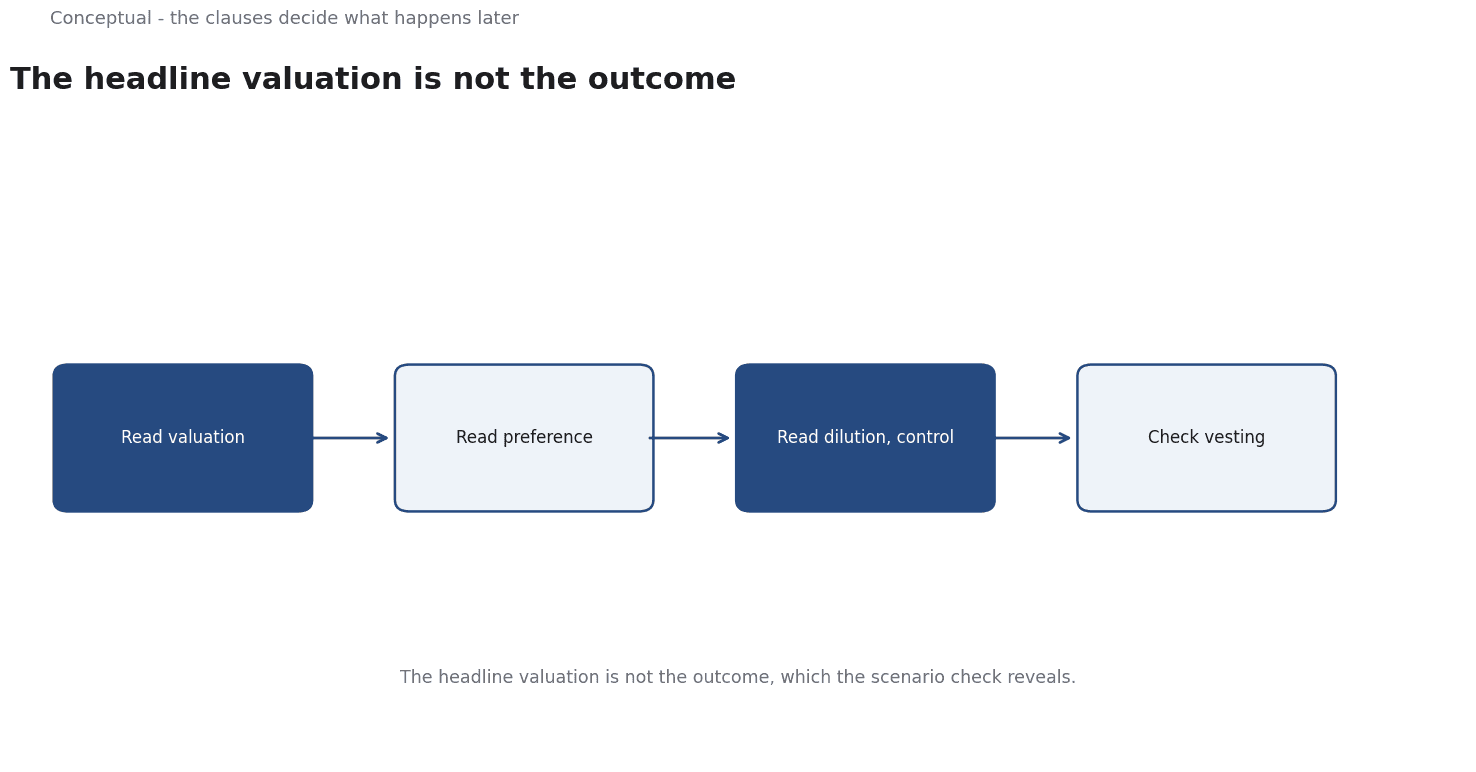
The checks
Valuation is a price, not a promise. The headline sets the price for the round, which the startup-valuation article treats as a method, as Cap Table Mechanics: Equity, Options, and Dilution explains dilution, as the scenario-analysis article requires conditional thinking, as the decision-memo article requires for a recorded judgement.
Liquidation preference. What gets paid first in an exit, which the term-sheet entry describes, as the equity-financing article treats the structure, as the waterfall discussion in the cap-table article advises, as the risk-assessment article requires residual risk to be stated.
Dilution and option pool. Who holds the equity after the round, which the cap-table and equity-dilution articles explain, as the option-pool discussion in the term-sheet entry treats the refresh, as the comparables article requires consistent definitions.
Control and protective provisions. Which decisions require investor consent, which the term-sheet entry treats as a structural term, as the governance checklist requires an accountable owner, as Term Sheet Basics: What Founders Should Read Twice argues for reading terms rather than labels.
Vesting and founder terms. What happens if a founder leaves, which the cap-table article treats as an equity mechanic, as the legal article requires a dated check, as the decision-memo article requires for a record.
Three consequences follow. The clauses should be modelled against scenarios, as the scenario-analysis article requires, as Cap Table Mechanics: Equity, Options, and Dilution advises, as the valuation article treats as conditional. The legal terms require qualified advice, as the legal article requires, as the tax article advises. And the decision should be recorded with the assumptions, as the decision-memo article requires.
A worked review
The following is hypothetical and illustrative. A founder receives a term sheet with an attractive valuation and a one-times liquidation preference.
Three checks decide the review. First, what happens in a modest exit, as the term-sheet and cap-table articles require, with a waterfall, as the scenario-analysis article advises, as the risk article requires residual risk? Second, how much dilution follows from the option pool refresh, as the cap-table and equity-dilution articles explain, with consistent definitions, as the comparables article requires? Third, which decisions require consent, as the term-sheet entry describes, with qualified advice on the clauses, as the legal article requires, as the decision-memo article requires for a record?
Three conclusions follow. Dilution and control change the picture, as the cap-table and term-sheet articles advise. And the decision should be recorded with the assumptions, as the decision-memo article requires.
What term-sheet evaluation cannot do
It cannot predict an exit, which the scenario-analysis article treats as conditional, as the publication standard forbids guaranteed outcomes, as the risk article requires residual risk. It does not replace legal advice, which the legal article requires, as the tax article advises on jurisdiction. And it cannot remove the need to understand the business, which the company-analysis article treats as prior, as the value-proposition article argues for the buyer's evaluation.
The counterargument that a high valuation settles the decision is fair as a price and incomplete about preferences and control, which the worked review shows, as Term Sheet Basics: What Founders Should Read Twice argues for reading clauses.
A decision test
- Read every clause, as Term Sheet Basics: What Founders Should Read Twice advises.
- Model outcomes under scenarios, as the scenario-analysis article requires.
- Check liquidation preference, as the term-sheet entry describes.
- Check dilution and the option pool, as Cap Table Mechanics: Equity, Options, and Dilution explains.
- Check control and protective provisions, as the term-sheet entry advises.
- Get qualified legal advice, as the legal article requires.
- Record the decision and assumptions, as the decision-memo article requires.
For the equity mechanics, see Cap Table Mechanics; for the basics, see Term Sheet Basics.
References & Further Reading
- Wikipedia contributors, 2026. Term sheet - Wikipedia — The structure and terms of a non-binding financing agreement.
- U.S. Securities and Exchange Commission (Investor.gov), 2026. Introduction to Investing — Primary regulator guidance on market mechanics and investor protection.