How to Get Behavioral Interviews Right
Behavioral interviews are often treated as a box-ticking exercise. Read how structured questions and decision theory shape a fair signal, and a test for running them.
Behavioral interviews are frequently run as a casual conversation: a few broad questions, a gut feeling, and a quick consensus. The real problem is that unstructured impressions are inconsistent between candidates and vulnerable to bias, so the process can feel thorough while producing a signal that does not predict job performance. The questions sound reasonable, but the comparison between candidates is weak.
Direct answer: A behavioral interview asks candidates to describe past experiences as evidence of future behavior, and it works best when questions and scoring are structured. O*NET OnLine from the U.S. Department of Labor describes jobs in terms of tasks, skills, and work activities that can anchor those questions, while Wikipedia's "Decision making" entry frames how judgments are formed and where they go wrong. The boundary: an interview is a sampled judgment, not a measurement of everything a person can do.
Comparability is the whole point, because the decision is relative: the team is choosing among candidates, and a signal that shifts with the interviewer is useless for that purpose.
Delta: This article adds a decision framing beyond the sources: it maps job descriptors and decision-process concepts to the specific design choices that make a behavioral interview fair and repeatable, with claim status explicit.
The mechanism
O*NET OnLine, maintained by the U.S. Department of Labor, is a resource that describes occupations in terms of tasks, skills, abilities, work activities, and work context. The mechanism is a structured map of what a job actually involves. The practical consequence is that it gives an interview a factual anchor: instead of inventing questions from a vague impression of the role, an interviewer can select the tasks and skills that matter and ask for past examples tied to each. The quality of the interview is therefore limited by the quality of the job description behind it.
Wikipedia's "Decision making" entry describes the process of selecting a course of action among alternatives and notes that judgments are affected by the information available and by cognitive limitations. The mechanism relevant here is bounded judgment: an interviewer forms an impression from a small sample of behavior and completes the picture with assumptions. The practical consequence is that unstructured interviews give those assumptions too much room. Two interviewers who see different slices of a candidate's experience can reach opposite conclusions, and each will feel confident.
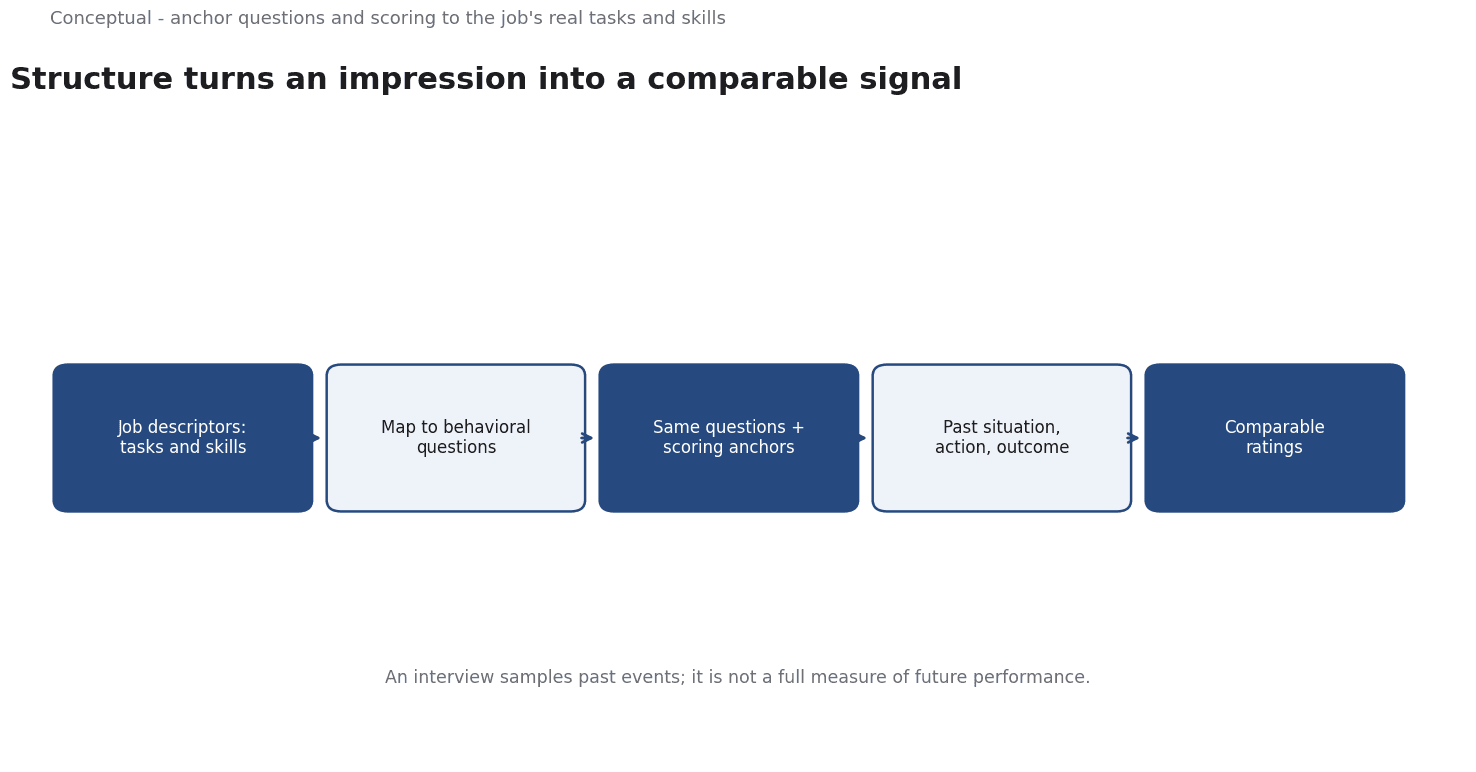
Structure narrows that gap in two ways. Asking every candidate the same job-relevant questions makes the evidence comparable, and scoring each answer against defined criteria keeps the evaluation anchored to the role rather than to a feeling. The mechanism is standardization of both input and rating. The practical consequence is that the interview becomes a consistent instrument rather than a series of independent conversations.
The final element is the link from past behavior to future performance. Behavioral questions rest on the assumption that how someone handled a prior situation is informative about how they will handle a similar one. The practical consequence is that questions should elicit specific situations and specific actions, not general self-descriptions. An answer that stays at the level of personality traits gives the decision-maker little to evaluate, while an account of a real event with a described action and outcome can be checked against the job's requirements.
A worked example
The following is hypothetical and illustrative. A hiring team is filling a role that O*NET-style descriptors identify as requiring stakeholder coordination and handling conflicting priorities. Three checks structure the interview. First, the coverage check: does each critical task have a question that asks for a past example, asked identically of every candidate? Second, the evidence check: does the scoring guide define what a strong, partial, and weak answer looks like before interviews begin? Third, the bias check: are the team's notes recording job-relevant observations rather than impressions about similarity or confidence? The outcome is a comparable set of ratings that can be discussed against the role's requirements. The limitation is that even structured ratings sample only a few past events and cannot capture every facet of future performance.
Evidence status
| Claim | Status | Source | Verified | Recheck when |
|---|---|---|---|---|
| O*NET describes occupations by tasks, skills, and work activities | source-reported | O*NET OnLine | 2026-11-18 | when the descriptor framework is revised |
| Decision making selects among alternatives under limited information | source-reported | Decision making - Wikipedia | 2026-11-18 | when the entry's model of judgment changes |
| Structured, job-anchored questions improve candidate comparability | inferred | Derived from the sources | 2026-11-18 | when new hiring research contradicts or supports it |
The first two rows report what the two sources state directly and can be checked against them. The third is an inference: it follows from combining a structured job map with a bounded view of judgment, but neither source presents it as a hiring rule. Recheck conditions point back to the sources or to new research, which keeps the status of each row explicit rather than implied.
What it cannot do
A behavioral interview cannot measure everything the job requires. It samples a handful of past situations, and a candidate's performance in those situations is only a partial indicator of future behavior. Skills that are hard to narrate, such as quiet reliability or judgment under sustained pressure, may not surface in a story. The limit is that the method captures what can be described in an interview window, so a high score means the candidate answered the sampled questions well, not that every requirement has been verified.
A hidden cost is the work of structuring. Writing job-relevant questions, defining scoring anchors, and training interviewers to use them consistently takes time that teams under deadline pressure often skip. The cost is paid twice: once in design, and again in discipline when a confident interviewer tries to improvise. Unstructured conversation feels faster and more natural, which is why teams drift back to it. The practical expense is not the interview hour but the design and calibration effort that makes the hour meaningful.
A decision-maker who forms an early impression tends to interpret later answers to fit it, a pattern consistent with the decision-making literature's account of bounded judgment. The same bias appears when a team hires for familiarity, rewarding candidates who share its background and communication style. The result is a process that feels objective because it has a scorecard, while the scores were shaped by an impression formed before the evidence arrived.
The boundary is that these sources provide a job map and a theory of judgment, not a validated hiring system. O*NET describes occupations; it does not prescribe interview questions or claim that any descriptor predicts performance. The decision-making entry describes how judgments form; it does not rank hiring methods. Applying them responsibly means using the job map to choose relevant topics and the decision concepts to design fair scoring, without claiming that the resulting interview is a complete or guaranteed predictor.
Because roles and teams change, the interview needs scheduled review. A descriptor that mattered for a job a year ago may no longer be central, and a scoring anchor that once separated candidates may now reward the wrong behavior. The practical requirement is to revisit the mapped tasks, the question set, and the scoring anchors on a fixed cadence, and to record which ratings drove which hiring decisions. Without that review, the process becomes a ritual whose questions nobody re-examines and whose scores drift away from the job.
The counterargument that structured interviews are too rigid to reveal personality is fair for roles where culture fit genuinely matters and incomplete for the many jobs where consistent, job-relevant evidence matters more than conversational ease.
A decision test
- Identify the tasks and skills the role truly requires.
- Map each critical requirement to one behavioral question.
- Write the same core questions for every candidate.
- Define scoring anchors before any interviews take place.
- Ask for specific past situations, actions, and outcomes.
- Record job-relevant evidence separately from overall impressions.
- Review the mapping and anchors after each hiring cycle.
These steps convert an unstructured conversation into a decision process with visible inputs and criteria. The mapping from occupational descriptors and judgment concepts to interview design is what makes the comparison between candidates fair. A passed test leaves a record of which requirements were sampled and why each rating was given, not simply a memory of who seemed impressive.
For further reading, see Decision Memos That Survive Review.
References & Further Reading
- U.S. Department of Labor, 2026. O*NET OnLine — The standard occupational taxonomy used to compare roles across industries.
- Wikipedia contributors, 2026. Decision-making - Wikipedia — Overview of decision processes, trade-offs and the distinction between the decision and its outcome; secondary reference.