How to Get Brand Lift Measurement Right
Brand lift measures a change in perception, not sales. Read how to run one, a worked example, and why a survey needs a comparison.
Brand lift studies are often read as proof that a campaign worked, which overstates what a survey can show. Google's experiment guidance describes a comparison design, and the marketing-communications entry covers how messages are received. The question is what changed because of the campaign.
Direct answer: Measure brand lift with a comparison group, neutral wording, and a clear definition of the perception being changed. The sources describe the method and reception; the rule is a synthesis.
Delta: This article adds a claim-status table and a worked example, separating documented method from local judgements about what matters.
The mechanism
The first point is the comparison. The experiment guidance describes holding out a group from the campaign, which provides the counterfactual that a before-and-after survey lacks. Without it, a change in awareness could have come from anything else in the period.
The second point is the question. The marketing-communications entry treats a message as received, which means the survey should measure a perception that the campaign could plausibly affect. A broad question about preference can move for reasons unrelated to the campaign, and the result will be hard to act on.
The third point is wording. AAPOR's standards require neutral wording and transparent reporting, which applies to a brand study as much as any other survey.
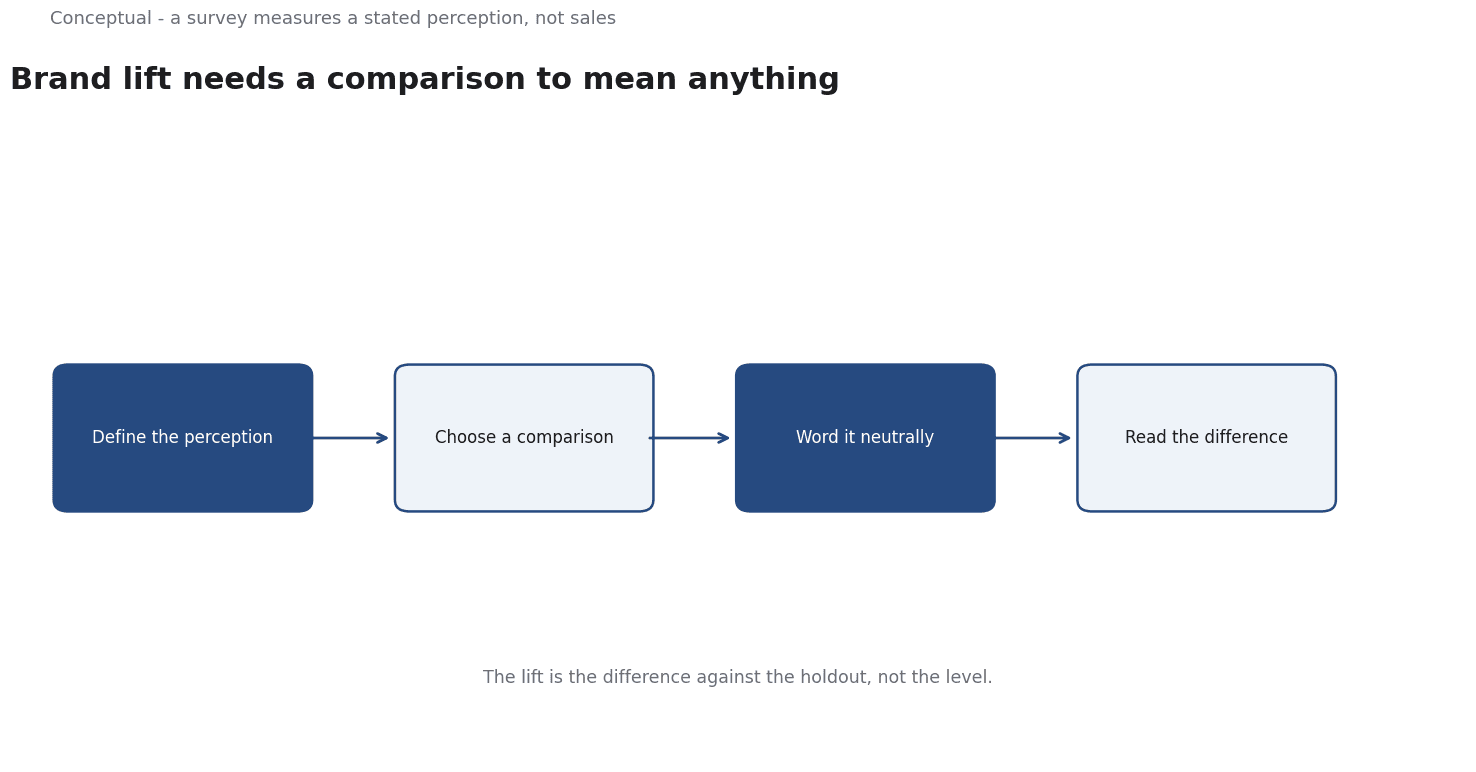
The sequence is: define the perception, choose a comparison, word the question neutrally, then read the difference. The definitions are local, so the conclusions are inferred; the method is source-reported.
A worked example
Illustrative. A campaign reports higher awareness among people who saw it.
Three checks decide. First, was there a comparable group that did not see the campaign, and were the groups similar? Second, did the question measure a specific perception the campaign was designed to change? Third, was the wording neutral, and was the sample reported?
The outcome is a qualified reading of the lift. The scenario is hypothetical; the method is the contribution.
Evidence status
| Claim | Status | Source | Verified | Recheck when |
|---|---|---|---|---|
| Experiments use a comparison group | source-reported | Google Ads experiment guidance | 2026-11-18 | Guidance changes |
| Messages are received by an audience | source-reported | Wikipedia, Marketing communications | 2026-11-18 | Practice changes |
| Define perception before measuring | inferred | Derived from both | 2026-11-18 | Campaign changes |
Why a survey needs a comparison
A perception measured after a campaign reflects everything the audience experienced, not only the campaign.
A comparison group separates the campaign's contribution from the background, which is the whole purpose of the study.
A further constraint is that a brand study measures a stated perception, which may not translate into behaviour. A campaign can raise awareness without changing a purchase, and the study should not be read as evidence of sales. Keeping the two measures separate is the discipline.
The comparison also needs to be genuinely independent. If the holdout group sees the campaign through another channel, the measured difference shrinks, and the study may conclude there was no effect when the design was at fault. Checking for contamination is part of the work.
Finally, a perception can change slowly. A short study may miss an effect that appears over months, and a long one risks being contaminated by other events. Choosing the window in advance, with the limits recorded, is the practical response.
A perception study should not be read as evidence of sales, which is a separate measure.
A holdout that was exposed to the campaign weakens the study, so contamination deserves a check.
The question should measure a perception the campaign could plausibly change.
The sample and the wording belong in the report, since both shape the result.
A study without a holdout cannot separate the campaign from everything else in the period.
A stated perception is not a purchase, and the two should not be conflated.
Neutral wording is a precondition for a lift that means anything.
What it cannot do
It cannot prove that a perception led to sales. It does not guarantee that the wording was understood the same way by everyone. And it cannot replace a behavioural measure.
The counterargument that any lift is useful is fair for tracking and incomplete for a decision to spend more.
A decision test
- Define the perception.
- Choose a comparison group.
- Word the question neutrally.
- Report the sample.
- Read the difference, not the level.
- Record the design and recheck date.
For the experiment basis, see Incrementality.
References & Further Reading
- Brian Vaver and Koehler, 2011. Measuring Ad Effectiveness Using Geo Experiments — Geo experiments for incrementality, the cleanest way to attribute marketing spend.
- Wikipedia contributors, 2026. Marketing communications - Wikipedia — The coordination of messages across channels and the distinction between consistent and identical communication.