How to Get Cap Table Right
A cap table records who owns a company and how much. Read the mechanism, a worked example and why a tidy spreadsheet is not the same as an accurate one.
A capitalization table is often treated as an administrative spreadsheet that only matters at a financing, which is when errors become expensive. The real problem is that ownership changes continuously through grants, conversions and rounds, while the table is frequently updated only when someone remembers. The cap-table and entrepreneurship entries provide the concepts; the missing piece is what it takes to keep the record accurate.
Direct answer: A cap table records the equity ownership of a company, listing holders, security types and the resulting percentages, so that dilution and proceeds can be worked out. Wikipedia's capitalization-table entry describes what it contains and why it changes; the entrepreneurship entry places it in the context of financing and risk. The boundary: a cap table is a record of ownership, not a valuation or a legal opinion.
Delta: This article adds a decision framing beyond the sources: it maps ownership records and the financing context to the specific question of when a cap table is reliable enough to support a decision, with claim status explicit.
The mechanism
The capitalization-table entry defines the cap table as a table, often a spreadsheet, showing the equity ownership of a company: who holds shares, the classes of stock and the percentages each holder owns. It typically includes common stock, preferred stock, options, warrants and other convertible instruments. The practical consequence is that the table must represent instruments that may convert, because present ownership understates potential ownership after conversion. A holder with options is not yet a shareholder in the same sense, but the table still needs to show the claim.
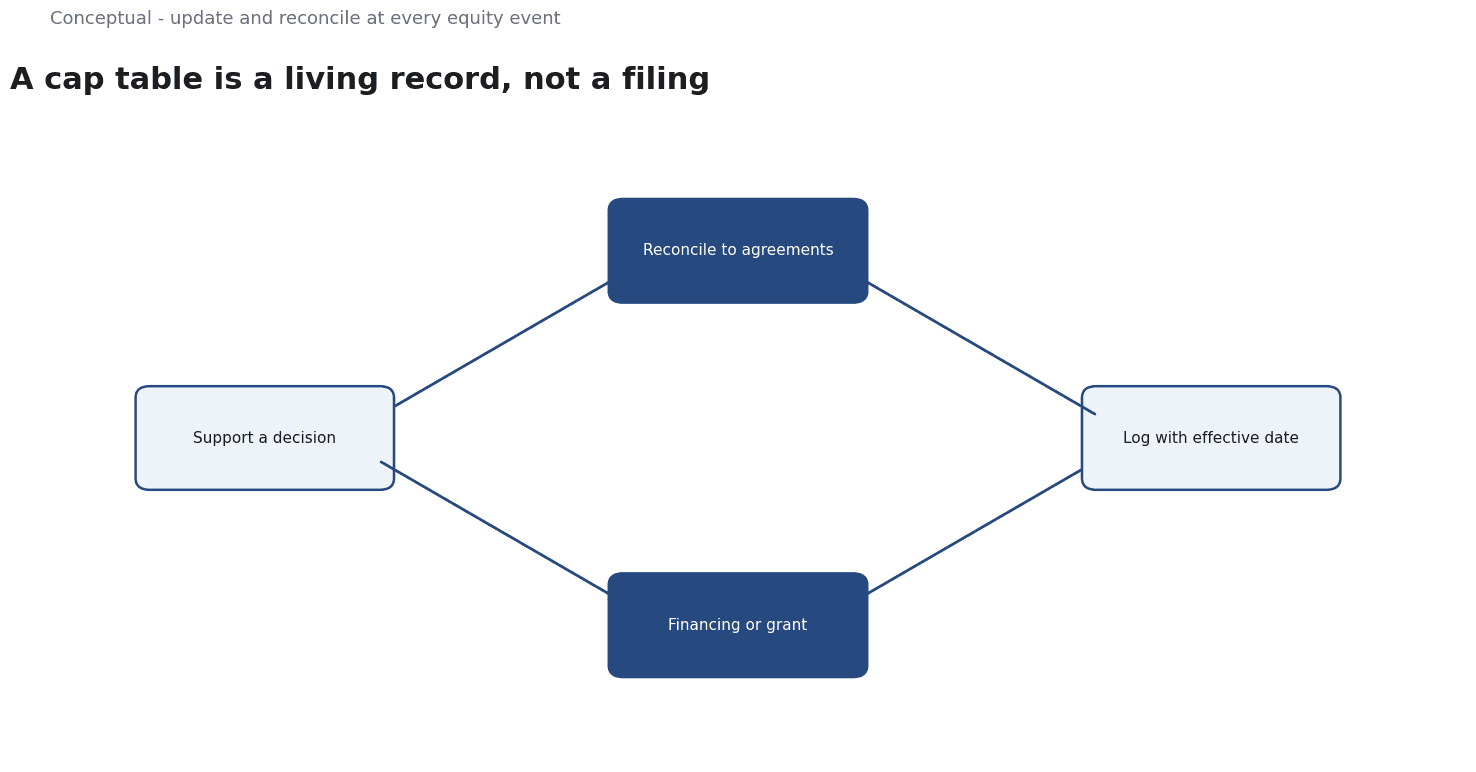
The entry also explains that the table changes with events: new financings, option grants, exercises and conversions each alter the distribution.
The practical consequence is that accuracy is a function of process, not of a one-time build.
The table must be updated at each event, with the effective date and the instrument recorded, so that a historical snapshot can be reconstructed later. A table that shows only the current state cannot answer questions about how the company arrived there.
The entrepreneurship entry describes entrepreneurship as designing, launching and running a new venture under risk and uncertainty, with financing a recurring activity. The practical consequence is that the cap table is most load-bearing precisely in the early, changing stages where records are weakest. The environment the table serves is one of frequent dilution and shifting claims, which is why a casual approach fails at the moment the numbers matter most. A well-kept table is a form of infrastructure for that environment.
The final mechanism is the link between the table and decisions. Ownership percentages determine dilution, control and the division of proceeds, so an error in the record propagates into negotiations and planning. The practical consequence is that before the table supports a term sheet or an employee grant, it should be reconciled against the underlying agreements. The mechanism ends at reconciliation, not at the spreadsheet, because the spreadsheet is only a summary of documents that sit outside it.
A worked example
The following is hypothetical and illustrative. A founder is preparing for a small financing and uses the cap table to explain dilution to an incoming investor. Three checks decide. First, completeness: does the table include options and convertible instruments, not just issued common shares, so that potential ownership is visible? Second, event history: were the last grant and the prior round recorded with effective dates, so the current percentages can be reconciled? Third, agreement match: do the recorded shares and classes match the signed documents rather than an old spreadsheet version? The outcome is a condition rather than a valuation: if the three checks pass, the table can support the discussion; if any fails, reconciliation comes first and the conversation is deferred. The scenario is hypothetical; the mapping from concepts to checks is the contribution.
Evidence status
| Claim | Status | Source | Verified | Recheck when |
|---|---|---|---|---|
| A cap table records holders, security classes and ownership percentages | source-reported | Capitalization table - Wikipedia | 2026-11-18 | Definition or scope changes in the source |
| The table changes with financings, grants, exercises and conversions | source-reported | Capitalization table - Wikipedia | 2026-11-18 | Practice description is revised |
| Reconciliation against agreements reduces the risk of stale records | inferred | Derived from the sources | 2026-11-18 | New guidance on equity record-keeping appears |
The two descriptive claims are reported directly from the reference entry and are stable as descriptions. The claim about reconciliation is an inference from combining the ownership definition with the financing context, so it should be revisited if record-keeping guidance changes. Marking the statuses explicitly keeps a reasoned recommendation from being mistaken for a documented rule.
What it cannot do
A cap table cannot value the company. Ownership percentages say nothing about what a share is worth; that requires a separate valuation exercise. The table also cannot settle legal questions about the terms of an instrument. It summarises agreements, it does not interpret them, so a dispute over conversion rights or preference terms has to be resolved from the documents themselves. Presenting the table as a valuation or a legal conclusion is a category error that becomes costly exactly when the numbers are scrutinised.
The hidden cost is maintenance. Keeping the table accurate requires discipline at every equity event, and that discipline consumes time and attention in a stage where both are scarce. There is also an opportunity cost: a decision may need to wait while records are reconciled. Against that sits the false confidence a clean-looking spreadsheet provides when it is built on outdated inputs. The cost is not the spreadsheet itself but the gap between how orderly it looks and how current it is.
Another is treating the table as a static artifact, built once and revisited only under pressure. A third is confusing issued ownership with fully diluted ownership, so the percentages quoted to a new investor describe a different company from the one the existing holders expect. Mixing up effective dates is a fourth, and it makes historical snapshots impossible to reconstruct. Each failure is quiet until a financing or a grant forces the numbers into the open.
There are settings where a simple cap table has reached its limit. Multiple security classes, cross-border holders and instruments with unusual terms may need dedicated systems and professional review. During disputes or formal processes, the table is evidence of what was recorded, not authority over what is owed. Its proper boundary is a tool for tracking and communicating ownership in a venture where the instruments are understood. Beyond that boundary, relying on it alone is unsafe.
Finally, the cap table needs review tied to events rather than to the calendar alone. Ownership changes at financings, grants, exercises and conversions, so each of those is a natural checkpoint. The practical requirement is to re-derive the position at each event, to record the table version and the effective dates used for a decision and to reconcile periodically against the signed documents. Without that habit the table drifts from reality in small steps, and the error is discovered only when it is most expensive.
The counterargument that a formal cap table is overkill for an early venture is fair for a sole founder with no external holders and incomplete for ventures that have options, convertibles or outside money, where informal records fail fastest.
A decision test
- Name the decision the cap table must support.
- List all holders, security classes and convertible instruments.
- Verify that every equity event is recorded with an effective date.
- Reconcile recorded shares and classes against signed agreements.
- Distinguish issued from fully diluted ownership.
- Record the table version and data used for the decision.
- Set a review point at the next equity event.
These steps treat the cap table as a living record rather than a filing. The test is passed when a reader can reconcile each percentage to an event and an agreement, and failed when the table is presented as a valuation or accepted without a recent reconciliation. For further reading, see Cash Flow Forecasting: A 13-Week Operating Model.
References & Further Reading
- Wikipedia contributors, 2026. Capitalization table - Wikipedia — Ownership and security records of a company.
- Wikipedia contributors, 2026. Entrepreneurship - Wikipedia — The process of starting and growing a business with limited resources.