How to Get Dark Funnel Right
Dark funnel activity happens in channels attribution cannot see. Use the purchase funnel and CRM concepts to connect hidden buying signals to decisions without false precision.
A large share of buying happens in private conversations, communities, and word of mouth that marketing analytics never records. The purchase funnel entry describes a model of the stages a buyer moves through on the way to a decision, and the customer relationship management entry describes how an organization manages its interactions with prospects and customers. The real problem is that teams try to measure an unobservable portion of that journey with tools built for visible clicks, producing confident numbers that are not actually supported by evidence.
Direct answer: The dark funnel is buyer activity that leaves no trackable digital trace. The sources describe funnel stages and CRM as a discipline for managing relationships; neither defines the dark funnel term. Calling that activity measurable is a synthesis used here to mark where instrumentation ends and structured qualitative capture begins.
Delta: This article adds a claim-status table beyond the sources: it maps hidden buying signals to a CRM capture decision, with claim status explicit.
The mechanism
The Wikipedia entry on the purchase funnel describes a model in which a customer progresses through stages such as awareness, consideration, and purchase on the way to a decision. The practical consequence is that the funnel is a simplification: it names stages a buyer passes through, but it says nothing about whether every stage is observable. The dark funnel is the portion of those stages that occurs off-platform, in channels that generate no impression, click, or cookie. A stage can be real and still be invisible to analytics.
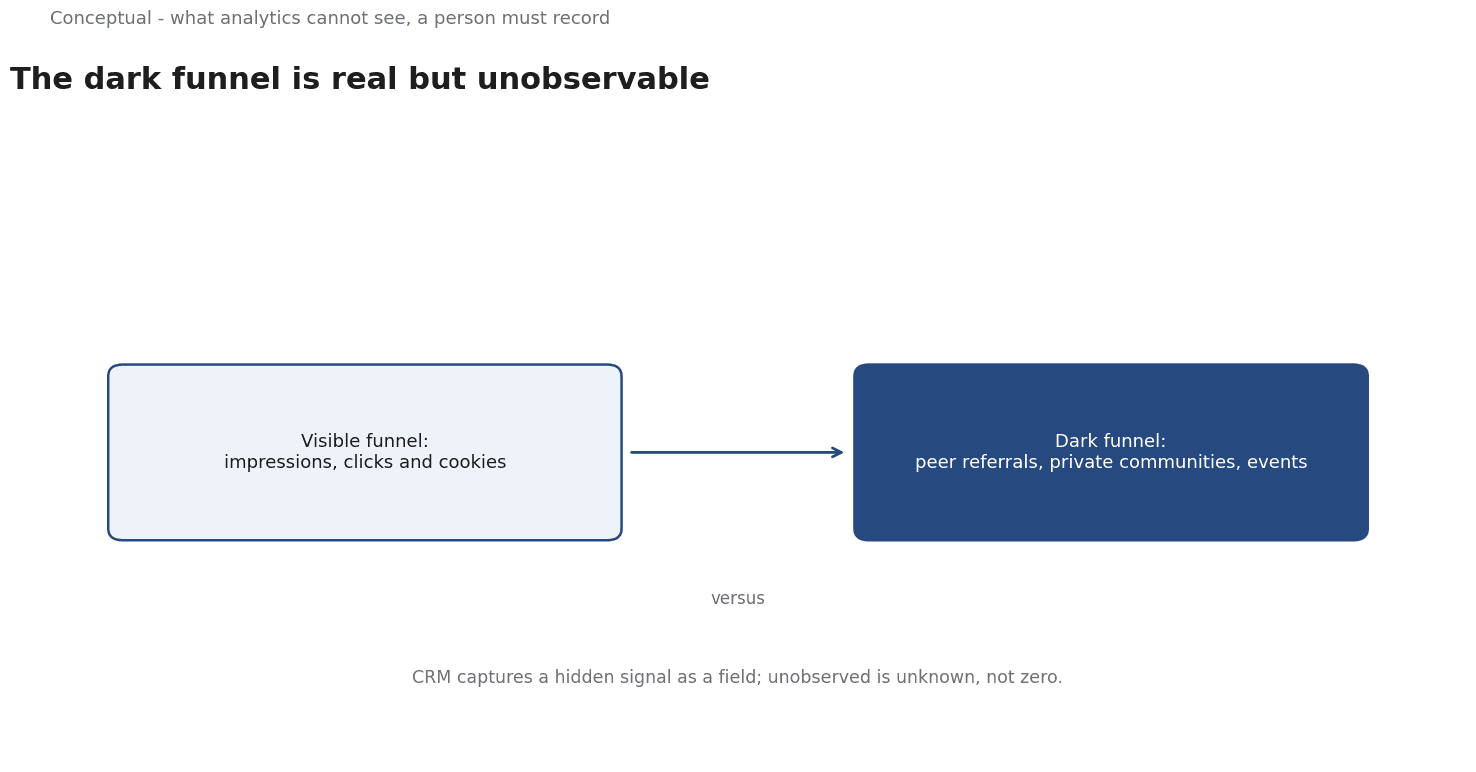
The customer relationship management entry describes the practices and systems an organization uses to manage interactions with current and prospective customers, often recording contacts, activities, and opportunities in a central system. The practical consequence is that CRM is where hidden signals can become recordable. Because it is fed by people as well as by automated events, it can capture a note about a conversation or a recommendation even when no digital trace exists. It converts an unobservable event into a field in a record.
Read together, the two concepts form a bridge. The funnel describes the path a buyer takes; CRM records what the organization learns about that buyer. When a stage is unobservable, the only way to know anything about it is for a person to capture a signal at the moment it is learned: a remark that a colleague recommended the product, a question raised in a private community, a conversation at an event.
The practical consequence is that dark funnel measurement is really structured qualitative capture, not a new form of instrumentation.
Its quality depends on what people write down, not on a pixel firing correctly.
A coherent reading separates reported signals from inferred ones. A CRM note that a buyer said a peer recommended the product is a directly reported signal. A claim that a podcast drove the deal because the buyer happened to mention it later is an inference, and a weaker one. Unobserved stages should be treated as unknown rather than zero; zero implies that nothing happened, while unknown admits that something happened out of view. That distinction, between absent evidence and evidence of absence, is the mechanism for reasoning about hidden buying activity without inventing precision.
A worked example
The following is hypothetical and illustrative. A sales team notices that several deals close with no recorded marketing touch, and asks whether paid channels are being under-credited. Three checks decide the response. First, add a single CRM field where representatives record how the buyer first heard of the product, captured at the first conversation. Second, review a sample of recently closed deals for recurring self-reported origins, looking for patterns such as peer referrals or professional communities. Third, compare those reported origins against tracked touches to see how much activity is genuinely untracked. The outcome: a recurring referral pattern appears that no dashboard showed, and the decision shifts toward a customer advocacy program rather than more tracking spend. The figures are invented; the sequence of checks is the contribution.
Evidence status
| Claim | Status | Source | Verified | Recheck when |
|---|---|---|---|---|
| The purchase funnel models stages from awareness to purchase | source-reported | Wikipedia, Purchase funnel | 2026-11-18 | Funnel models or their definitions are revised |
| CRM manages interactions and relationships with prospects and customers | source-reported | Wikipedia, Customer relationship management | 2026-11-18 | The scope of CRM definitions changes |
| Unobserved funnel stages should be treated as unknown rather than zero | inferred | Derived from the sources | 2026-11-18 | A direct measurement method for hidden activity exists |
The first two rows are documented in the sources: one describes the stage model, the other the relationship discipline. The third row is an inference from combining them, since neither source discusses unobservable activity directly. Recheck it if a method emerges that genuinely instruments private buying conversations without relying on self-report.
What it cannot do
The dark funnel cannot be measured in the way a click can. By definition it leaves no trackable trace, so any number attached to it is an estimate built on self-report or inference, not an observation. A framework can make the unknown more visible and better described, but it cannot turn private conversations into clean event data. The honest limit is that the more precise the number looks, the more likely it is to be an artifact of the estimation method rather than a fact about buyers.
A hidden cost of relying on people to capture signals is that the data is labor-intensive and uneven. Representatives record what is easy to remember and what seems important, which introduces recall bias and a tendency to report flattering origins. One team may log every referral while another logs none, so the resulting field measures documentation habits as much as buyer behavior. The cost is ongoing: the capture habit has to be maintained, coached, and sampled for quality, or the record quietly decays into blank fields.
A team that wants to credit a community or a podcast will assign a percentage of closed deals to it based on a handful of anecdotes, then treat that percentage as if it were measured. Double counting is the related risk: a buyer who heard about the product from a peer and also clicked a paid ad may be credited to both sources. The failure is attractive because it produces the tidy attribution figure that dashboards promise, but it converts uncertainty into false confidence.
The boundary of the approach is the known prospect. CRM captures signals once a person is identified and in a relationship with the organization. It cannot see anonymous activity before that point: the private deliberation, the community thread, the recommendation made before anyone filled in a form. Anything about that early stage remains conjecture. Claims about the full influence of hidden channels on anonymous buyers therefore go beyond what CRM records can support, even when later notes are thorough.
These records need review whenever the sales process, the CRM fields, or buyer behavior changes. A field that was meaningful last quarter can become noise if the question changes or the team stops filling it in. Sampling a set of records against what representatives actually heard is the only way to keep the signal trustworthy. Without that review, a trend in recorded origins may reflect a change in documentation discipline rather than a change in how buyers find the product.
The counterargument that self-reported buyer origins are noisy is fair for precise attribution and incomplete for strategic direction, where a consistent qualitative pattern can still inform where to invest even when its exact size is unknowable.
A decision test
- Define which funnel stages in the current process are observable and which are not.
- Add one simple CRM field for a self-reported first-touch origin.
- Require the field to be captured at the first conversation, not reconstructed later.
- Sample a set of closed deals and read the notes for recurring patterns.
- Compare self-reported origins with tracked touches to identify double counting.
- Treat unobserved stages as unknown and avoid assigning them precise percentages.
- Review field quality on a fixed cadence before using the data for budget choices.
These steps make hidden activity legible without pretending it is measured. They do not produce an attribution percentage, and that is the point: the output is a qualitative pattern and a decision about where to invest. The result is a choice grounded in what the organization actually learned from buyers, with the remaining uncertainty stated openly. For further reading, see voice of customer turning feedback into decisions.
References & Further Reading
- Wikipedia contributors, 2026. Purchase funnel - Wikipedia — Model of the customer path to purchase.
- Wikipedia contributors, 2026. Customer relationship management - Wikipedia — Systems for managing customer relationships.