DCF Pitfalls: The Assumptions That Break Valuation
Discounted cash flow is a framework for assumptions, not a truth machine. Read the four failure points, a worked example, and the honest use.
A discounted cash flow model converts a set of assumptions into a single number, which makes it look more authoritative than it is. The arithmetic is mechanical; the assumptions are judgements about an uncertain future. Most DCF failures are not errors in the formulas but weaknesses in the inputs and in the story they encode.
Direct answer: The main pitfalls are inconsistent cash flows and discount rates, an unrealistic forecast horizon, a terminal value that dominates the result, and a growth assumption that exceeds the economy in the long run. Damodaran's valuation materials treat these as explicit choices, and the cost-of-capital article explains the discount rate. The boundary: a DCF is a conditional estimate, not a prediction, and the result should be reported as a range with the drivers stated, as the sensitivity article recommends.
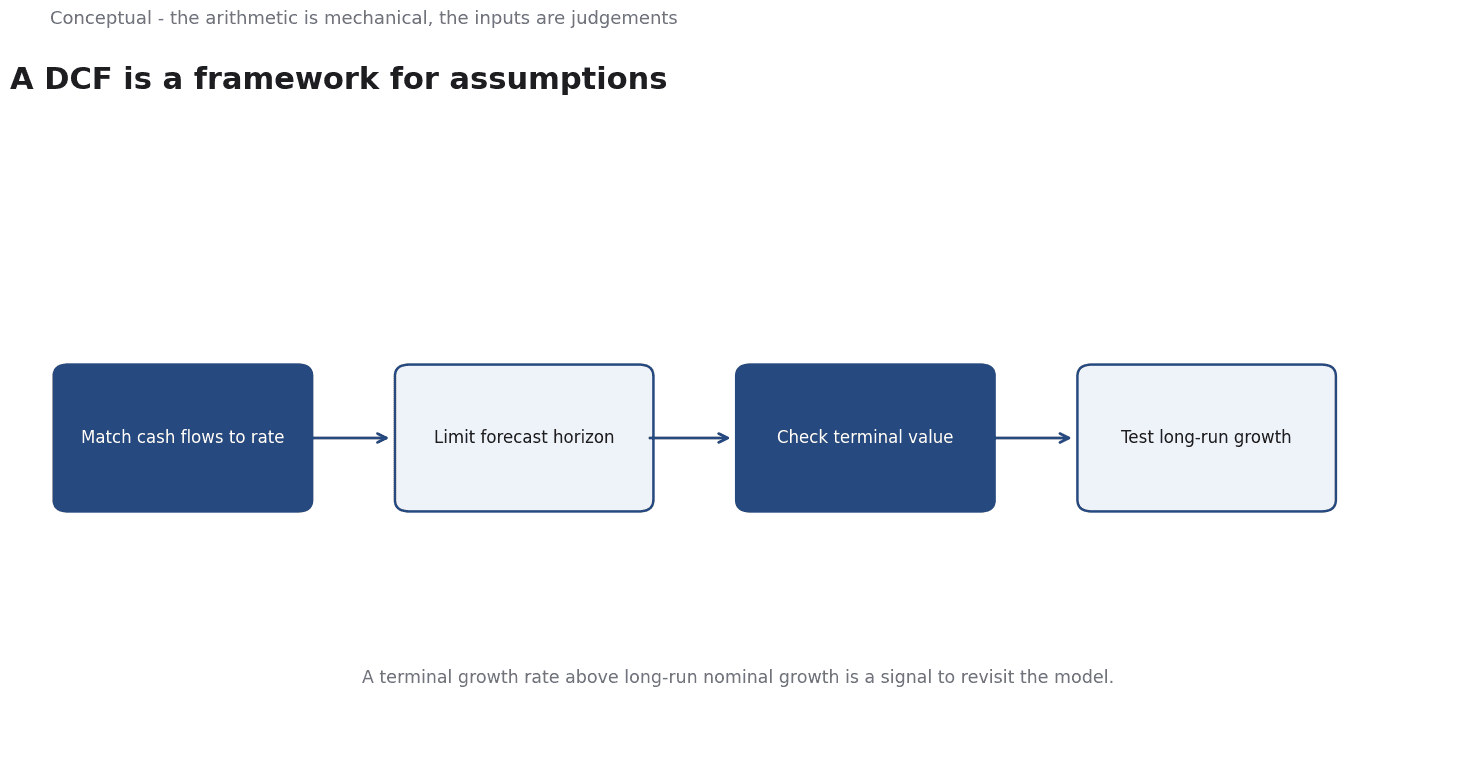
Four failure points
Inconsistent basis. Nominal cash flows must be discounted at a nominal rate; real cash flows at a real rate, as the real-interest-rates article explains.
Forecast horizon. A five-year forecast is an assumption about how long the company has a distinguishable future. Too short and the terminal value carries everything; too long and the explicit forecast becomes fiction, as the valuation article argues for a horizon tied to the business's competitive position.
Terminal value dominance. If most of the value comes from the terminal calculation, the model is really a statement about perpetual growth, which the sensitivity article recommends testing explicitly. A small change in the terminal growth rate then moves the entire result.
Impossible growth. A company cannot grow faster than the economy forever, which the macroeconomics article treats as an arithmetic constraint.
A terminal growth rate above the long-run nominal growth rate is a signal to revisit the model, not a detail to defend.
A worked example
The following is hypothetical and illustrative. A DCF produces a value of 200 million using ten years of forecast cash flows and a terminal growth rate of 4%. The discount rate is 9%.
Three checks decide whether to trust it. First, what share of value comes from the terminal calculation? If it is 75%, the model depends mostly on the 4% assumption, which the sensitivity article recommends ranking as dominant. Second, is 4% sustainable in perpetuity? If long-run nominal growth is around 3%, the assumption implies the company eventually becomes the economy, which the macroeconomics article treats as impossible. Third, is the discount rate consistent with the cash flows, as Cost of Capital for Private Companies: A Practical Estimate requires? A nominal 9% against real cash flows is a structural error, as the real-interest-rates article explains.
Three conclusions follow. The terminal growth rate should fall to a sustainable level, which reduces the value materially. The result should be reported as a range, as the valuation article recommends. And the assumptions should be recorded with sources, as the financial-modeling article requires for any relied-upon model.
What a DCF cannot do
It cannot value a company with no predictable cash flows, which the startup-valuation article treats as a reason to use other methods at an early stage. It cannot remove uncertainty about the future, which investor education states explicitly. And it cannot decide strategy: a high value does not make an acquisition right if it does not fit the business, which the strategy article argues for positioning before analysis.
The counterargument that DCF is too uncertain to use is too strong.
It is uncertain, which is why the assumptions should be explicit and the result a range, as the sensitivity article recommends.
A decision test
- Match the cash-flow and discount-rate basis, as the real-interest-rates article requires.
- Set a horizon tied to the competitive position, as the valuation article advises.
- Check the share of value from the terminal calculation.
- Test terminal growth against long-run nominal growth, as the macroeconomics article explains.
- Verify the discount rate with the cost-of-capital framework.
- Report a range with the dominant drivers, as the sensitivity article recommends.
- Record the assumptions and sources, as the financial-modeling article requires.
For the discount rate, see Cost of Capital for Private Companies; for the method, see How to Value a Public Company.
References & Further Reading
- Aswath Damodaran, 2026. Damodaran Online: Home Page for Aswath Damodaran — Damodaran's practitioner resources on valuation and cost of capital (stable home page; the WACC data file path is intermittently slow).
- Wikipedia contributors, 2026. Valuation (finance) - Wikipedia — Overview of absolute and relative valuation approaches; secondary reference.