How to Get Emergency Funds Right
An emergency fund is a buffer against specific disruptions. Read how to size it, a worked example, and why a single number fits nobody.
Emergency savings are often described with a single rule, which ignores the expenses it must cover. The emergency-fund entry describes cash held for unexpected costs, and the cash-flow entry covers the movement of money through a period. The right size depends on what would actually happen if income stopped.
Direct answer: Size a buffer from essential monthly costs, the stability of income, and the time needed to recover — not from a fixed number of months. The sources define the instrument; the sizing method is a synthesis.
Delta: This article adds a claim-status table and a worked sizing example, separating the documented purpose of a buffer from the local assumptions used to size it.
The mechanism
Three inputs determine the size:
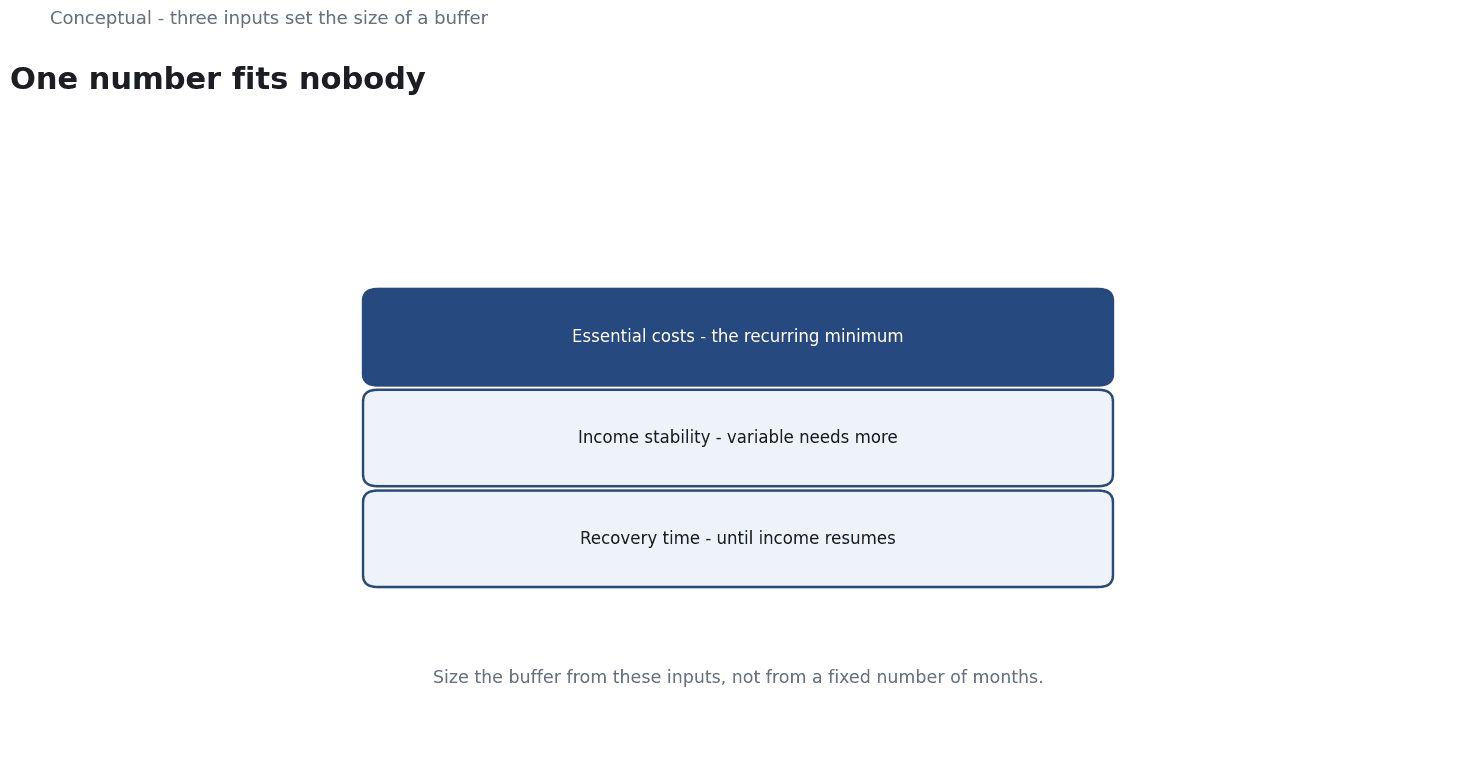
- Essential costs. The buffer covers what must be paid, not the full lifestyle. Cash-flow records identify the recurring minimum.
- Income stability. A variable income needs a larger buffer than a stable one, because the gap can arrive at any time.
- Recovery time. The buffer must last until income resumes or costs are reduced. That period is an estimate, not a fact.
The sequence is: list essential costs, estimate the disruption window, then choose a buffer and a rule for using it. The estimates are local judgements, so they are inferred; the purpose of the fund is source-reported.
A worked example
Illustrative. A freelancer has variable income and fixed housing costs.
Three checks decide. First, what are the essential costs for one month, using recorded outflows rather than a guess? Second, how long could income realistically be interrupted, given the type of work? Third, is the money accessible without penalty, and is there a written rule for when to use it rather than invest it?
The outcome is a target amount and a usage rule. The numbers are hypothetical; the method is the contribution.
Why essential costs are the right base
A buffer sized from total spending is usually larger than one sized from essential spending, and the difference is not caution. Discretionary costs can be reduced when income is interrupted; fixed costs cannot.
Counting only the expenses that must be paid gives a target that is both smaller and more honest.
The records matter here. A budget written from memory tends to include the lifestyle people want to preserve rather than the minimum they could manage. Cash-flow records from several months give a better basis because they show what was actually paid. Averaging across months also absorbs irregular costs that a single month would miss.
Income stability changes the answer in the opposite direction. A stable salary arriving on a known date makes a short window plausible. Variable income can fail at any point, which lengthens the risk even when the average is the same. The buffer should reflect the worst plausible gap, not the average one.
Accessibility is a separate test. Money in a pension account or an investment with a settlement delay is not available when an expense is due. A buffer needs to be withdrawable quickly, without a decision that depends on market conditions. The usage rule matters for the same reason: writing down what counts as an emergency prevents the buffer from being spent on planned expenses.
What changes the target
Review the target after any change in fixed costs or income pattern. A new housing payment, a second income, or a move to contract work all change the calculation. A buffer that was right last year can be quietly wrong today, which is why the recheck date belongs in the record.
Evidence status
| Claim | Status | Source | Verified | Recheck when |
|---|---|---|---|---|
| Emergency funds cover unexpected expenses | source-reported | Wikipedia, Emergency fund | 2026-11-18 | Definition revised |
| Cash flow records recurring movement of money | source-reported | Wikipedia, Cash flow | 2026-11-18 | Source revised |
| Size from essential costs and recovery time | inferred | Derived from the two sources | 2026-11-18 | Income or costs change |
Why the rule of thumb fails
Neither is stable. A household with low fixed costs and a short recovery window needs less than the rule suggests; one with high fixed costs and a long window needs more. Using the rule unchanged transfers those differences into risk.
Accessibility matters as much as size. Cash in an account that cannot be withdrawn quickly is not a buffer, even if it appears in a net-worth statement. The usage rule matters too: without one, a buffer is easily spent on non-emergencies and quietly rebuilt at the worst possible time.
What it cannot do
It cannot remove the need for insurance, which covers large and specific losses. It does not guarantee that income recovers. And it cannot eliminate the opportunity cost of holding cash.
The counterargument that a larger buffer is always safer is fair for security and incomplete for the cost of idle money.
A decision test
- List essential monthly costs from records.
- Estimate the disruption window.
- Check access to the money.
- Write a usage rule.
- Review after income or cost changes.
- Record the assumption and the recheck date.
For the trade-offs, see Emergency Funds Trade-offs.
References & Further Reading
- Wikipedia contributors, 2026. Emergency fund - Wikipedia — Cash held for unexpected expenses.
- Wikipedia contributors, 2026. Cash flow statement - Wikipedia — Operating, investing and financing activities, and why net income and cash flow differ.