Emergency Funds Trade-Offs
An emergency fund trades liquidity for lower expected return. Read the source definitions, a worked sizing example, and where a cash buffer stops helping.
An emergency fund is often described as a fixed number to hold in cash, which hides the trade-off behind it. The emergency fund entry describes money set aside for unexpected expenses or income loss, and the cash flow entry describes money moving in and out over a period. The real problem is that a buffer held for safety has a cost, and deciding the right size means weighing that cost against the liquidity it buys.
Direct answer: An emergency fund trades lower expected return on cash for the ability to absorb a shock without selling other assets or borrowing. The sources define the fund and cash flow; the sizing rule is a synthesis. It measures accessible liquidity, not wealth or return.
Delta: This article adds a claim-status table and a shock-to-buffer decision test beyond the sources: it maps each cash outflow to a buffer decision, with claim status explicit.
The mechanism
An emergency fund is money kept aside for unexpected expenses or a sudden loss of income. It is held in a form that can be reached quickly, which usually means cash or a cash-like account. The cash flow entry describes inflows and outflows over a period, placing the buffer inside the broader movement of money. The two concepts connect directly: a fund exists to cover outflows that arrive when inflows fall. What the fund measures is the number of periods of essential spending that can be covered without drawing on other resources.
It is a liquidity measure, not a return measure.
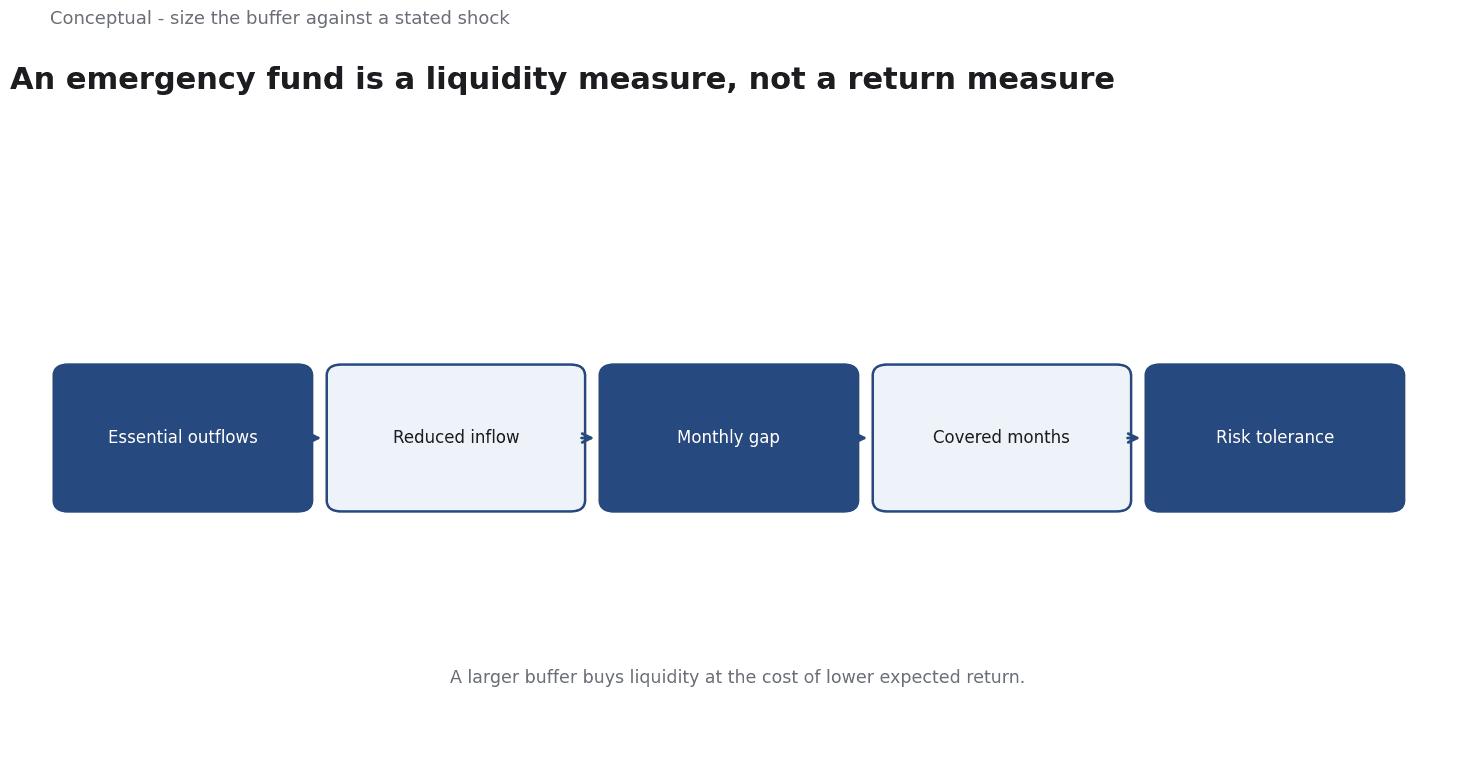
The practical consequence is that the size of the fund is a decision under uncertainty. A larger buffer covers more shocks but leaves more money in low-return cash, which has an opportunity cost. A smaller buffer frees money for other uses but may be exhausted by a single event. Neither source prescribes a target number or a holding period, so that choice is local and should be marked as inferred. The decision instrument is the gap between essential outflows and the cash available to cover them in a bad month. A fund that covers that gap is doing its job; one that exceeds it may be holding more cash than the trade-off justifies.
The cash flow view makes the trade-off visible. Expected inflows and essential outflows can be placed in months, and the buffer is tested against a period when inflows drop. That test reveals how many lean months the fund can absorb. It also shows that the relevant figure is essential spending, not total spending, because a genuine emergency is unlikely to include discretionary items. The sources describe cash movement and the purpose of a fund; they do not define which spending counts as essential. That definition is a local judgement, and it should be written down so a reviewer can challenge it.
The output is a number of covered months compared with a stated risk tolerance. That comparison, rather than the raw balance, is the decision instrument. It tells a household how long it could maintain essentials under a shock and whether that duration is acceptable. The value lies in the sequence: list essential outflows, estimate a reduced inflow, measure the gap, and compare the fund against it. A decision made in that order can be explained later, because the assumptions and the choice are recorded separately.
A worked example
The following is hypothetical and illustrative. A household reviews its emergency fund before a period of unstable income. Three checks decide the review. First, what are the essential outflows in a normal month, excluding discretionary spending? Second, how many months could those outflows be covered if income stopped entirely? Third, would drawing on the fund force the sale of other assets at a bad time? The review shows that the fund covers four months of essentials but that one large annual expense sits outside the monthly estimate. The household sets the buffer against that expense and records the new target. The outcome is a sizing decision, not a prediction that income will fall. The numbers are hypothetical; the verification method is the contribution.
Evidence status
| Claim | Status | Source | Verified | Recheck when |
|---|---|---|---|---|
| An emergency fund covers unexpected costs or lost income | source-reported | Wikipedia, Emergency fund | 2026-11-18 | Definition revised |
| Cash flow tracks money moving in and out over a period | source-reported | Wikipedia, Cash flow | 2026-11-18 | Definition revised |
| Essential spending, not total spending, sets the buffer | inferred | Derived from the sources | 2026-11-18 | Household costs change |
The first two rows are factual claims drawn directly from the sources. The third is an inference about how to size the buffer, because neither source defines essential spending or a target. Recheck the definitions when the source entries change, and the inferred claim when household costs or income stability change.
What it cannot do
An emergency fund does not grow wealth. It is held in accessible form precisely because it must be available on short notice, and that accessibility carries an opportunity cost. A larger fund improves liquidity while reducing the money available for other uses, and over a long horizon that difference can be substantial. The sources describe the fund and cash movement, not the return trade-off, so they cannot settle the question of how much is too much. Treating a large buffer as a sign of financial strength without weighing its cost is a category error. It answers how long essentials can be covered, not whether the overall position is efficient. A reader who wants a return or wealth measure must look to a different instrument.
The hidden cost is that the fund can quietly become a permanent holding. A buffer built for a specific risk is often kept long after the risk changes, because it feels safer to leave it in place. The sources do not define a review cycle, so the discipline of revisiting the target is local. A fund that is never re-examined may be too large for the current situation or too small after costs rise. The cost is paid in idle capital and in the attention that was never given to the review. This is easy to miss because the holding looks reassuring on a statement; the question of whether it is still the right size rarely asks itself.
A common multiple of monthly spending assumes that all spending is essential and that income can stop completely, which may be unrealistic for some households and insufficient for others. A rule applied without a cash flow test gives a number that looks precise but is not tied to the situation it is meant to protect. A reviewer who asks what shock the fund is for, and over what period, will get a better answer than one who quotes a multiple. Each assumption should carry a confidence marker, because the farther out a shock sits, the weaker the estimate becomes.
There is a boundary around the method. It covers accessible cash under current arrangements. It does not model credit lines, insurance, or support from others, all of which can absorb a shock but are not the same as holding cash. It does not replace a broader plan, because a fund addresses one kind of risk and leaves others untouched. A shock larger than the buffer, or one that lasts beyond the covered period, falls outside what the instrument can handle by design. A household that needs protection beyond that boundary must look to other tools, and the sources do not extend that far.
Because costs and income change, the buffer needs a refresh and the assumptions need periodic review. Each assumption should be recorded with a recheck condition, and the definition of essential spending should be treated as a local policy decision rather than a number the sources supply. Without that record, a future reviewer cannot tell which choices were deliberate and which were habits. The balance will still be there; the reasoning behind the target is what makes it reusable.
The counterargument that a cash buffer is fair for absorbing a sudden loss is incomplete when the fund is larger than the shock it was meant to cover.
A decision test
- List essential outflows for a normal month.
- Estimate inflows in a bad month.
- Measure the monthly gap between them.
- Count how many months the current fund covers.
- Compare that count with a stated risk tolerance.
- Decide whether to raise, lower, or hold the buffer, and record why.
- Record the owner and the recheck condition.
A fund is useful only when its size is tied to a stated shock and refreshed over time. The test turns a cash balance into a sequence of sizing decisions with a visible rationale, so a reviewer can see which assumption set the target and when it must be revisited. For further reading, see Cash Flow Forecasting: A 13-Week Operating Model.
References & Further Reading
- Wikipedia contributors, 2026. Emergency fund - Wikipedia — Cash held for unexpected expenses.
- Wikipedia contributors, 2026. Cash flow statement - Wikipedia — Operating, investing and financing activities, and why net income and cash flow differ.