How to Get Emerging Markets Right
Emerging markets reward local evidence and punish averages. Read the approach, a worked entry, and why a global playbook can mislead.
Emerging markets are often entered with a playbook copied from a mature market, which hides the differences that decide the outcome. The Wikipedia entry describes the characteristics of these markets, and Damodaran's framework insists on explicit assumptions. The approach starts with local evidence.
Direct answer:
Enter with local evidence, explicit assumptions, and a small reversible commitment, then measure before scaling.
The sources describe the market class; the entry method is a synthesis.
Delta: This article adds a claim-status table and a worked entry, separating documented market characteristics from the local judgements about pricing and risk.
The mechanism
Three points matter:
- Averages hide variation. The Wikipedia entry describes markets with developing characteristics. The average says little about a specific city or channel.
- Assumptions must be visible. Damodaran's framework treats explicit assumptions as the basis of valuation. A plan that buries them cannot be corrected.
- Commitment should be staged. A small entry produces evidence cheaply. A large one spends the budget before the assumptions are tested.
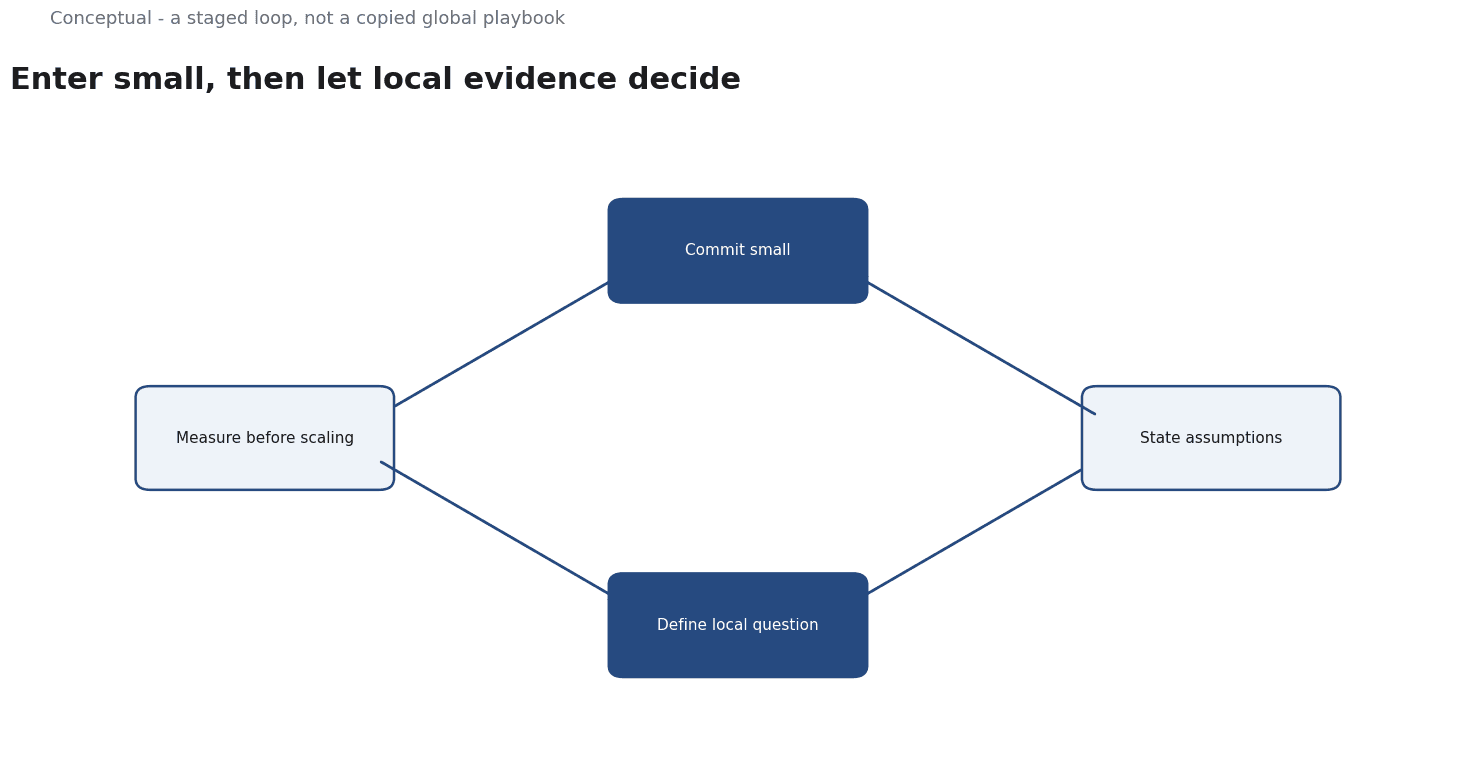
The sequence is: define the local question, state assumptions, commit small, then measure. The assumptions are local judgement, so they are inferred; the market description is source-reported.
A worked entry
Illustrative. A company considers entering a market with a different payment infrastructure and price sensitivity.
Three checks decide. First, which local condition most affects the product — payments, distribution, or price? Second, what assumptions are being made about each, and how would they be tested cheaply? Third, what is the smallest commitment that could produce useful evidence?
The outcome is a staged plan with a reversal condition. The scenario is hypothetical; the method is the contribution.
Why the local question comes first
A market entry usually begins with a global template: the same product, the same price, the same channel. The template encodes assumptions that were true somewhere else. Asking which local condition most affects the product forces those assumptions into the open, where they can be tested rather than assumed.
The payment system is often the clearest example.
Distribution and price sensitivity have the same character: they are local facts, not preferences that can be changed by communication.
Why assumptions need to be written
An assumption that is never written down cannot be corrected. When a plan fails, the team will debate the outcome without knowing which belief was wrong. Recording the assumptions at the start turns a failure into information, because each one can be checked against what happened.
Evidence status
| Claim | Status | Source | Verified | Recheck when |
|---|---|---|---|---|
| Emerging markets have developing characteristics | source-reported | Wikipedia, Emerging market | 2026-11-18 | Classification changes |
| Valuation depends on explicit assumptions | source-reported | Damodaran Online | 2026-11-18 | Framework changes |
| Stage entry around local evidence | inferred | Derived from the market description | 2026-11-18 | Conditions change |
Why the global playbook misleads
A playbook encodes assumptions from the market where it worked. In a different market, the same steps can assume a payment system, a distributor, or a price point that does not exist. Naming those assumptions is the first local work.
A staged entry also has a timing cost. A competitor that commits fully may capture the market before a careful entrant finishes testing. The response is not to abandon staging but to set a deadline on evidence gathering, so that a small commitment does not become an indefinite delay. A decision to move faster is still a decision, and it should be recorded with the risks that were accepted.
The framework also has a limit on what it can observe. Local evidence gathered in one city may not transfer to another in the same country, where infrastructure and habits can differ. Treating the first market as a sample rather than as the whole opportunity keeps the conclusion proportionate to the evidence.
The local evidence should be dated and sourced, because conditions in these markets can change quickly. A figure gathered last year may no longer describe the payment mix or the competitive set, and a plan built on it will be confident and wrong. Recording the observation date turns the evidence into something that can be challenged when conditions move.
The entry should also state what would make the team stop. A reversal condition is not pessimism; it is the mechanism that keeps a small commitment from becoming a large one by inertia. Without it, the decision to enter is effectively permanent, whatever the evidence says.
What it cannot do
It cannot guarantee success in a market with different conditions. It does not remove political or currency risk. And it cannot replace on-the-ground evidence.
The counterargument that a proven model is safer is fair for execution and incomplete for fit.
A decision test
- Define the local question.
- State the assumptions.
- Choose a small commitment.
- Measure the result.
- Keep a reversal condition.
- Record the decision and recheck date.
For the risk context, see Risk Assessment.
References & Further Reading
- Wikipedia contributors, 2026. Emerging market - Wikipedia — Markets with developing characteristics and higher variability.
- Aswath Damodaran, 2026. Damodaran Online: Home Page for Aswath Damodaran — Publicly maintained datasets for industry averages, WACC, and valuation.