How to Get Executive Communication Right
Executive communication is about decisions, not airtime. Read what the underlying skills involve, a worked example, and a test for making an update useful.
Leaders have limited attention and usually hear about problems after they are already ambiguous. Communication skills and public speaking are broad subjects, and treating them as a checklist of techniques misses the point. The real problem is getting a decision made when the listener has little time and many competing signals.
Direct answer:
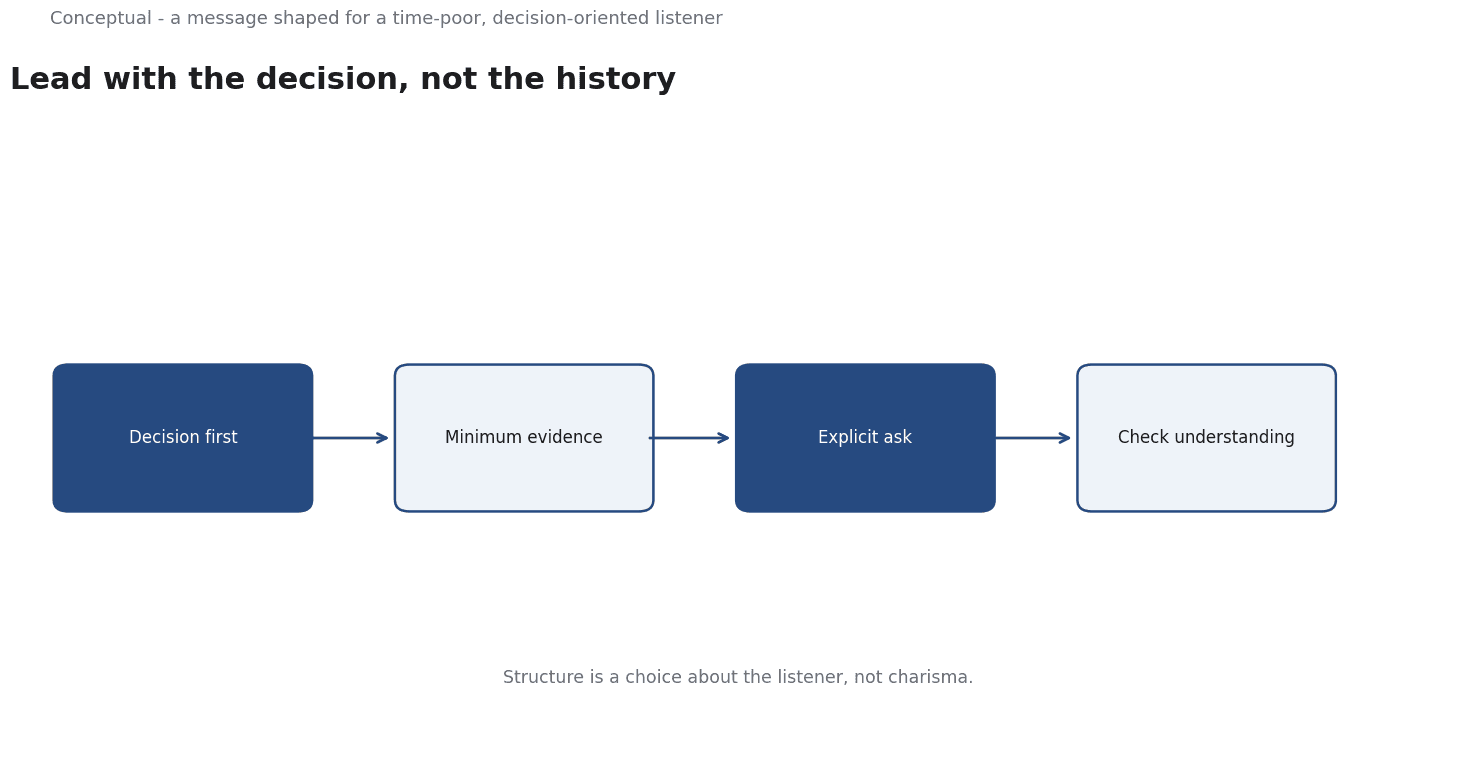
Executive communication means stating the decision or status first, supporting it with the minimum necessary evidence, and making the ask explicit.
The sources describe the component skills of speaking and listening; the useful unit is what the listener can decide afterward. The boundary: polished delivery cannot rescue an unfocused message.
Delta: This article adds a claim-status table and a decision-focused update test beyond the general skill descriptions: it maps communication mechanics to a listener's decision, with claim status explicit.
The mechanism
The material on communication skills treats the subject as a set of interacting abilities rather than a single act of talking. Verbal and nonverbal signals, listening, and adapting to an audience all appear as parts of the whole. The practical consequence for a busy listener is that an update is not only output. If you never check whether the message was understood, you cannot know that it landed, and a one-way broadcast leaves half the loop unused.
Public speaking adds a second layer: organizing points, managing nerves, and using voice and body to support the message. The practical consequence for a short executive update is that structure matters more than performance. A clear opening claim followed by two supporting points does more work than elaborate delivery, because the listener is trying to place your information against a dozen other demands.
The two combine into a constrained form. The audience is time-poor and decision-oriented, which changes what a good message looks like. Leading with the conclusion, then the evidence, then the ask respects that constraint. It is a design choice about the listener, not a personality trait, so it can be learned and applied by someone who dislikes speaking in public.
A practical consequence is that preparation shifts from wording to selection. Because attention is scarce, every extra point displaces another one. The discipline is deciding what to leave out before the meeting, not improvising under pressure. That selection is local judgement about the audience and the decision, so the claim about its value is an inference rather than something the sources state directly.
A worked example
The following is hypothetical and illustrative. A manager needs a decision on staffing a project that is slipping, and has five minutes with a director. Three checks decide the outcome. First, does the first sentence state the decision needed, such as whether to add one engineer, rather than describing the project's history? Second, is there one supporting number and one named risk, instead of a survey of every issue? Third, is the ask explicit, with a date by which the answer is needed? When the update leads with the decision and bounds the evidence, the director can approve or decline in the room. When it does not, the conversation becomes a request for more information. The scenario is hypothetical; the structure is the contribution.
Evidence status
| Claim | Status | Source | Verified | Recheck when |
|---|---|---|---|---|
| Communication skills include listening, clarity and audience awareness | source-reported | Wikipedia: Communication skills | 2026-11-18 | The entry is revised |
| Public speaking covers structure and delivery | source-reported | Wikipedia: Public speaking | 2026-11-18 | The entry is revised |
| Leading with the decision helps a time-poor listener act | inferred | Derived from the sources | 2026-11-18 | Audience or format changes |
The first two rows describe what the sources cover and are reported directly. The third row combines those general descriptions with the constraint of a time-poor audience, so it is an inference about how to arrange a message. No row claims a measured improvement in career outcomes, which the sources do not supply.
What it cannot do
Executive communication cannot create authority. A well-structured message does not make the underlying position correct, and it does not make a weak proposal strong. It can make a decision legible, which is valuable, but legibility is not the same as merit.
It also carries a hidden cost. Compression removes nuance, and a leader who acts on a simplified version may miss a condition that mattered. The manager who presents only the single strongest number can get a fast decision that is wrong in detail. Good practice therefore includes naming the main risk and the limits of your confidence, even when that makes the update less tidy.
A common failure mode is rehearsed delivery that conceals uncertainty. Confidence in the voice is easily mistaken for confidence in the evidence, and an audience under time pressure may not separate them. The remedy is not to sound hesitant but to state uncertainty explicitly, so that the listener knows which part of the message is firm and which part is a judgement.
There is also a boundary in the evidence. The sources are general reference descriptions of communication skills and public speaking, not studies of executive settings. They support claims about what the fields include, not claims about how much a technique improves outcomes. Any statement about what works in a specific organization is local judgement and should be treated as such.
Finally, the form needs review when the audience or medium changes. A spoken update to a room, a written note, and a one-to-one conversation put different demands on the same message. A format that works in one setting can fail in another, so the decision about structure should be revisited rather than assumed. Recording what the listener actually did after the update is the cheapest way to learn.
There is a further cost in always leading with the conclusion. Some listener genuinely needs context first, particularly when the decision is unfamiliar or the stakes are high enough that a bare conclusion sounds like an unsupported claim. In those cases the disciplined move is to state the ask briefly and then supply the context, rather than to compress the message until it becomes opaque. The point is to serve the listener, not to follow a rule about ordering for its own sake.
Counterargument: "The counterargument that clear delivery is enough is fair when the decision is simple and incomplete when the decision turns on facts the delivery has smoothed away."
A decision test
- State the decision or status in the first sentence.
- Identify exactly what you need the listener to decide.
- Select the minimum evidence that supports that decision.
- Make the ask explicit, with an owner and a date.
- Name the main risk and your confidence in the evidence.
- Check for understanding before the conversation ends.
- Review what the listener did after the update and adjust.
The test turns a broad skill into a repeatable practice. It does not require charisma, only the discipline to choose what the listener needs and to leave the rest out. Repeating the last step is what makes the practice improve over time.
For further reading, see Voice of Customer.
References & Further Reading
- Wikipedia contributors, 2026. Communication skills - Wikipedia — Context for concise, structured reporting and communication.
- Wikipedia contributors, 2026. Public speaking - Wikipedia — Speaking to an audience and how it is prepared.