How to Get First-party Data Right
First-party data is collected through a direct relationship. Read how to use it well, a worked example, and why consent is not a licence to collect everything.
First-party data is often described as a safe answer to tracking restrictions, which skips the obligations that come with it. The Wikipedia entry describes data collected directly by an organisation, and GDPR Article 6 sets conditions for lawful processing. The right approach starts with purpose.
Direct answer:
Collect first-party data for a stated purpose, with a lawful basis and a clear benefit for the customer, then use only what that purpose requires.
The sources describe the data and the law; the method is a synthesis.
Delta: This article adds a claim-status table and a worked example, separating documented obligations from local choices about collection.
The mechanism
The first point is purpose. The first-party-data entry describes data collected directly, which says nothing about why it is collected. A purpose stated in advance limits what is reasonable to collect and gives a standard for judging later use.
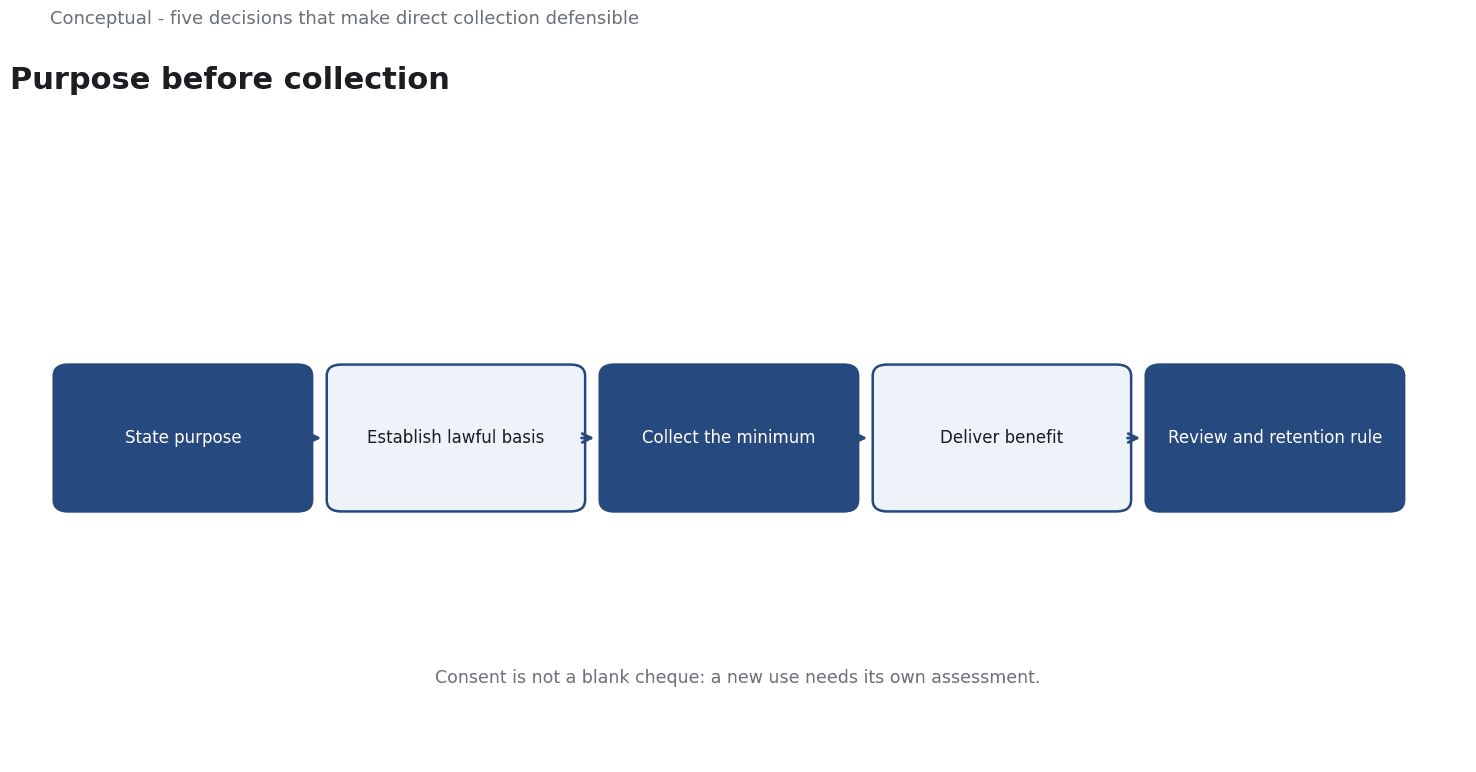
The second point is lawful basis. GDPR Article 6 describes the conditions under which processing is permitted, which is independent of where the data came from. Being first-party does not remove the obligation; it changes which basis is likely to apply.
The third point is value exchange. A customer who provides data should get something useful in return, whether a better service or a relevant offer. Without that, collection is a cost to the customer and a risk to the organisation, whatever the legal position.
The sequence is: state the purpose, establish the basis, collect the minimum, deliver the benefit, then review. The decisions are local, so the conclusions are inferred; the obligations are source-reported.
A worked example
Illustrative. A retailer wants to use purchase history to recommend products.
Three checks decide. First, is the purpose stated specifically enough to limit the data used? Second, is there a lawful basis, and is it documented with a date? Third, do customers receive a benefit that justifies the processing, and can they see or change what is held?
The outcome is a collection plan with a review condition. The scenario is hypothetical; the method is the contribution.
Evidence status
| Claim | Status | Source | Verified | Recheck when |
|---|---|---|---|---|
| First-party data is collected directly | source-reported | Wikipedia, Data | 2026-11-18 | Definition changes |
| Lawful bases are required for processing | source-reported | GDPR Article 6 | 2026-11-18 | Law changes |
| State purpose before collection | inferred | Derived from the obligations | 2026-11-18 | Purpose changes |
Why consent is not a blank cheque
Consent can authorise processing, but it does not make every use sensible. A purpose that is too broad gives the business no standard for deciding what to do with the data, and the customer no way to predict how it will be used. Specificity protects both sides.
A further constraint is that data collected for one purpose is not automatically available for another.
Recording the purpose with the data makes that boundary visible.
The benefit also has to be real. A personalisation that feels intrusive can cost more trust than it gains, and a customer who does not see the value will look for ways to avoid it. Measuring whether the benefit is recognised is part of the work, not an optional check.
Finally, retention should be decided before collection. Data kept longer than needed adds risk without adding value, and a rule for when to delete it is easier to apply when it is set at the start.
A new use needs its own assessment, since the original purpose does not cover every later idea.
A customer who cannot see the benefit will eventually treat the data collection as a cost.
A retention rule set at the start is easier to follow than one invented after the data has accumulated.
The smallest collection that serves the purpose is usually the safest one to hold.
The purpose should be written down before the first field is collected.
What it cannot do
It cannot replace a lawful basis. It does not guarantee that customers see a benefit. And it cannot remove the need to review what is held.
The counterargument that direct collection is always safer is fair relative to third-party tracking and incomplete on its own.
A decision test
- State the purpose.
- Establish and document the basis.
- Collect the minimum needed.
- Deliver a visible benefit.
- Allow review and correction.
- Record the decision and recheck date.
For the privacy frame, see Privacy.
References & Further Reading
- Wikipedia contributors, 2026. Data - Wikipedia — Data collected directly by an organisation.
- GDPR Info, 2016. Art. 6 GDPR – Lawfulness of processing - General Data Protection Regulation (GDPR) — The lawful bases for processing personal data under GDPR.