How to Get Hedging Right
A hedge reduces an existing exposure. Read the method, a worked example, and why a position without exposure is a bet.
Hedging is described as insurance against price movement, which is incomplete: the instrument only makes sense relative to an exposure the holder already has. The Wikipedia entry defines a hedge as an offsetting position, and the futures entry describes the standardized contract. The difference between a hedge and a bet is the exposure.
Direct answer:
Define the physical exposure, choose an instrument that offsets it, size the position to that exposure, and record the basis risk that remains.
The sources define the instrument; the sizing rule is a synthesis.
Delta: This article adds an explicit claim-status table and a worked sizing example, so the reader can see which steps come from the source and which are judgement.
The mechanism
Three points from the sources matter:
- A hedge offsets. The Wikipedia entry describes reducing risk with an offsetting position. Without an existing exposure, there is nothing to offset.
- Contracts are standardized. The futures entry describes quantity, quality, and delivery terms. A mismatch leaves basis risk.
- Margin is an obligation. A futures position requires margin, which creates cash obligations even when the view is correct.
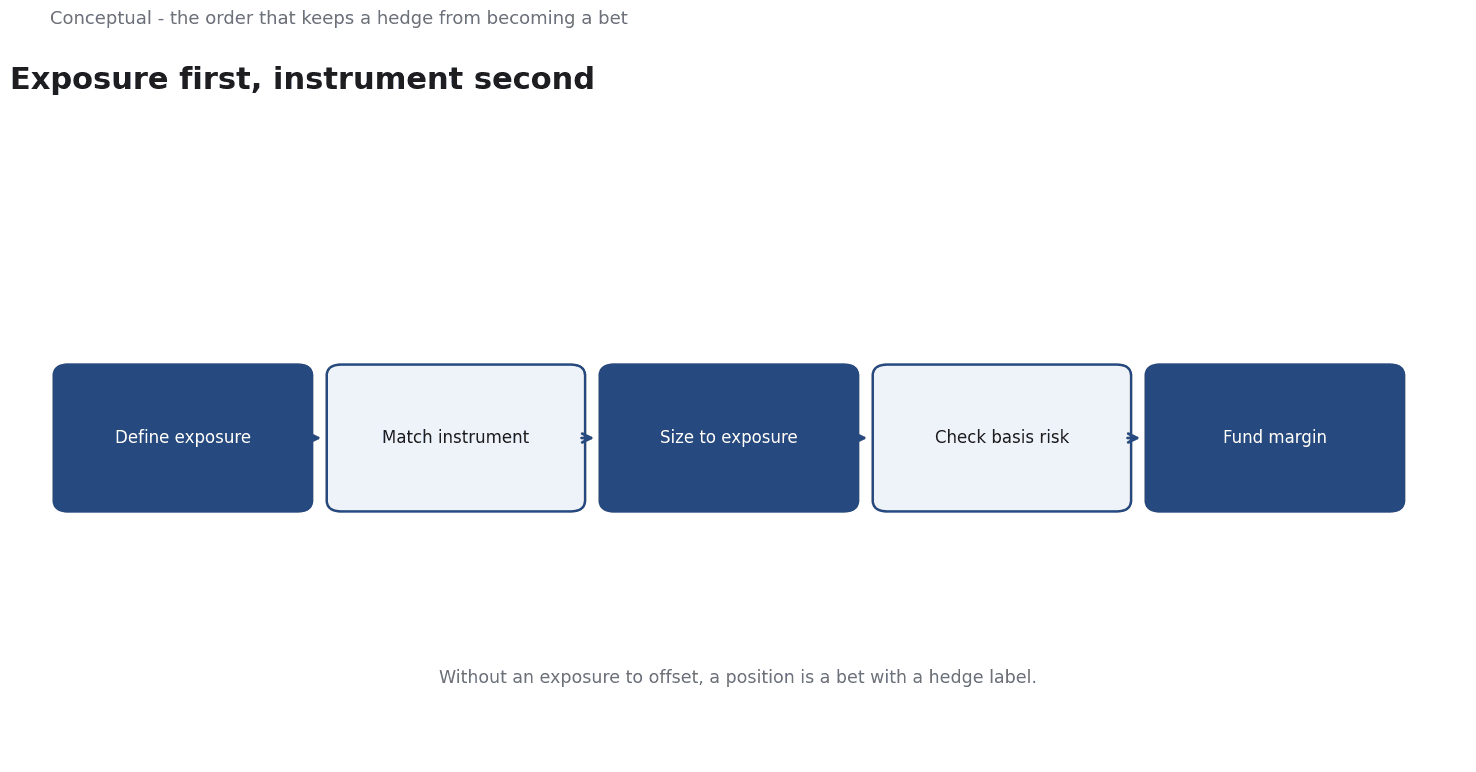
The practical sequence is therefore: exposure first, instrument second, size third, basis check fourth. Reversing that order produces a directional bet with a hedge label. This is an inferred rule derived from the two definitions.
A worked example
Illustrative. A manufacturer expects to buy 1,000 units of a commodity input in three months.
Three checks decide. First, what is the exposure — a quantity and a window, not a general worry about price? Second, does the chosen contract match the input's grade and delivery period? Third, what happens if the spot and futures prices diverge, and what margin must be funded?
The outcome is a hedge ratio with a recorded residual risk. The numbers are hypothetical; the method is the contribution.
Why the exposure comes first
A hedging instrument is defined by what it offsets. When the exposure is vague, the instrument has no size, no horizon, and no meaningful success condition.
The terminology hides this distinction because both activities use the same contracts and the same settlement rules.
The working definition of an exposure has three parts: a quantity, a direction, and a window. A manufacturer expecting to buy a known quantity in a known period has a clear exposure. A company that worries generally about prices does not. Once those three parts are written down, the choice of instrument becomes a matching problem rather than a prediction problem. The contract should cover roughly the right quantity, the right grade, and the right delivery period.
Mismatches are where basis risk lives. A futures contract on a benchmark grade will not move exactly with the input a particular factory buys. That difference does not disappear because the position is called a hedge. It remains as residual risk, and it deserves to be stated in the same record as the rationale for entering the position. A hedge that is described as eliminating risk has already lost the ability to be evaluated honestly.
Margin is the practical constraint that often surprises new users. A futures position requires funds as prices move, even if the ultimate view is correct. A hedge can therefore create a cash problem before it produces an economic result. Sizing the position to the exposure is also a way of sizing the margin obligation to something the business can fund. This is a matter of treasury, not just of market view.
The final discipline is to record what remains unhedged. Partial hedges are normal, especially when the exposure is uncertain. Calling them partial is not an admission of failure; it is the condition for judging afterwards whether the instrument did what it was meant to do.
Evidence status
| Claim | Status | Source | Verified | Recheck when |
|---|---|---|---|---|
| A hedge is an offsetting position | source-reported | Wikipedia, Hedge (finance) | 2026-11-18 | Definition revised |
| Futures contracts are standardized | source-reported | Wikipedia, Futures exchange | 2026-11-18 | Contract rules change |
| Size the hedge to the physical exposure and record basis risk | inferred | Derived from the two definitions | 2026-11-18 | Instrument changes |
What it cannot do
It cannot eliminate risk; it changes its shape. It does not guarantee a better outcome, because the hedge can be wrong in direction or size. And it cannot remove margin obligations, which are contractual.
The counterargument that a hedge is simply a safe trade is fair for a matched exposure and incomplete when no exposure exists.
A decision test
- State the exposure with quantity and window.
- Choose a matching instrument.
- Size the position to the exposure.
- Check basis risk.
- Check margin obligations.
- Record the decision and what remains unhedged.
For the instrument, see Hedging Best Practices.
References & Further Reading
- Wikipedia contributors, 2026. Hedge (finance) - Wikipedia — Reducing an existing exposure with an offsetting position.
- Wikipedia contributors, 2026. Futures exchange - Wikipedia — The structure of futures contracts, exchanges, clearing and margin; a secondary reference.