How to Get Industry Switching Right
A structured approach to industry switching that maps transferable skills to a target role, closes real gaps through reskilling, and sets a clear go or no-go gate.
Changing industries is often sold as a fresh start, but the people who stumble usually misjudge what carries over and what does not. The real problem is translating existing skills into a new context while closing the knowledge gaps that genuinely block entry. Without a structured approach, a switch becomes an expensive guess.
Direct answer:
A successful industry switch maps transferable skills to a target role's requirements and fills only the gaps that actually block entry.
Career-change literature frames this as a transition of roles and identity over time, while reskilling supplies the targeted learning. The practical move is to audit skills, test demand, then retrain with a specific job in mind.
Delta: This article adds a decision framework beyond the sources: it maps transferable skills to a reskilling choice and a go or no-go gate, with claim status explicit.
The mechanism
The encyclopedia entry on career change describes it as a shift in occupation or industry, often involving a change in role identity and a period of transition rather than a single event. The practical consequence is that planning has to cover timing, finances, and identity, not just a job application. A switch is a process with stages, and treating it as a one-day decision underestimates what it demands.
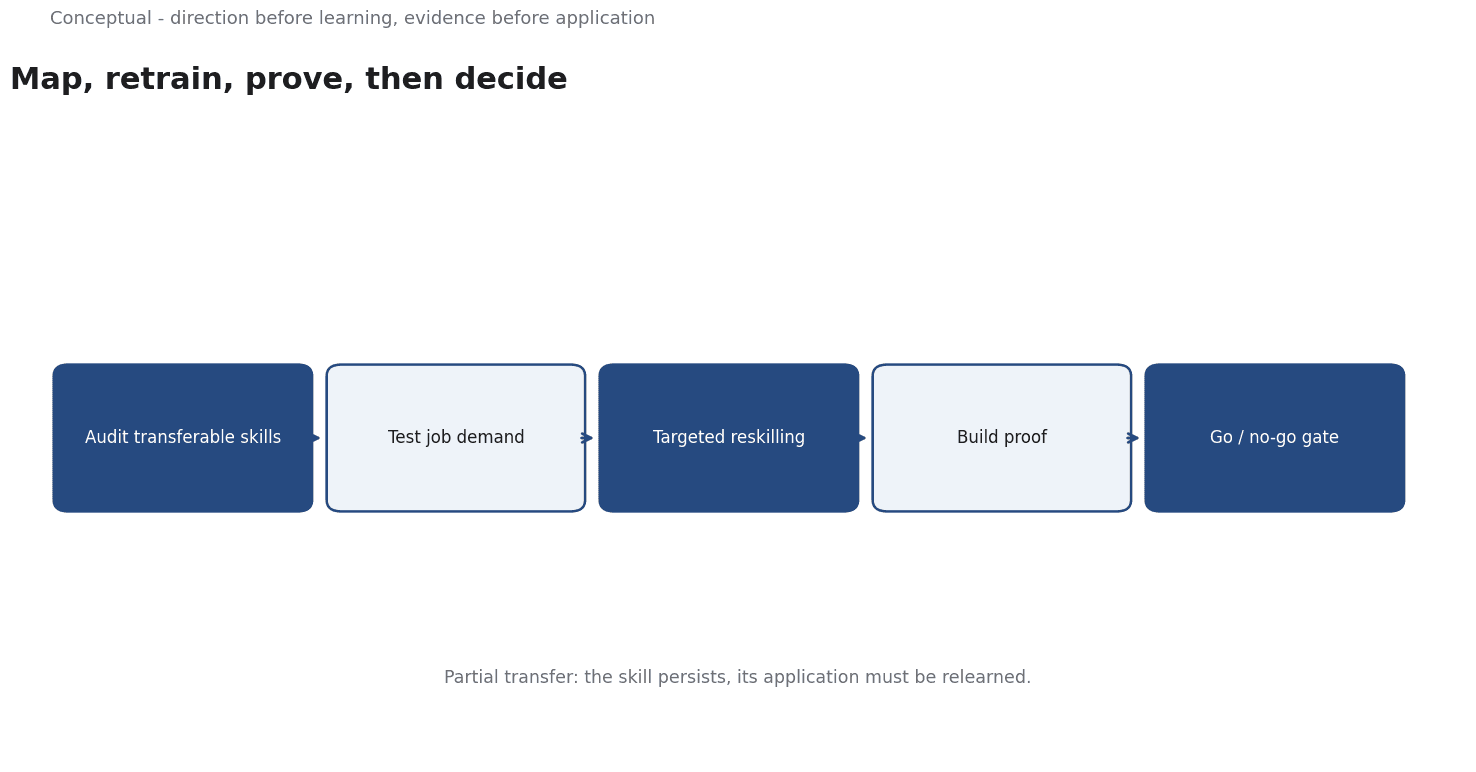
Transferable skills are the bridge between old and new work. Abilities such as analysis, communication, project management, and domain judgment often travel across industries, but their value depends on context. The mechanism is partial transfer: the underlying skill persists while its application must be relearned. Naming a skill precisely is what makes it portable; a vague claim like "good with people" carries little signal in a new field.
The entry on retraining, or reskilling, defines it as learning new skills to perform a different job, distinct from upskilling within one's current role. The practical consequence is that effective retraining is targeted at a specific role rather than being generic coursework. The goal is employability in a defined target, so the learning should be chosen backward from that target's requirements.
Between the two sits evidence. Employers in an unfamiliar industry discount an outsider's background because they cannot easily judge it. A portfolio, a small project, or a relevant credential lowers that perceived risk by making the transfer visible. Without such proof, even genuine skill may go unrecognized, which is why the framework below ends with an explicit proof step.
A worked example
The following is hypothetical and illustrative. A hypothetical mid-career analyst wants to move into renewable energy. Three checks shape the plan. First, a skill map shows strong data analysis and stakeholder communication that transfer, but no energy-market domain knowledge. Second, a scan of current job postings confirms the data skills are in demand and names a specific gap in power-market fundamentals. Third, a short targeted course plus a small public analysis project produces tangible evidence of the new domain skill. The outcome: the analyst applies with a portfolio that speaks the new industry's language rather than a generic resume, secures an interview, and uses the go or no-go gate to limit time spent if interviews do not convert.
Evidence status
| Claim | Status | Source | Verified | Recheck when |
|---|---|---|---|---|
| Career change is a transition involving role and identity, not a single event | source-reported | Career (Wikipedia) | 2026-11-18 | Career theory is revised |
| Reskilling means learning skills for a different job | source-reported | Retraining (Wikipedia) | 2026-11-18 | Policy terminology shifts |
| Transferable skills need re-learning in the new context | inferred | Derived from the sources | 2026-11-18 | New hiring research appears |
The first two rows restate definitions from the encyclopedia entries and are relatively stable, though terminology in policy and career theory does change. The third row is an inference from the gap between possessing a skill and applying it in a new setting. It is a useful planning assumption rather than a measured result, and it should be revisited if hiring research shifts.
What it cannot do
No framework can guarantee that a switch succeeds, because hiring depends on factors outside individual control. Market cycles, regional demand, and timing all shape outcomes, and a well-executed plan can still meet a closed door. The decision test improves the odds and limits downside; it does not convert an uncertain process into a certain one.
Switching also carries hidden costs that are easy to underestimate. It often means a temporary income dip, a loss of accumulated seniority, and the effort of learning while still working. The financial and emotional strain is real, and a plan that ignores it can run out of runway before the transition completes. Any go or no-go gate should therefore include a financial buffer.
A credential that many others hold loses its signaling value, so a switcher can complete the training and still face the same competition. Choosing retraining without checking actual demand is the trap that turns a planned move into sunk cost.
Transfer has hard limits. Some industries require licenses, certifications, or years of domain-specific practice that a short course cannot substitute for. Regulated fields such as health, law, or finance have formal gates, and no amount of general skill or enthusiasm bypasses them. The skill audit must identify these gates early, before time is invested.
Finally, target roles evolve. The skills in demand today may be reshaped by tooling or by shifts in the industry itself. The skill map and the retraining plan both need periodic review against current postings and conditions, not a one-time check at the start of the transition.
Counterargument: the claim that switching is too risky and best avoided is fair for people with strong momentum in a current path and incomplete for those in a shrinking field, where the greater risk is staying.
A decision test
- Name the target industry and the specific role you want.
- List current skills and mark which ones are genuinely transferable.
- Identify the true gaps that block entry to that role.
- Check current demand for the role and its required skills.
- Choose retraining that directly closes the named gaps.
- Build one piece of evidence that proves the new skill.
- Set a go or no-go gate with a timeline and a fallback.
These steps work because they order the decisions correctly: direction before learning, evidence before application, and a stop condition before commitment. The gate is what keeps the process honest, since it converts a vague aspiration into something that can be evaluated. Revisit the map and the evidence as the target role changes.
For further reading, see Decision memos that survive review.
References & Further Reading
- Wikipedia contributors, 2026. Career - Wikipedia — The structure of careers and transitions between roles.
- Wikipedia contributors, 2026. Retraining - Wikipedia — Learning new skills for a different role.