How to Get Media Planning Right
Media planning links spend to demand outcomes. Read the decisions a plan must make, a worked example, and where channel metrics stop being useful.
Media planning decides where, when, and how often a message runs. Demand generation is the function that turns awareness into interest and leads. The real problem is that plans are often built from available inventory and past habit, so spend is defended with reach figures rather than with the demand outcome the plan was meant to produce.
Direct answer: Start a plan from a defined demand objective, then choose channels, schedule, and budget that can serve it. The sources define media planning and demand generation as distinct ideas; connecting each media choice to a demand objective is a synthesis, not a rule the sources state. Right means the plan shows what each placement is expected to do for demand, so a reviewer can judge it.
Delta: This article adds a claim-status table and an objective-to-placement decision test beyond the sources: it maps each media choice to a demand decision, with claim status explicit.
The mechanism
Media planning, as the source describes it, is a sequence of decisions about objectives, target audience, channel selection, scheduling, and budget. Its output is a plan, not merely a list of ads to run. Demand generation describes the activities that create awareness and interest in an offering. The practical consequence is that a plan beginning with a channel, chosen because it is cheap or familiar, has skipped the objective and can be judged only by activity metrics.
A plan beginning with the demand objective can be judged by whether its channels plausibly move a buyer toward that objective.
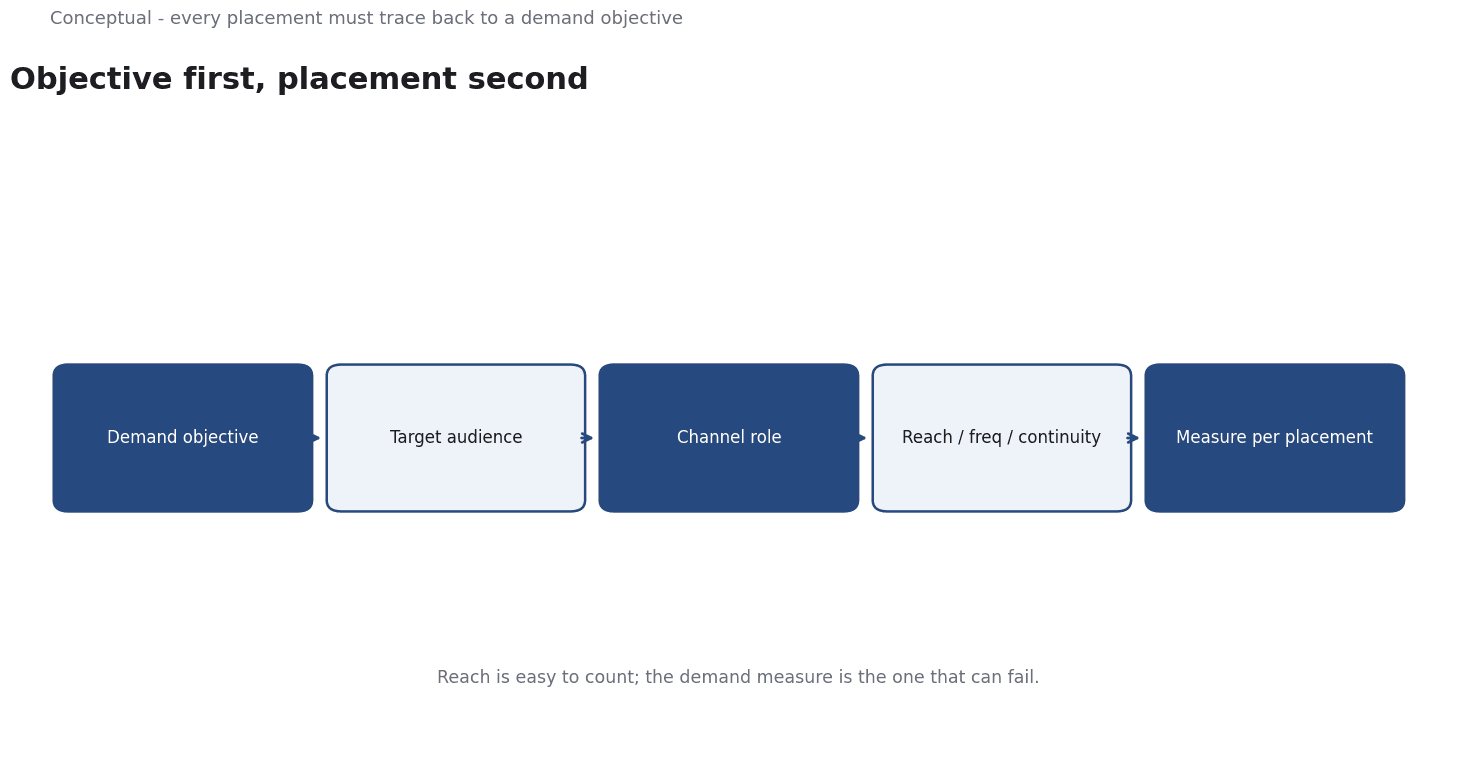
The levers are reach, frequency, continuity, and budget allocation. Reach states how many people a message may touch; frequency states how often; continuity states over what span of time. Each lever trades against the others under a fixed budget, so a plan is a set of allocations rather than a wish list. The consequence is that every choice should carry a reason tied to the objective. A placement that cannot be linked to awareness, interest, or lead creation is difficult to defend when the budget is cut.
The sources treat media planning and demand generation separately; neither prescribes that a plan must be built backward from a demand objective. That mapping is a synthesis and is marked inferred. Keeping the marker matters because it is a local modeling choice: a team in a different market could reasonably sequence the work in another way. The claim made here is that the mapping helps review, not that the sources command it.
The output is a written plan stating objective, audience, channel, schedule, budget, and the measure that will judge each placement. That last field converts the plan from a spending list into a testable instrument. Without it, post-campaign review collapses into a debate about which channel felt more effective, with no shared standard for the argument.
A worked example
The following is hypothetical and illustrative. A small software team plans a campaign for a product with a stated demand objective: qualified sign-ups. Three checks decide the review. First, does each chosen channel have a stated role in moving a prospect from awareness to interest? Second, under a fixed budget, are reach and frequency traded off deliberately rather than assumed from last year? Third, is there a measure for each placement that could actually fail, so a weak placement can be told from a strong one? The plan shows a large spend on a broad channel with no stated path from that channel to a sign-up, while a smaller channel carries the interest stage. The team reallocates part of the spend and records a sign-up measure for each placement. The outcome is a traceable decision, not a claim that the campaign will succeed. The numbers are hypothetical; the verification method is the contribution.
Evidence status
| Claim | Status | Source | Verified | Recheck when |
|---|---|---|---|---|
| Media planning covers objectives, audience, channel, schedule and budget | source-reported | Wikipedia, Media planning | 2026-11-18 | Source definition revised |
| Demand generation creates awareness and interest in an offering | source-reported | Wikipedia, Demand generation | 2026-11-18 | Source definition revised |
| Mapping each placement to a demand objective improves review | inferred | Derived from the sources | 2026-11-18 | Objectives or channels change |
The first two rows are factual claims drawn from the sources and should be rechecked when those entries change. The third is an inference about review quality, because neither source endorses a particular planning sequence. Recheck it when the objective or the channel set shifts, since a mapping that served one market may not serve another.
What it cannot do
A media plan does not guarantee creative effectiveness. Even a correctly mapped placement can fail if the message itself does not resonate with the audience. The sources define planning and demand generation, not creative quality, so treating a well-structured plan as a guarantee of response is a category error. The plan governs where a message runs and with what weight; it says nothing about whether the message works once it arrives. That judgment belongs to a different discipline and a different test.
The hidden cost is the measurement apparatus. Connecting placements to demand outcomes needs tracking, shared definitions, and often tooling, and that work recurs every campaign. A team that writes a careful plan but does not maintain the measurement fields ends up with a document nobody can evaluate. The cost is paid in discipline and attention, not only in media spend. Plans that omit this cost look cheap on paper and expensive in practice.
Reach and impressions are easy to count, while demand outcomes are harder, so review drifts toward the numbers that are available. A plan can then appear successful because it delivered impressions even though it generated no interest. The format invites this drift because exposure metrics appear early and often, while the demand measure sits in a field that is easy to leave blank. Reviewers should read the demand measure first.
There is a boundary around attribution. A plan can state a plausible role for each channel, but it cannot prove that a channel caused a lead. Market conditions, competitor action, and seasonality all move outcomes, and the plan cannot separate them. It is a map of intent, not a causal model, and should not be presented as proof of contribution. Where a causal claim is needed, a controlled test is the more honest instrument.
Because channels and objectives change, the mapping needs periodic review. Each assumption about a channel's role should carry its own recheck condition, and the demand objective should be restated when the market shifts. Without that record, a future reviewer cannot tell which placements were deliberate and which were inherited from an earlier plan.
The counterargument that objective-first planning is fair for allocating scarce budget and for making choices reviewable is incomplete when no credible demand measure exists to judge the mapping.
A decision test
- State the demand objective in observable terms.
- Name the target audience for that objective.
- List candidate channels and the role each could play.
- Allocate the budget across channels, recording reach, frequency, and continuity assumptions.
- Write a measure for each placement that could fail.
- Check that every placement links to the objective; drop those that do not.
- Record each assumption with a recheck date and an owner.
A media plan is useful only when its choices can be traced to an objective and a measure. The test turns a spending list into a sequence of decisions a reviewer can follow, so the link between placement and demand stays visible. For further reading, see Marketing Dashboards without the Hype.
References & Further Reading
- Wikipedia contributors, 2026. Media planning - Wikipedia — Selecting channels and scheduling advertising.
- Wikipedia contributors, 2026. Demand generation - Wikipedia — An overview of demand generation as a marketing discipline distinct from lead generation; secondary reference used with the lead-generation entry.