How to Get Network Effects Right
Network effects make a product more valuable as users join. See how adoption thresholds map to strategy decisions, with claim status explicit.
Network effects are routinely cited to justify high valuations and aggressive spending, often without checking whether the effect actually exists. The real problem is that user growth is not the same thing as value created for other users, and the two get conflated in strategy decks. A team that claims a network effect it does not have will build the wrong plan around it.
Direct answer: A network effect exists when a product becomes more valuable to its users as the number of users grows, either directly or through complementary goods. A valuation framework prices the future cash flows that such growth might produce but supplies no fixed multiplier. The bounded claim: the strategy decision depends on which side of the network is seeded and what behavior counts as critical mass.
Delta: This article adds an effect-to-intervention mapping beyond the sources: it maps each type of effect to a seeding decision, with claim status explicit.
The mechanism
Wikipedia defines a network effect as the effect that a user or participant gains from a good or service when other people use it, or when a compatible complementary product becomes available. The value of the product rises with the size of the network rather than only with its features. The practical consequence is that adoption and value reinforce one another, so early usage carries strategic weight beyond the revenue it generates. A product with a real effect can improve as it grows without a single feature change.
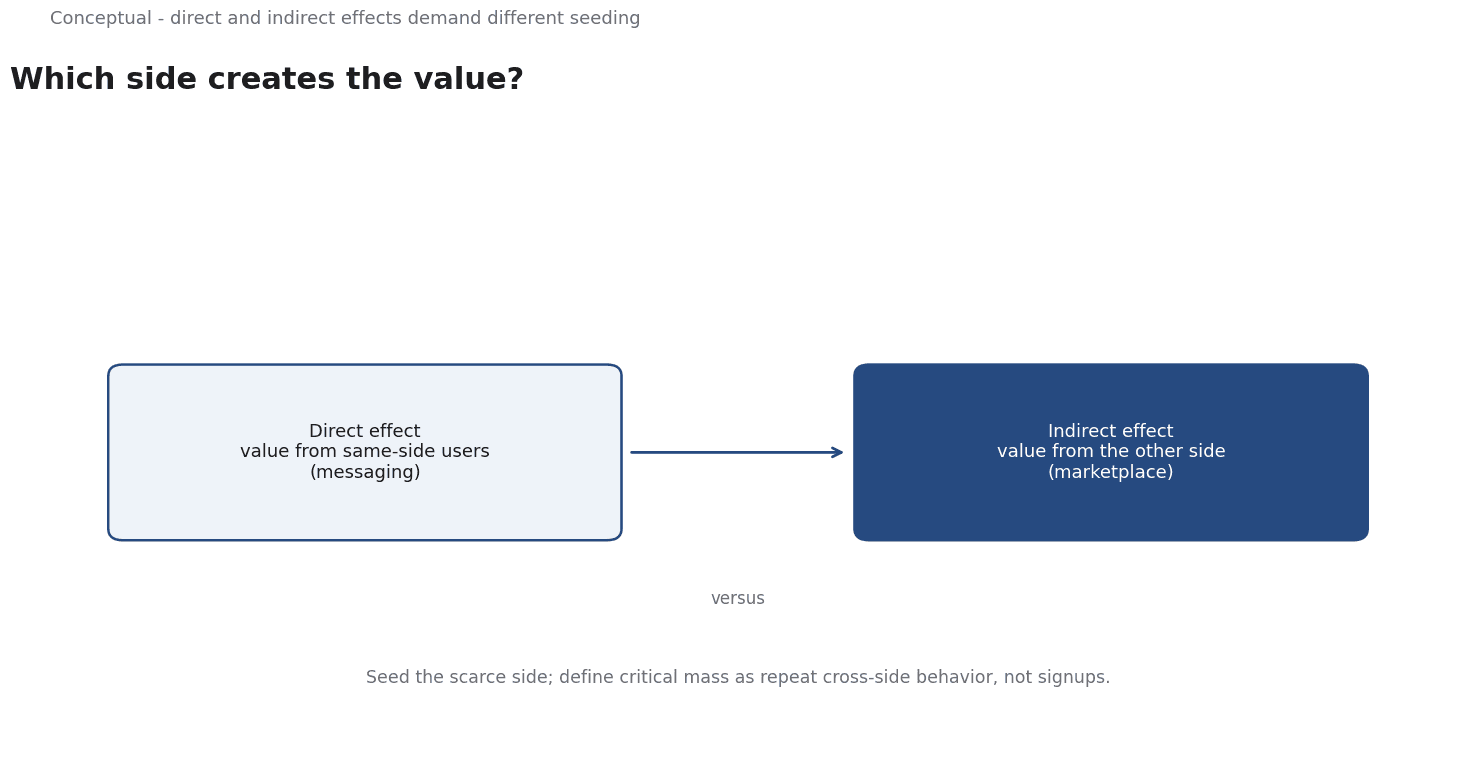
The same source distinguishes direct effects from indirect ones. A direct effect arises when value rises with the number of users on the same side, as with a messaging network where each new participant can reach more people. An indirect effect arises when value rises because a complementary side grows, as with a platform whose appeal to one group depends on the apps or customers available on the other. Marketplaces often face a chicken-and-egg problem because each side is valuable only when the other is present.
The practical consequence is that strategy has to decide which side to seed first, rather than treating all users as equivalent.
The valuation source frames the general task of estimating what an asset is worth, without offering a formula that turns a user count into a number. Network effects are one reason a company with modest current profit may command a high value, because expected future cash flows may grow faster as the network expands. But neither source supplies a fixed conversion from adoption to value, and that mapping is a local choice that must be marked as inferred. Treating every rising user count as proof of a network effect is an error, because growth can come from spending or novelty rather than from value created for other users.
The useful output is a policy mapping the type of effect to a concrete intervention. It states which side is seeded, what observable behavior marks critical mass, and what signal would show the effect is real rather than assumed. That policy, not a raw user chart, is the decision instrument. It makes the rationale reviewable because the effect type and the threshold are recorded together. A team that writes them down can later explain why it subsidized one group and what it expected to happen as a result, instead of pointing to a growth curve that could mean several things.
A worked example
The following is hypothetical and illustrative. A two-sided marketplace reports steady signups but little repeat activity, and the team is considering more acquisition spend. Three checks shape the decision. First, is the claimed effect direct or indirect, and which side's presence actually creates value for the other? Second, is there evidence of critical mass in the form of repeat cross-side interactions rather than registrations alone? Third, would participation on the subsidized side persist once the incentive is removed, or does activity track the subsidy exactly? The review finds that most signups never complete a cross-side transaction and that activity falls when incentives pause. The team focuses seeding on the scarce supply side and adopts a repeat-interaction measure as the threshold for continued spending. The outcome is a testable strategy instead of a growth narrative. The details are hypothetical; the decision method is the contribution.
Evidence status
| Claim | Status | Source | Verified | Recheck when |
|---|---|---|---|---|
| A network effect means value rises as more users join | source-reported | Network effect, Wikipedia | 2026-11-18 | Definition revised |
| Direct and indirect effects differ by which side creates the value | source-reported | Network effect, Wikipedia | 2026-11-18 | Taxonomy revised |
| Mapping user growth to value is a local, inferred choice | inferred | Derived from the sources | 2026-11-18 | Business model changes |
The first two rows report the definition and the distinction given in the reference article. The third is an inference about what the sources leave open, because neither supplies a conversion from users to value for a specific business. Recheck the source rows when the definition or taxonomy is revised, and the inferred row when the platform's business model or incentive structure changes.
What it cannot do
Network effects do not guarantee success. A product can have a genuine effect and still fail if it never reaches critical mass or if a rival tips the market first. Treating the presence of an effect as a predictor of outcome confuses a mechanism with a result. The effect describes a tendency for value to rise with participation; it says nothing about whether the product will get enough participation to matter. A market can support only so many winners, and being early is not the same as being durable. Evidence of an effect is a starting point for strategy, not a forecast of victory.
The hidden cost is that building a network effect costs more than launching a product. Seeding one side, subsidizing early participation, and maintaining enough liquidity to keep users engaged all consume resources before meaningful revenue arrives. That asymmetry is why many platforms fail at the starting point rather than later. The cost is paid in incentives, in operational effort to match the two sides, and in the discipline to stop subsidizing once the threshold is reached. A team that budgets only for launch will run out of room before the effect has a chance to operate.
Falling average costs come from scale, and customer preference can come from reputation; neither necessarily depends on other users joining in the way an effect does. A team that claims an effect it does not have will design incentives for the wrong group and measure the wrong signal. The question worth asking is whether one additional user raises the value of the product for existing users. If the answer is no, the growth may be healthy but it is not a network effect, and the strategy should reflect that distinction.
There is a boundary around the idea. It covers value created by participation, not pricing power, not regulation, and not the underlying quality of the product. It cannot tell a team which side to subsidize, how much to spend, or what threshold matters for its market. It can only show whether a claimed effect is consistent with the observed pattern of usage. That is a narrower contribution than the narratives that surround the term, where a network effect is treated as a complete explanation for any fast-growing company. The concept is a lens on one mechanism, not a theory of every outcome.
Because networks evolve, the mapping needs a refresh. Each claimed effect should carry its type, the side being seeded, and a recheck condition, and the threshold should be treated as a local decision rather than a value the sources provide. Without that record, a future reviewer cannot tell a real effect from a slogan. The usage data will still be there; the rationale for why a side was prioritized is what makes the decision reviewable. For further reading, see Marketing Dashboards Without the Hype.
A decision test
- State what one new user changes for existing users.
- Classify the claimed effect as direct or indirect.
- Identify which side must be seeded first.
- Define critical mass as a repeat behavior, not a signup count.
- Check whether participation persists after incentives are removed.
- Separate the effect from scale economies or brand preference.
- Record the effect type, the threshold, and a recheck condition.
A network effects strategy is useful only when the type of effect and the threshold are both explicit. The test turns a growth claim into a sequence of decisions with a visible rationale, so a reviewer can see why one side was seeded and what would count as success. Growth can still be disappointing; the difference is that the team will know which assumption failed and can revise it rather than defend a vague story.
A counterargument
A fair objection is that the article's decision instrument is mostly vocabulary. Its own evidence table marks the user-to-value mapping as inferred, and both sources are general Wikipedia definitions; neither can tell a team which side to subsidize or where critical mass begins. The 'What it cannot do' section concedes as much, so the effect-to-intervention mapping adds review structure rather than predictive power. There is also a practical gap: the decision test asks teams to separate a network effect from scale economies and brand preference, yet early usage data often cannot distinguish them, and the article supplies no method beyond asking the question.
The discipline of recording assumptions is real, but it should not be mistaken for evidence that the claimed effect exists.
References & Further Reading
- Wikipedia contributors, 2026. Network effect - Wikipedia — Value growing with the number of users.
- Wikipedia contributors, 2026. Valuation (finance) - Wikipedia — Overview of absolute and relative valuation approaches; secondary reference.