How to Get Retail Analytics Right
Retail analytics breaks when store and web records are blended. Read how point-of-sale and web data differ, what key connects them, and which decisions each supports.
Retail analytics goes wrong when the store system and the web system are treated as two versions of one truth, each with its own definition of a transaction. The point of sale entry describes the system where sales are recorded in store, while the web analytics entry describes the measurement of online behavior. The question is how to combine two partial records into one decision without pretending they measure the same thing.
Direct answer: Treat point-of-sale data and web analytics as complementary records with different units, not as rival versions of a single metric. Define a shared entity such as the customer or the order, reconcile definitions at the boundary, and keep channel-specific measures distinct. The boundary is that online behavioral data is an instrumented view of activity, not a complete census of intent.
Delta: This article adds a claim-status table and a decision test beyond the sources: it maps each data source to the retail decision it can support, with claim status explicit.
The mechanism
Point of sale is the system that records sales transactions at the moment of exchange, typically capturing item, quantity, price, and time. The important concept is that it is an operational record created to complete a sale, not an artifact designed to answer analytical questions. The practical consequence is that fields exist because checkout needed them, so attributes useful for analysis may be absent or entered inconsistently. An analyst should study what the system actually captures rather than what a reporting template wishes it captured. Item-level detail is usually strong there, which makes the source well suited to inventory and merchandising questions.
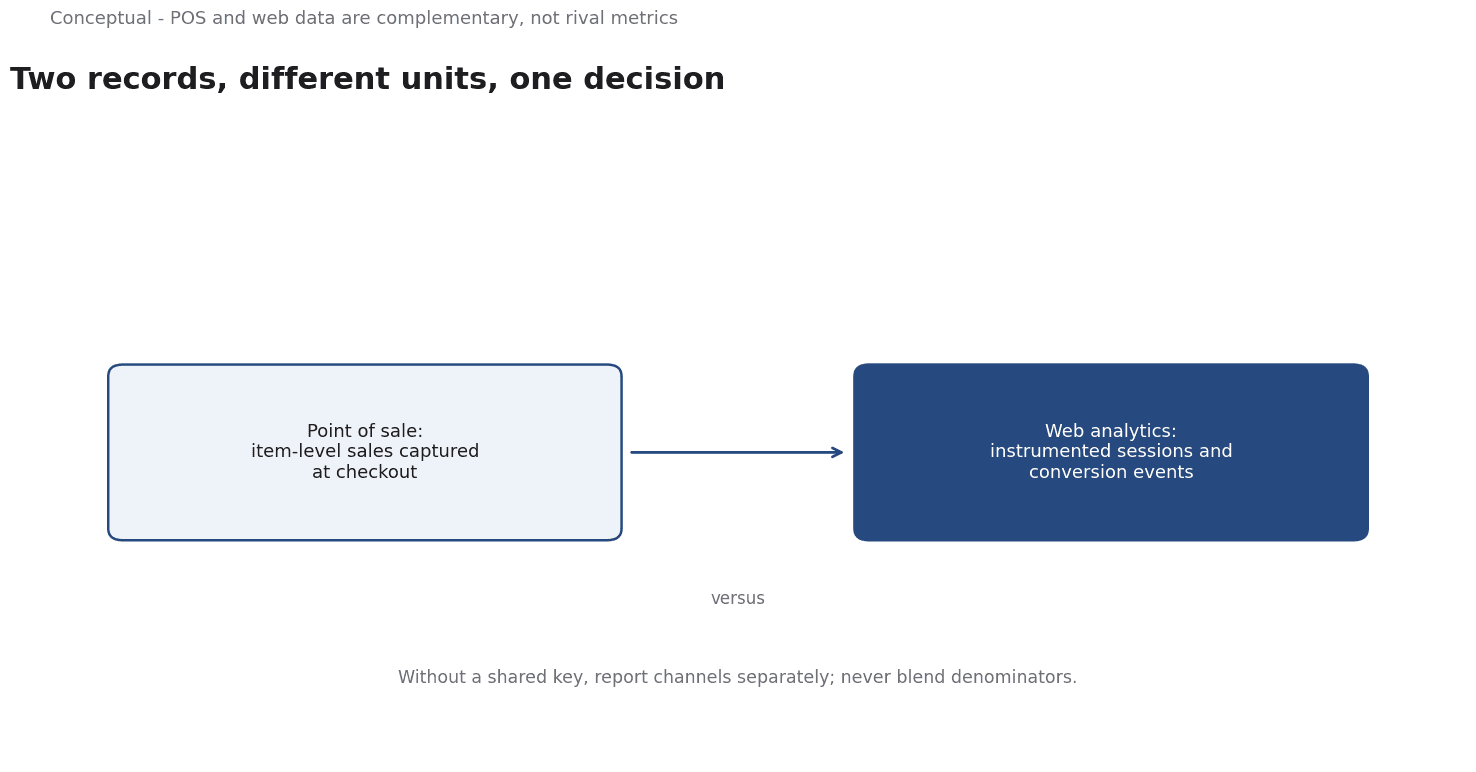
Web analytics measures and reports online activity such as sessions, page views, and conversion events. The important concept is that it is instrumented behavioral data, shaped by tagging decisions and by what the instrumentation can observe. The practical consequence is that a missing event is usually a measurement gap, not evidence that nothing happened. A sudden drop in a reported event can be a tag failure rather than a change in demand. Because the source records the path toward a purchase, it is well suited to acquisition and funnel questions, provided the reporting is checked against the instrumentation that produced it.
Combining the two requires a shared key and a declared unit of analysis. A transaction in point of sale, a session on the web, and a customer who can be linked across both are different units, and mixing them without stating which one is in use creates a number that answers no question. The practical discipline is to choose the key that fits the decision: inventory choices need item-level store data, while channel allocation needs web attribution.
When no reliable cross-channel identity exists, the honest answer is to report the channels separately rather than manufacture a blended figure from incompatible denominators.
The final step is to mark what the sources establish and what this analysis infers. The descriptions of point-of-sale systems and of web analytics are source-reported. The claim that the shared key is the binding constraint is inferred from how the two records fail to line up. Making that status explicit keeps a local diagnosis from being presented as a documented fact.
A worked example
The following is hypothetical and illustrative. A retailer operates stores and a web channel and wants one view of demand for a product line. Three checks decide the approach. First, do both channels record the same event definition for a completed order, including how returns and cancellations are handled? Second, is there a shared customer key, or are the two systems linked only through aggregate totals that cannot distinguish one repeat buyer from two new ones? Third, does the decision require item-level detail, which only the store system provides, or channel attribution, which only the web data provides? The outcome is a short record stating the decision, the unit of analysis, and the source chosen. If no shared key exists, the team reports channel metrics separately and avoids a blended conversion number, since the two denominators are not comparable.
Evidence status
| Claim | Status | Source | Verified | Recheck when |
|---|---|---|---|---|
| POS records sales transactions at the point of exchange | source-reported | Wikipedia POS | 2026-11-18 | Definition revised |
| Web analytics measures online activity and conversion | source-reported | Wikipedia Web analytics | 2026-11-18 | Definition revised |
| The shared key is the binding constraint is inferred | inferred | Derived from the sources | 2026-11-18 | Identity linkage changes |
Two rows restate documented descriptions of the two systems. The third row is a diagnosis derived from how their units differ, not a claim the sources make. Recheck the documented rows when the reference definitions change and the inferred row when identity linkage or event instrumentation changes.
What it cannot do
Retail analytics cannot observe what it does not record. A store system captures completed sales but not the browse, the abandoned consideration, or the customer who left without buying. Web analytics captures instrumented online behavior but misses purchases made in store and any interaction that the tagging did not fire. Neither source is a complete account of demand, and a dashboard built from either one is a view of a system's coverage as much as a view of customers. Treating the visible portion as the whole is the basic error that a careful analysis has to guard against.
The hidden cost is instrumentation and identity linkage. Tags break when sites change, event names drift between teams, and store fields depend on consistent entry at checkout. Linking a web session to a later store purchase requires an identity mechanism that many retailers do not have, and building one is a program rather than a reporting task. Reconciliation consumes analyst time every period because the two systems close at different moments and treat returns differently. These costs are easy to omit from a plan that focuses on the dashboard rather than on the data pipeline behind it.
A store conversion rate and a web conversion rate have different denominators and different definitions of a visit, so averaging them produces a figure that describes neither channel. A related failure is reading a measurement gap as a behavioral change: a reporting drop after a site release is more likely a broken tag than a shift in demand. Both errors are invisible in a clean chart, which is why the decision test starts by fixing the unit of analysis and checking the event definition before any trend is interpreted.
There is a boundary in what the sources cover. They describe a point-of-sale system and web analytics as categories of technology; they do not settle how customer identity should be governed, what privacy constraints apply, or which system is authoritative when the two disagree. Those are policy decisions with legal and ethical dimensions that sit outside the technical description. A team that treats a system definition as an answer to those questions has extended the source well beyond what it supports, and the extension should be labeled as a local choice.
Finally, the definitions and the item taxonomy need scheduled review. New channels appear, product hierarchies change, and event schemes are revised as the site evolves. A metric that was reliable last year can quietly change meaning when the instrumentation changes underneath it. The review should check the event definitions, the item hierarchy, and the identity linkage on a fixed schedule, and it should ask whether the decisions the analytics supports are still the decisions the business is making.
Counterargument: "The counterargument that one unified platform removes this problem is fair for a single-channel retailer with simple data, and incomplete when store and web records carry different units and definitions."
A decision test
- Name the retail decision the analysis must support, such as replenishment or channel spend.
- Declare the unit of analysis: a transaction, a session, or a linked customer.
- Check the event definition in each channel, including returns and cancellations.
- Determine whether a reliable shared key exists across store and web records.
- Choose the source that matches the decision and state why the other is excluded.
- If no key exists, report channels separately and do not publish a blended rate.
- Set a review date for event definitions, item hierarchy, and identity linkage.
The test keeps the analysis tied to a choice instead of to a dashboard. A team that can name the unit of analysis and the source that supports the decision has a defensible measure; a team that blends two denominators has a number that cannot be acted on. For further reading, see Data quality in practice.
References & Further Reading
- Wikipedia contributors, 2026. Point of sale - Wikipedia — Systems for recording transactions at the point of sale.
- Wikipedia contributors, 2026. Web analytics - Wikipedia — Collection and interpretation of website behaviour data.