How to Get Referral Programs Right
Referral programs turn customers into promoters, but incentives can crowd out genuine recommendation. Read the mechanism, a worked example, and the limits.
Referral programs are popular because acquisition through existing customers often looks cheaper than paid channels. The Wikipedia entries on referral marketing and word of mouth describe recommendations that spread through personal networks, but a program adds an incentive to something that was once voluntary. The real problem is that paying for a recommendation can change who recommends and why.
Direct answer: Design the reward so it follows a genuine referral, not the act of signing up a low-quality account. The sources define referral marketing and word of mouth; the guardrails against self-referral and gaming are a synthesis.
Track the quality of referred customers, not only the count of referrals.
Delta: This article adds a reward-to-quality mapping beyond the sources: it maps each incentive rule to a fraud or trust decision, with claim status explicit.
The mechanism
The referral marketing entry describes companies that encourage customers to bring in new customers, often by offering a reward. The word of mouth entry describes informal communication about a product between people, outside the direct control of the marketer. The practical consequence is that a referral program sits between a commercial incentive and a personal recommendation. The customer's credibility is the asset being used, and an incentive that feels manipulative can spend that credibility faster than it buys reach.
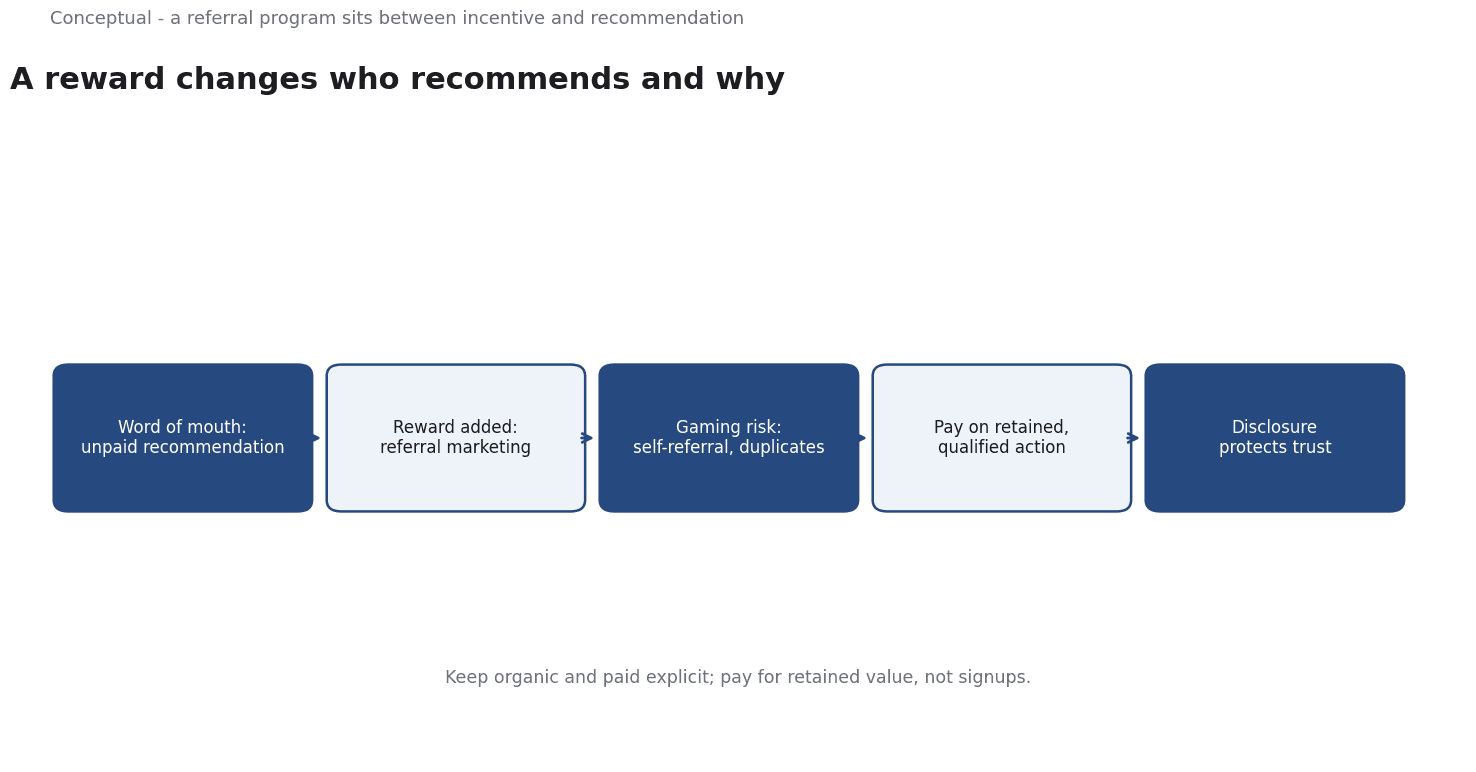
The two sources differ in how much control the marketer has. Word of mouth is unpaid and organic; referral marketing is structured and rewarded. A program converts the first into the second. The practical consequence is that once a reward exists, some participants optimize for the reward rather than for a good fit. Self-referrals, duplicate accounts, and signups with no intent to buy appear, because the participant is answering the incentive rather than making a recommendation to a friend.
Timing and attribution carry much of the design. The reward should be tied to the referred customer doing something valuable, not merely to the signup. The practical consequence is that paying at signup rewards volume, so the program fills with accounts that never convert. Tying the payout to a retained, qualified action aligns the promoter's interest with the business, even though it means a slower and smaller-looking headline count. The tradeoff is deliberate rather than accidental.
Trust framing is the final piece. Word of mouth works because the recommender has a relationship with the recipient and stakes some reputation on the suggestion. The practical consequence is that disclosure and clear terms protect that trust: a recipient who later learns the recommender was paid may discount the advice and blame both the brand and the sender. The useful output is a mapping from each incentive rule to a fraud, quality, or trust decision, with the boundary between organic and paid recommendation kept explicit.
A worked example
The following is hypothetical and illustrative. A subscription business launches a referral program offering account credit to both parties. Three checks decide whether it is sound. First, an identity check: can one person create multiple accounts and refer themselves, and are matching payment or device signals used to block it? Second, a quality check: is the reward paid at signup, or only after the referred customer completes a paid month? Third, a disclosure check: are promoters required to state plainly that they are rewarded? The program pays credit only after a referred account completes a paid billing cycle, blocks self-referral through identity matching, and includes a clear disclosure line. The outcome is slower but cleaner growth, with referred-customer retention measured beside the referral count. The numbers are hypothetical; the verification method is the contribution.
Evidence status
| Claim | Status | Source | Verified | Recheck when |
|---|---|---|---|---|
| Referral marketing rewards customers for bringing in new customers | source-reported | Wikipedia, Referral marketing | 2026-11-18 | Entry revised |
| Word of mouth is informal recommendation between people | source-reported | Wikipedia, Word of mouth | 2026-11-18 | Entry revised |
| Paying at signup invites gaming, so pay on retained value | inferred | Derived from the sources | 2026-11-18 | Fraud patterns change |
The first two rows are factual claims drawn directly from the sources. The third is an inference, because neither entry prescribes when a reward should be paid or how to handle abuse. Recheck the source claims when the entries are revised, and the inferred claim when fraud patterns or the product's billing cycle change.
What it cannot do
A referral program cannot manufacture genuine advocacy. It can amplify recommendations that would happen anyway, and it can purchase introductions from people willing to make them, but it cannot make a customer believe in a weak product. The sources describe how referrals spread and how programs reward them; neither claims that an incentive creates conviction. A program layered on a poor experience will produce referrals once and then go quiet, because the promoter has no honest story to tell.
The hidden cost is fraud management and support. Self-referrals, duplicate accounts, and disputes over unpaid rewards consume staff time that the acquisition math rarely includes. Program terms must be written, published, monitored, and enforced, and enforcement has to be fair enough not to alienate honest promoters. A promoter who feels wrongly denied will complain publicly, which turns a cost center into a reputational one. This expense is ongoing rather than a one-time setup, and it grows with the size of the reward.
A payout triggered at signup rewards volume, so the program accumulates accounts that never convert and a metric that looks healthy while delivering nothing. A second failure mode is untimely disclosure: if recipients learn later that the recommender was paid, the recommendation loses credibility and the recipient feels used. A third is reward leakage, in which the same customer reappears through multiple identities. None of these shows up if the only tracked number is the referral count.
There is a boundary around attribution. A program can observe that a referred customer signed up, but it cannot know how much the recommendation mattered compared with other marketing the customer saw. It also does not cover what happens after the referral, such as whether the new customer stays or expands. Long-term value sits outside the program's view unless it is deliberately measured and tied back to the reward rule. The count of referrals is a leading indicator at best, and treating it as the outcome invites the wrong optimization.
Because fraud patterns and the product itself change, the rules need periodic review. Identity checks, payout triggers, disclosure language, and qualifying actions should be owned by a named party with a recorded recheck condition. Without that record, a future reviewer cannot tell which rules were deliberate and which were convenient defaults, and a program that was clean at launch slowly accumulates abuse.
The counterargument that incentives are fair for increasing reach is incomplete when a paid recommendation is read as an honest one by a recipient who trusts the sender.
A decision test
- Define the qualifying action that earns a reward.
- Block self-referral and duplicate accounts with identity checks.
- Pay only after the referred customer reaches that action.
- Require clear disclosure of the incentive.
- Measure retained value of referred customers, not just count.
- Write and publish the program terms.
- Assign an owner and a recheck date for the rules.
A referral program works when the reward follows real value rather than a signup event. This test turns a growth tactic into a sequence of checks a reviewer can audit, so the decision rests on the quality of referred customers rather than on a count that invites gaming. For further reading, see Voice of Customer: Turning Feedback into Decisions.
References & Further Reading
- Wikipedia contributors, 2026. Referral marketing - Wikipedia — The mechanisms and incentives of referral marketing programmes.
- Wikipedia contributors, 2026. Word of mouth - Wikipedia — How recommendations spread between customers.