How to Measure Brand Lift
Brand lift is a change in perception, not a click. Read the comparison designs, a worked example, and the limits of survey-based measurement.
A brand campaign produces no immediate checkout, so teams reach for a survey and report a lift in awareness. That number can be real and still not mean the campaign worked: without a comparison group, it may reflect seasonality, news, or the survey itself. Measuring brand lift is a problem of research design before it is a problem of statistics.
Direct answer: Brand lift is measured by comparing an exposed group with a comparable unexposed group on a defined outcome — recall, recognition, preference, or branded search — with the population and question wording stated in advance. AAPOR's standards govern the survey; geo experiments offer a comparison design for campaigns. The boundary: a lift in perception is not proof of revenue, and a poorly designed survey can manufacture a lift that does not exist.
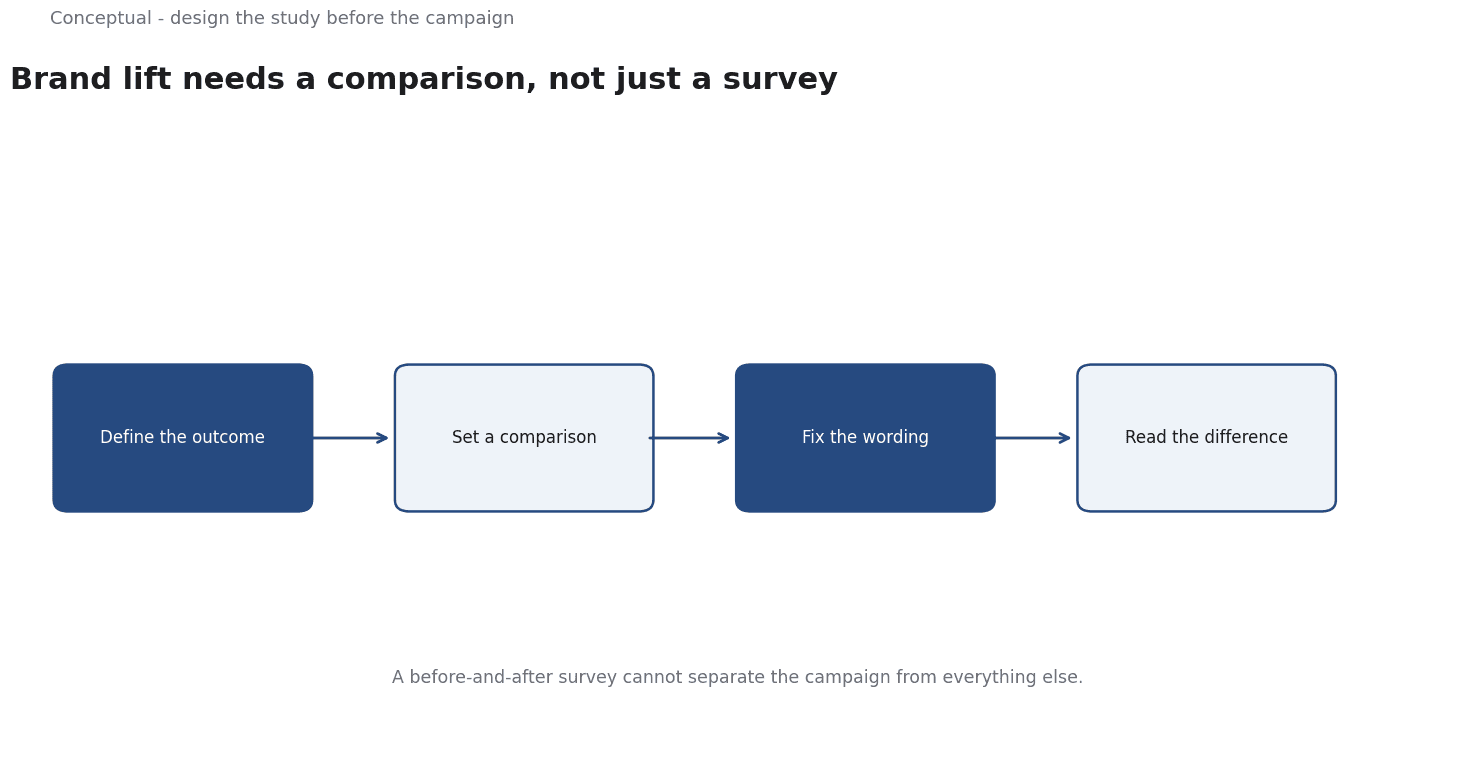
Two comparison designs
Survey-based lift. Expose one group to the campaign and keep another unexposed, then ask both the same questions with the same wording. The difference between groups is the estimate. The population, sampling method, and question wording must be fixed before the campaign runs.
Geo-based comparison. Run the campaign in some regions and not others, then compare observable signals — branded search, direct traffic, or sales — in both. This avoids survey bias but requires regions that are genuinely comparable and enough time for an effect to appear.
Both designs share a requirement: the comparison must be set up before the campaign, not assembled afterwards from convenient data.
A worked example of a lift study
The following is hypothetical and illustrative.
A company runs a video campaign in five cities and holds out five similar cities. Before the campaign:
- Aided brand recognition: 30% in test cities, 29% in holdout cities.
- Branded searches per month: 5,000 and 4,800.
After six weeks:
- Recognition: 38% in test, 30% in holdout.
- Branded searches: 7,200 and 4,900.
Three readings follow:
- The difference is the estimate. Recognition rose 8 points in test cities and 1 point in holdouts, so the campaign's estimated lift is roughly 7 points, not 8. Reporting the raw change would overstate it.
- The signals agree. Branded searches rose sharply in test cities and barely moved in holdouts. Two independent signals pointing the same way is stronger evidence than either alone.
- The survey needs its method stated. Who was asked, how were they selected, and what exactly was the question? Without that, an 8-point change could be sampling variation. AAPOR's standards exist for this reason.
Three decisions follow:
- Report the difference between groups, with the sample sizes.
- State the survey method alongside any perception figure.
- Treat perception lift as an input to a later conversion measure, not as the final result.
When to choose which design
The two designs answer different questions and suit different situations. Three considerations decide:
What outcome matters? If the business needs to know whether a campaign changed how people think about the brand, a survey-based design is the direct instrument. If it needs to know whether the campaign changed observable behaviour — searches, visits, sales — a geo comparison is more relevant, and it avoids the biases that surveys introduce.
How large is the expected effect? A small change in recall needs a large survey sample to detect. A large change in branded search may be visible in logs with no survey at all. Choosing the instrument before knowing the expected magnitude is how studies end up underpowered.
How comparable are the regions or groups? A geo design lives or dies on the similarity of the comparison regions. If the candidate holdout cities differ in size, media habits, or customer mix, the difference you measure may be the difference between cities, not the campaign. Survey designs have the analogous problem when the exposed and unexposed groups are not comparable.
A team that cannot state these three things before launch is not ready to measure lift. Running the study first and interpreting it later is a recipe for finding whatever story the numbers can support.
What brand lift cannot show
It does not establish causation without a comparison.
It does not measure sentiment quality. Recognition can rise because of a controversy. A lift in a neutral or negative direction is still a lift, which is why some studies include a favourability question.
It does not translate directly into revenue. A 7-point recognition lift may or may not change consideration and purchase. Each stage needs its own measurement, as the funnel article explains.
The counterargument — that brand work cannot be measured and should be judged on faith — is wrong.
It can be measured with a comparison design. What cannot be done is to extract a precise revenue figure from a perception survey without evidence linking the two.
A decision test
- Define the outcome — recall, recognition, preference, or behaviour.
- Set a comparison group before the campaign runs.
- Fix the survey population and wording in advance.
- Report the difference between groups, not raw change.
- Pair perception with an observable signal such as branded search.
- State the time window and the sample sizes.
- Link to conversion as a separate measurement, not an assumption.
For the survey standards, see AAPOR; for the comparison design, see Measuring Brand Awareness.
References & Further Reading
- Brian Vaver and Koehler, 2011. Measuring Ad Effectiveness Using Geo Experiments — Geo experiments for incrementality, the cleanest way to attribute marketing spend.
- American Association for Public Opinion Research, 2026. AAPOR — The professional association for public opinion and survey research; its standards and resources underpin the survey-design discussion.