Brand Awareness Metrics That Are Actually Useful
Awareness is not a single number. Read the four signals that show whether people know you, and a worked measurement example.
Brand awareness is measured badly more often than almost anything else in marketing. A reach number counts impressions, not attention; a survey asks a question nobody can answer reliably. The research standards published by AAPOR are a useful corrective: define the population, the wording, and what the result can support.
Direct answer:
Measure awareness with four signals — unaided recall, aided recognition, branded search behaviour, and direct traffic — each with a defined population and time window.
Geo experiments can test whether a campaign caused a change in those signals. The boundary: awareness is a means to a decision, not a goal in itself; a brand that everyone knows but nobody buys from has a different problem.
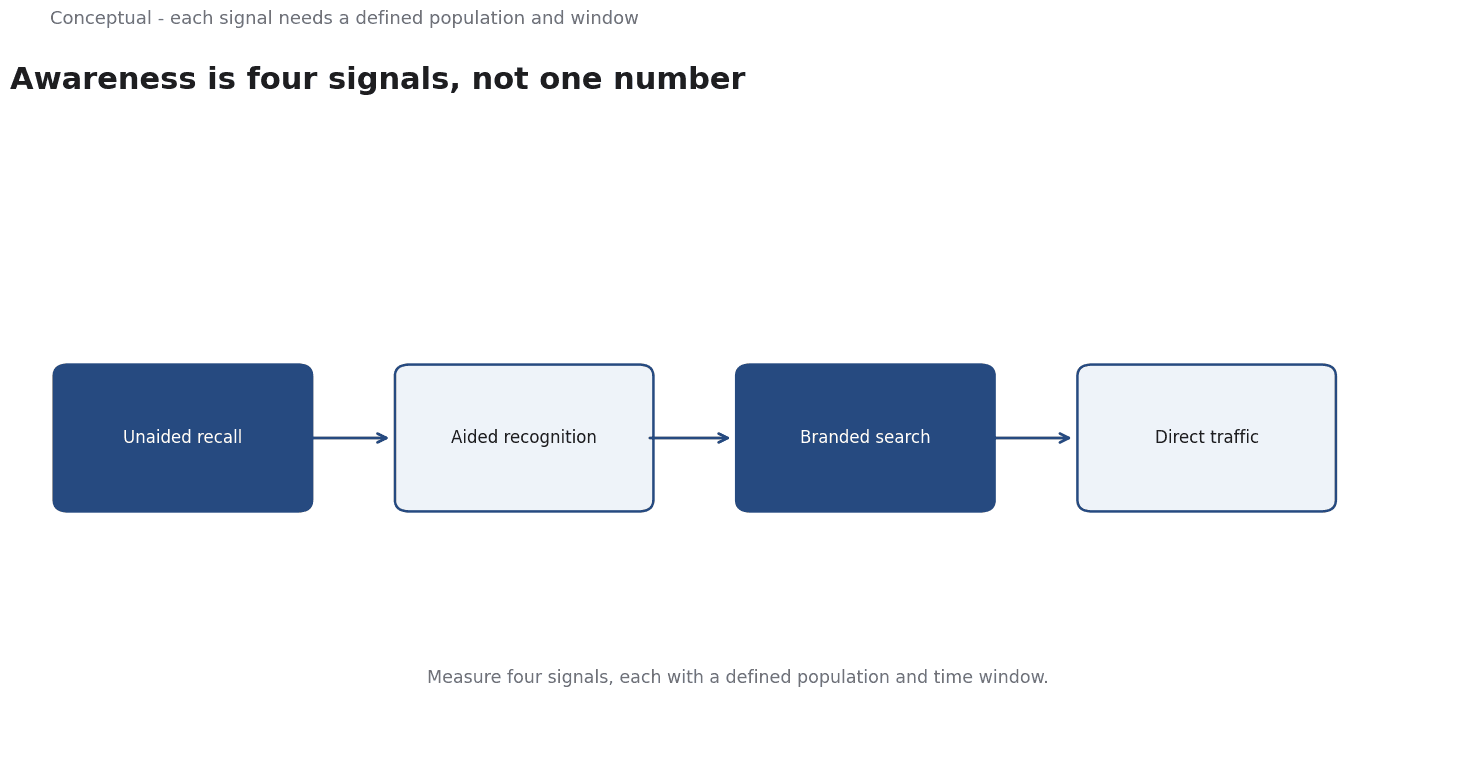
Four signals
Unaided recall. "Which brands come to mind when you think of category X?" This is the strongest signal and the hardest to move. It requires a survey with a defined population and consistent wording.
Aided recognition. "Have you heard of brand Y?" Easier to answer and easier to inflate, because a yes does not imply any recall in a real buying situation.
Branded search. The number of people searching for your name or product. This is observed behaviour rather than a survey answer, but search volume can be driven by news or controversy, not preference.
Direct traffic. People arriving at your site without a referrer. A useful directional signal, though it includes bookmarks, typing, and misclassified campaigns.
Each signal has a different time horizon. Recall moves over quarters; branded search can move in days during a campaign. Reading them together prevents a short-term spike from being mistaken for lasting awareness.
A worked example of a measurement plan
The following is hypothetical and illustrative.
A company runs a brand campaign in two regions, holding one out as a comparison. Before the campaign, baseline measures are:
- Unaided recall in the target category: 12% in the test region, 11% in the holdout.
- Branded searches per month: 8,000 and 7,600.
- Direct visits per month: 15,000 and 14,400.
After eight weeks:
- Recall: 15% in the test region, 11.5% in the holdout.
- Branded searches: 11,000 and 7,700.
- Direct visits: 18,000 and 14,600.
Three readings follow:
- The change is consistent across signals. Recall, search, and direct traffic all moved in the test region and barely moved in the holdout. That is stronger evidence than any single metric.
- The survey needs its standards stated. Who was asked, how they were selected, and what question wording was used? Without that, a three-point recall move could be sampling noise. AAPOR's standards exist for this reason.
- Awareness is not yet revenue. The campaign changed what people know; it has not shown that they will buy. The next measurement is whether conversion among aware buyers changed, which is a different stage of the funnel.
Three decisions follow:
- Report the holdout difference, not the raw before-and-after change.
- State the survey method with every recall figure.
- Treat awareness as an input to a later conversion measurement, not as the final result.
Choosing which signal to lead with
Different business situations call for different lead measures. Three examples:
A new category — where buyers do not yet know the problem has a name — should lead with unaided recall and problem-aware content. Awareness here is about teaching a market, and it will move slowly. Judging it on weekly branded search is premature.
An established category with a new entrant should lead with aided recognition and branded search. The buyer already knows the category; the task is to become a name they consider. A geo holdout is especially useful here because category-level trends can otherwise mask the campaign's effect.
A mature brand should treat awareness as a guardrail and lead with conversion measures. Spending to raise recall when recall is already high is a poor use of budget compared with improving the consideration stage.
These choices are not about which metric is best in the abstract. They are about which signal is sensitive to the decision the business is trying to change.
What awareness metrics cannot tell you
They do not measure sentiment. A brand can be widely known and disliked. Recall and recognition say nothing about whether the association is positive.
They do not isolate a channel. Branded search can rise because of a campaign, a product launch, or a news event. A holdout helps, but only if the comparison regions are genuinely similar.
They are not comparable across categories. Recall of a everyday brand and a specialised B2B brand cannot be judged on the same scale. Compare against your own baseline and, where possible, against direct competitors in the same study.
The counterargument — that awareness is too soft to measure — is wrong.
It is measurable with care; what is hard is attributing a change to one cause.
Geo experiments and consistent survey wording are the tools for that.
A decision test
- Choose two behavioural and one survey signal.
- Define the population and wording for any survey question.
- Use a holdout region where a campaign effect needs to be demonstrated.
- Report the difference between regions, not raw growth.
- Track signals on their natural time horizon — recall quarterly, search weekly.
- Pair awareness with a conversion measure at a later stage.
- Do not compare across categories without a common study.
For the measurement design, see Marketing Attribution; for the funnel context, see How to Build a Marketing Funnel.
References & Further Reading
- Brian Vaver and Koehler, 2011. Measuring Ad Effectiveness Using Geo Experiments — Geo experiments for incrementality, the cleanest way to attribute marketing spend.
- American Association for Public Opinion Research, 2026. AAPOR — The professional association for public opinion and survey research; its standards and resources underpin the survey-design discussion.