How to Write a Value Proposition
A value proposition states who benefits, from what, and why it is better. Read a worked rewrite, the positioning logic, and how to test it.
Most value propositions fail because they describe the company rather than the customer's decision. "We provide innovative solutions for modern teams" could appear on thousands of websites. A useful value proposition lets a specific buyer answer three questions: is this for me, what changes if I choose it, and why this rather than the alternative.
Direct answer:
Write a value proposition that names the customer, the problem or outcome, and the differentiated reason to believe — then test whether the intended reader can repeat it back.
Porter's strategy argument warns that operational effectiveness is not strategy, and the blue-ocean framing asks whether the comparison set itself should change. The boundary: a sentence is not a value proposition if the product cannot deliver it, and clever wording cannot substitute for a distinctive position.
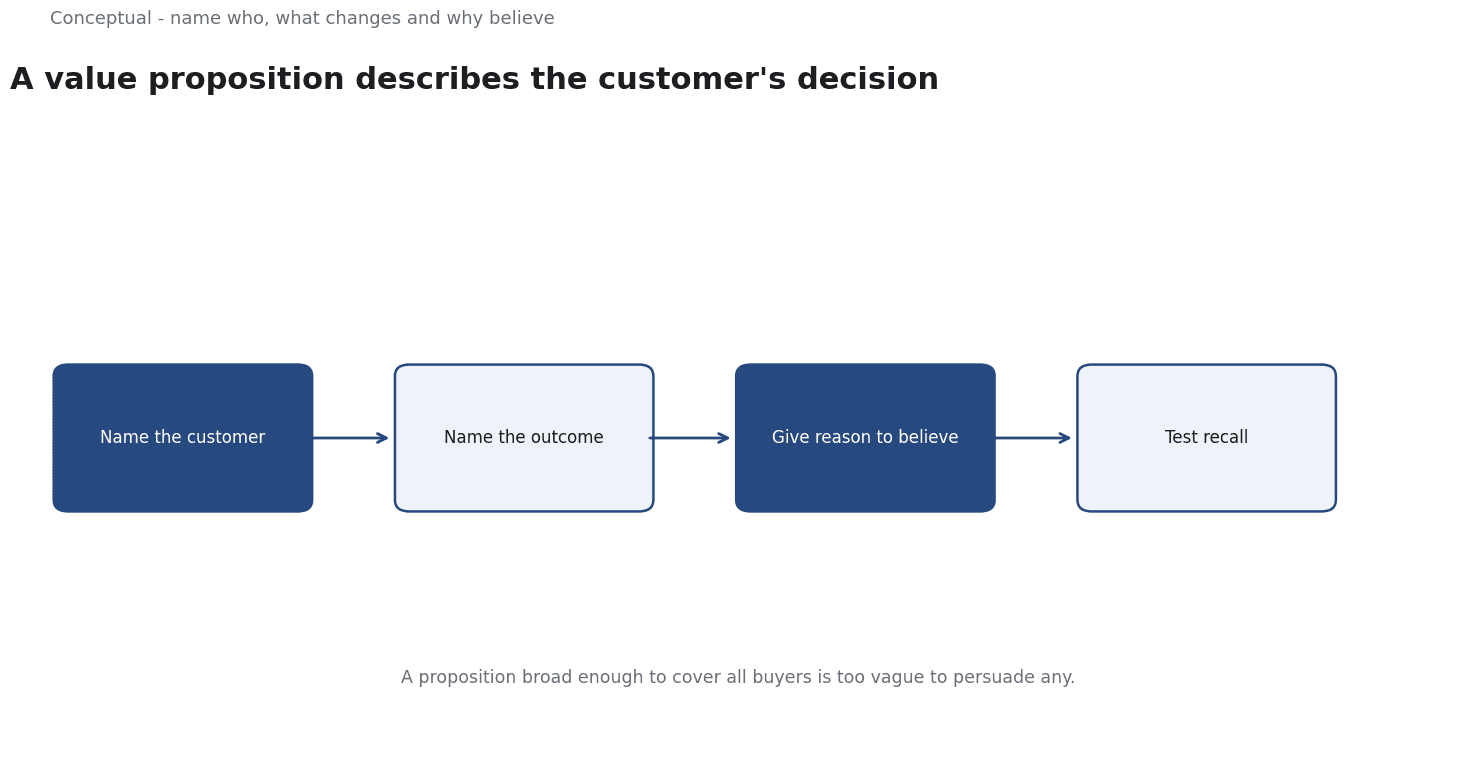
Three questions to answer first
Who is it for? A segment specific enough that a reader recognises themselves. "Businesses" is too broad; "finance teams preparing for an annual audit" is usable.
What changes? An outcome the customer values, ideally stated in terms they already use. "Faster" is weak unless the reader knows what becomes faster.
Why you? A reason grounded in something the business can defend — a mechanism, a documented result, or a structural advantage. "Better service" is a claim; a response-time guarantee with measured support is evidence.
These questions are a test of the underlying strategy. If the third has no good answer, the problem is not the wording.
A worked rewrite
The following is hypothetical and illustrative.
Before: "We offer a modern platform that helps teams work more efficiently with their data."
Problems: no named customer, no specific outcome, no reason to believe, and words that any competitor could use.
After: "For finance teams preparing an audit, our reconciliation tool cuts evidence-gathering from three days to four hours by matching transactions to source documents automatically. Unlike manual spreadsheet workflows, every figure keeps a traceable link to its source."
Three changes follow:
- The customer is named. A finance team with an audit coming recognises the situation.
- The outcome is measured, with a mechanism. "Three days to four hours" is a claim that needs a source, and "automatic matching" explains how.
- The comparison is explicit. "Unlike manual spreadsheet workflows" names the alternative, so the buyer knows what is being replaced.
Three checks make it honest:
- The time figure must come from a real measurement, with a stated context.
- The automatic matching must actually exist and work on the buyer's data.
- The alternative must be the one the buyer really uses, not a straw man.
From sentence to test
A value proposition is a hypothesis about what customers value. Three ways to test it:
The repeat-back test. Show the sentence to a target customer and ask what they think the product does. If their answer differs from yours, the proposition is unclear.
The landing-page test. Use the proposition as the headline and measure qualified conversion, as Landing Page Best Practices for B2B describes. A clear proposition should improve the rate at which the right visitors take the next step.
The sales-call test. Note whether prospects quote the proposition back when explaining why they bought. Their words are better evidence than internal approval.
Each test has a different failure mode: repeat-back catches ambiguity, landing-page tests catch irrelevance, and sales calls catch a gap between the promise and the delivered experience.
What a value proposition cannot do
It cannot fix an undifferentiated product. If a competitor can make the same claim truthfully, the issue is positioning or capability, not copy. Porter's point about fit applies: a distinctive position is supported by a system of activities.
It cannot replace evidence. A measured claim needs a source and a context. A number without a denominator invites disbelief from a careful buyer.
It cannot serve every segment.
Separate propositions for distinct segments are better than one compromise.
The counterargument — that a value proposition is just marketing language — is fair when it is written without strategy.
Done properly, it is a compact statement of the strategic choice, which is why it is hard to write and worth the effort.
A decision test
- Name the segment narrowly enough to be recognised.
- State the outcome in the customer's language, with a source for any number.
- Name the alternative the buyer actually considers.
- Give a defensible reason grounded in mechanism or evidence.
- Run the repeat-back test with target customers.
- Test on the landing page with qualified conversion as the metric.
- Revise when the product or the market changes, not on a writing schedule.
For the strategic frame, see Brand Positioning; for the page, see Landing Page Best Practices for B2B.
References & Further Reading
- Michael E. Porter, 1996. What Is Strategy? — The differentiation-versus-cost argument behind competitive-advantage analysis.
- Wikipedia contributors, 2026. Blue Ocean Strategy - Wikipedia — The strategy framing of creating uncontested market space rather than competing in an existing one; secondary reference.