Brand Positioning: Why Being Different Is More Important Than Being Better
Positioning is about the space a brand occupies in a customer's choice set. Read the mechanism and why trade-offs are what defend it.
"Better" is not a position. When a brand claims higher quality, better service, and greater convenience than its competitors, it has described its ambitions rather than its place in the market — and it has given the customer no reason to choose it in a specific situation. The more useful question is not how good the brand is, but what it is unambiguously for, and what it is willing to be worse at.
Direct answer: A brand position is a specific place in the customer's decision process, defined by the alternatives it displaces and the situations in which it wins. It is sustained by trade-offs rather than by adjectives, which is why a strategy that tries to be better on every dimension has no defensible position. The practical work is to choose the context in which the brand is the obvious answer, then align the activities behind that context so that competitors cannot imitate part of it without damaging their own position.
What positioning actually is
The word gets used to mean a tagline or a target demographic, and both are outputs.
The underlying object is a choice about which need, in which situation, the brand will serve better than any alternative.
That framing yields three questions that are more useful than "what is our brand about?":
- What situation triggers the choice? A purchase is made in a context — a deadline, a gift, a routine refill, a crisis. A position anchored to a situation is actionable; one anchored to an attribute is not.
- What is the alternative being displaced? Positioning is relative. "Better coffee" is not a position; "the coffee you buy when you are already late and still want it decent" is, because it names the occasion and the substitute.
- What must be true for this position to hold? That is the set of activities the business has to maintain, and the answer is usually operational rather than promotional.
A claim about the product can be matched by a competitor with a bigger budget. A claim about a decision — "we are the default when X" — implies a whole configuration of product, distribution, price, and service that a competitor would have to rebuild.
Trade-offs are what make a position stick
Porter's argument in "What Is Strategy?" supplies the mechanism, and it is as applicable to brands as to corporate strategy. "A strategic position is not sustainable unless there are trade-offs with other positions", and "trade-offs occur when activities are incompatible — more of one thing necessitates less of another".
For a brand, the trade-offs are visible in what it refuses:
- The premium brand that does not discount. Discounting would win the deal and destroy the position.
- The fast, cheap option that does not offer deep advice. Advice would raise cost and slow the interaction that the customer is buying.
- The expert brand that does not chase every segment. Serving everyone would make the product average for the people who valued the expertise.
These are not limitations imposed by lack of capability. They are deliberate restrictions, and they are the reason imitators struggle. A competitor that adds a premium line to a budget brand does not become premium; it creates a confusing sub-brand with none of the cost base or service model that made premium credible in the first place.
Porter's phrase for such a competitor is "straddler", and brand portfolios are full of them. The straddler fails because it has no incompatibilities — nothing it would have to give up — and is therefore easy to displace on each dimension by a brand that made a choice.
Messages are the output, not the work
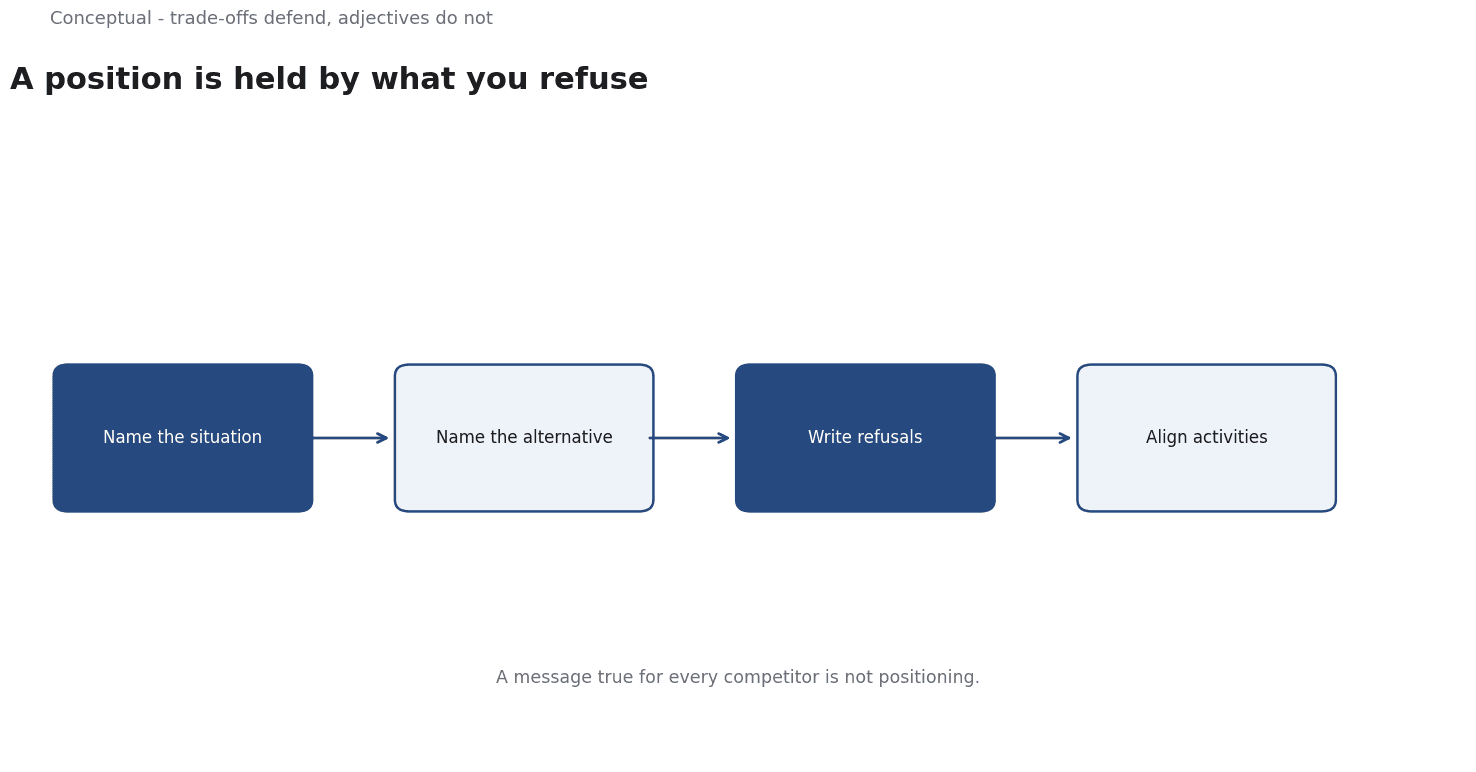
Brand teams tend to start with language, because language is cheap to change. The order that works is: position, activities, proof, message.
The activities come first because they determine what can be claimed truthfully. A brand promising reliability in a time-sensitive category needs the operations that produce reliability — stock, routing, support, staffing — and without them the message is a liability. This is the same logic as product-led growth teams organising around activation: the message describes a loop that has to actually exist.
The proof comes next, and the primary evidence beats the adjective. Retail and channel data from bodies such as the National Retail Federation lets a brand check its claims against how the market actually behaves — which channel, which occasion, which customer — rather than against internal belief. And published company material, such as Amazon's own account of working backwards from the customer, is useful not because the lessons transfer wholesale but because it shows what a position looks like when it is expressed as a sequence of operating decisions.
The message is final, and it should be narrow enough to be false for a competitor. If it is true for everyone, it is not positioning.
A way to work on your own brand
- Name the trigger situation, not the demographic. Who is the customer, in what moment, with what alternative in hand?
- Write the refusal list. The situations the brand will not serve, the customers it will not chase, the features it will not add. If the list is empty, the position is not chosen.
- Check the activity alignment. For each claim, name the operational thing that makes it true. If you cannot, the claim is not supported.
- Audit the portfolio for straddlers. Sub-brands that blur the parent's position usually cost more than the revenue they add, and they are hard to kill once they have a team.
- Test the message for imitability. If a competitor could run the same campaign tomorrow without changing anything, the campaign is not protecting anything.
- Re-check the trigger once a year. Situations shift; a position anchored to an occasion that no longer exists decays quietly while the spend continues.
For the corporate-level version of this argument, see How Companies Build Competitive Advantages; for how positioning becomes launch language, see Product Marketing.
A worked example
The following is hypothetical and illustrative. Consider a coffee brand with a budget line and a premium line whose spend is rising while growth is flat. It proposes a third sub-brand for "quality without compromise." Three checks follow the article's method. First, name the trigger: channel data of the kind the National Retail Federation publishes would be consulted to find the occasion where the brand is already the default, instead of assuming an attribute like quality. Second, write the refusal list: under Porter's trade-off argument, the team records what the new line must be worse at, because a position with no incompatibilities is a straddler. Third, test activity alignment in the working-backwards manner, naming the operational commitment behind each claim. If the first check finds no occasion, or the refusal list is empty, the sub-brand is shelved. The bounded outcome is a decision before launch: no new brand, spend redirected to the one occasion the data supports.
A counterargument
A fair critic could object that the hard line between "better" and "different" borrows Porter's trade-off argument without its scope conditions.
"What Is Strategy?" concerns firms whose activities are genuinely incompatible, and the article's examples - the premium brand that refuses to discount, the fast option that refuses deep advice - assume incompatibilities many brands cannot enforce because channel partners, not the brand, control the interface. Porter's "straddler" is presented as uniformly doomed, yet no evidence is offered that sub-brands fail more often than they succeed; that claim is asserted, not supported by the cited Amazon material, which documents working backwards rather than portfolio outcomes. National Retail Federation channel data is mentioned as a check on claims against behaviour, but channel data shows what sells, not whether a position is defensible.
References & Further Reading
- Michael E. Porter, 1996. What Is Strategy? — The differentiation-versus-cost argument behind competitive-advantage analysis.
- Colin Bryar and Bill Carr, 2019. Amazon Company News — Primary company material on how the working-backwards method is applied.