How to Write Subject Lines People Open
Subject lines decide whether a message gets a chance. Read the constraints, a worked test design, and why open rate is a weak score.
Subject-line advice is usually a list of tricks: use numbers, ask a question, add urgency. Tricks can lift an open rate in the short term and train a list to ignore you in the long term. The more durable approach treats the subject line as a promise that the message must keep.
Direct answer:
A subject line should describe the content accurately, respect the constraints of the inbox and the sender's reputation, and be tested against a clear outcome.
Gmail's sender guidelines govern whether the message is seen at all, and research standards from AAPOR remind us that a survey or test needs a defined population and question wording. The boundary: open rate is a noisy proxy — privacy features can register opens without a reader — so a subject-line test should be judged on downstream action, not on opens alone.
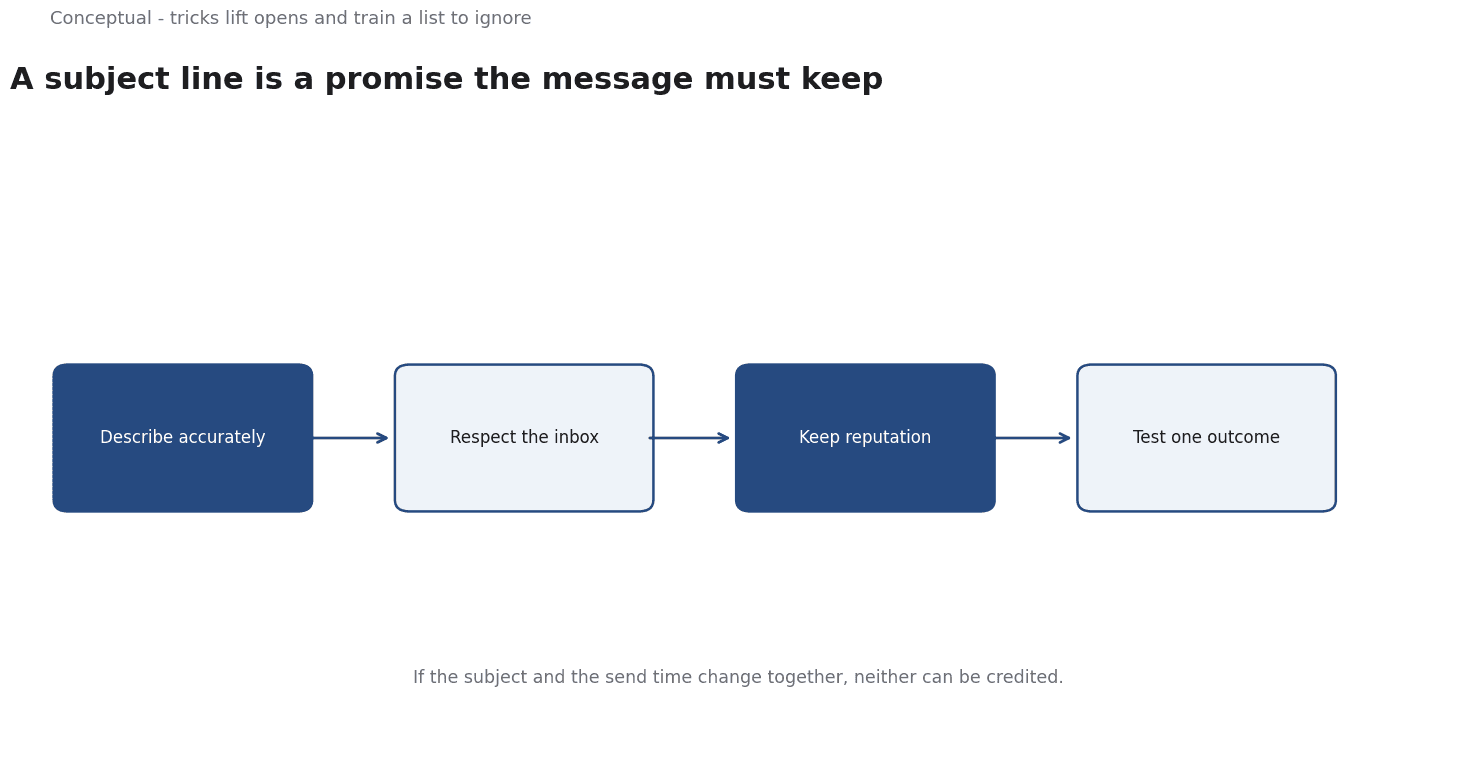
What a subject line has to do
Earn the open by describing value. The reader decides in a fraction of a second, using the sender name and the subject together. A specific promise — "Your March invoice is ready" — beats a vague one — "Important update" — because the reader can predict the content.
Match the message. A subject that overpromises produces opens and then disappointment, which shows up as unsubscribes and complaints. Those damage reputation, as the sender guidelines make clear.
Survive the preview. Many clients show the first line of the message next to the subject. If the subject and preview contradict each other, the reader trusts neither.
Work on a phone. Most messages are read on small screens. Long subjects are truncated, so the important words belong at the front.
A worked test design
The following is hypothetical and illustrative.
A newsletter sends to 50,000 subscribers and wants to test two subject lines for an issue about pricing changes.
- Version A: "Important pricing update"
- Version B: "What changes in your plan on 1 June"
A valid test has four elements:
- Random assignment. Split the list randomly into two equal groups, not by geography or signup date, so the groups are comparable.
- One variable. The message body, send time, and sender name stay identical. Only the subject changes.
- A primary metric with a window. Define the outcome — clicks to the pricing page within 48 hours — before the test. Opens are a diagnostic, not the decision metric.
- A minimum sample. With 25,000 per group, a small difference in click rate can be detected. A test on 200 subscribers cannot.
Three outcomes are possible:
- B wins on clicks and does not raise complaints → adopt the specific-subject pattern.
- The two are indistinguishable → the subject did not matter; keep the clearer one and test something else.
- B wins on opens but not clicks → the subject generated curiosity without delivering value, which is a warning about the content, not a subject-line success.
Three lessons follow:
- Clicks are a better decision metric than opens, because they require action.
- Complaints are a guardrail. A subject that wins opens but raises complaints is a loss.
- Tests need a defined population and wording, which is the research principle AAPOR publishes for surveys.
What to stop doing
Fake urgency. "Last chance" repeated weekly trains readers to discount it and can attract spam complaints.
Clickbait. A subject that promises one thing and delivers another improves one metric and degrades the relationship. The email-metrics article explains why unsubscribes and complaints are leading indicators.
Keyword stuffing. Piling promotional words into a subject line reduces clarity and can trigger filtering. The sender guidelines reward wanted mail, not keyword density.
Testing one variable at a time is not optional.
The counterargument — that a rigorous test is too slow for a weekly newsletter — is fair.
The response is to accumulate tests rather than run them all at once: one clean test per send builds a body of evidence over a quarter.
What a test cannot prove
Context changes. A subject that works for a pricing update may fail for a product launch. Treat results as pattern evidence, not universal rules.
List composition matters. A test on engaged subscribers may not generalise to inactive ones. State which population was tested.
Opens are unreliable. Privacy features preload images and register opens without a reader. A test that optimises opens may optimise a measurement artefact.
A decision test
- Describe the message in one sentence before writing the subject.
- Put the distinguishing words first for small screens.
- Keep the subject and preview consistent.
- Randomise the test and change one variable.
- Choose a downstream metric with a defined window.
- Watch complaints and unsubscribes as guardrails.
- Keep results by message type, not as a single rule.
For the broader measurement frame, see Email Marketing Metrics; for test design, see A/B Testing.
References & Further Reading
- Google, 2026. Email sender guidelines - Gmail Help — A major mailbox provider's published sender requirements and bulk-sender recommendations.
- American Association for Public Opinion Research, 2026. AAPOR — The professional association for public opinion and survey research; its standards and resources underpin the survey-design discussion.