Index Investing Explained
Index investing is often sold as effortless. Read how tracking an index works, what costs and trade-offs remain, and a test for deciding when it fits.
Index investing is often presented as a passive choice that removes the hard decisions from investing. The real problem is that an index fund still requires decisions about which market to track, what costs to accept, and how to behave when the tracked market falls. Those decisions are frequently hidden inside the phrase "just buy the index."
Direct answer: An index fund is a fund designed to replicate the performance of a specified market index by holding its constituent securities in similar proportions, as Wikipedia's entry on the term describes.
The appeal is diversification and lower costs than active management, but the investor still owns the market's risks and still chooses the index.
Damodaran Online supplies long-horizon return and valuation data that can frame those choices without removing them.
Delta: This article adds a decision framing beyond the sources: it maps the mechanics of index replication and the availability of long-run return data to the specific question of when index investing fits a given investor, with claim status explicit.
The mechanism
Wikipedia's "Index fund" entry describes an index fund as a mutual fund or exchange-traded fund constructed to replicate the performance of a particular market index. The mechanism is replication: the fund holds the index's constituent securities in roughly the weights they carry in the benchmark, so its return tracks the benchmark rather than a manager's judgment. The practical consequence is that the investor accepts the market's return by construction. There is no mechanism for outperformance, because outperformance would require deviating from the index, and the fund's rules forbid that deviation.
The same entry emphasizes broad holdings and low costs. By spreading exposure across many securities, an index fund reduces the impact of any single company's poor performance. Low portfolio turnover and passive management keep trading and management costs down. The consequence is twofold: company-specific risk is diversified away, and the cost drag that compounds over long holding periods is smaller than under active management. The other side of the same mechanism is that systematic risk cannot be diversified away. When the whole market falls, an index fund falls with it, and the low-cost structure offers no defense.
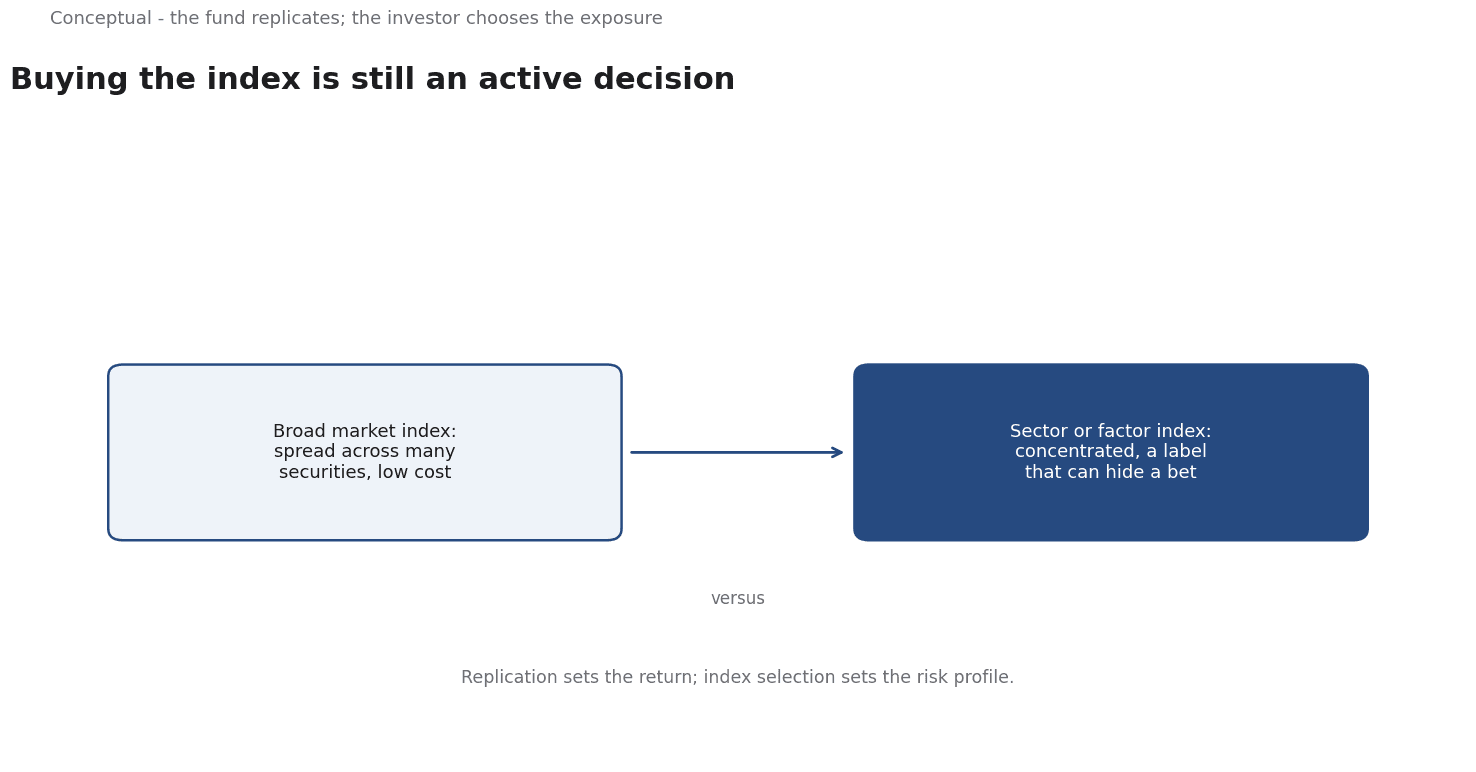
A subtle point in the mechanism is that choosing an index is itself an active decision. Two investors who both "buy the index" can own very different things: one tracks a broad domestic market, another a narrow sector or a foreign region, and a third a factor-weighted variant. The fund replicates whatever benchmark it is given, so the risk profile is set at the index-selection step, not at the purchase step. The practical consequence is that the hard thinking happens before the trade, and a label that sounds neutral can hide a concentrated bet.
Damodaran Online, the data resource by Aswath Damodaran at NYU Stern, supplies long-horizon return, risk premium, and valuation series that are widely used to frame such decisions. The mechanism here is expectation setting: historical series give an investor a sense of the trade-off between risk and return across asset classes. The practical consequence is bounded. Historical averages are descriptions of the past, not forecasts, and the data can inform an assumption about future risk without guaranteeing any outcome. Used well, they turn a vague belief that markets rise into a testable set of assumptions.
A worked example
The following is hypothetical and illustrative. An investor with a twenty-year horizon is choosing between a broad-market index fund and a narrow sector fund, attracted by the sector's recent strong returns. Three checks structure the decision. First, the replication check: what does each fund actually hold, and how concentrated are the sector fund's largest positions? Second, the cost check: what are the expense ratios and turnover, and how would a small annual difference compound over the horizon? Third, the data check: what do long-horizon return and risk-premium series say about the sector's historical volatility relative to the broad market? The outcome is a decision rule. If the sector's concentration is acceptable and the historical premium compensates for its volatility, it may have a role as a small sleeve; otherwise the broad-market fund is the default. The limitation is that past series cannot confirm future returns.
Evidence status
| Claim | Status | Source | Verified | Recheck when |
|---|---|---|---|---|
| An index fund is built to replicate a market index | source-reported | Index fund - Wikipedia | 2026-11-18 | when the entry's definition or scope changes |
| Broad holdings and passive management keep costs low | source-reported | Index fund - Wikipedia | 2026-11-18 | when fund fee structures change materially |
| Long-horizon return and valuation data are available to frame expectations | source-reported | Damodaran Online | 2026-11-18 | when the data library's coverage or method changes |
| Historical return data inform expectations but do not guarantee outcomes | inferred | Derived from the sources | 2026-11-18 | when new evidence on return predictability appears |
The first three rows report claims stated by the two sources and can be checked directly against them. The fourth is an inference: it follows from combining a replication-based fund with historical data, but neither source states it as a rule. Recheck conditions point to source changes or to new evidence, which keeps each row's status explicit rather than assumed.
What it cannot do
The central limit is that an index fund cannot outperform the index it tracks, and it cannot protect the investor when that index falls. Replication is the whole mechanism, so any expectation of beating the benchmark is a misunderstanding of the product. In a broad market decline, the fund declines with the market; there is no cash buffer, no defensive tilt, and no manager discretion to raise cash. An investor who expects index investing to limit downside has mistaken diversification for protection. Diversification removes company-specific risk, but it leaves the systematic risk that dominates in a crisis.
A hidden cost lies in the decisions that remain after the index is chosen. Funds tracking the same index can differ in expense ratio, tracking error, sampling method, and tax efficiency. Small differences in cost compound over long horizons, so the "cheap" label is only true relative to a specific alternative. There is also a subtler cost: an index that looks diversified may be concentrated in a few large constituents or a single sector, so the investor carries concentration risk while believing they own the whole market. That cost is not visible in the fund's headline name.
A common failure mode is behavioral rather than structural. Index investing reduces the frequency of decisions, which is a strength, but it does not remove the decision to sell when markets fall.
The mechanism works over long horizons precisely because it stays invested through short-term pain. When the investor cannot tolerate that pain, the product fails in practice even though it performed exactly as designed.
There are settings where a simple index allocation is the wrong tool. Liabilities with a fixed date and amount, such as a near-term obligation, may require a cash or bond ladder rather than an equity index whose value at the needed date is unknown. Goals that depend on capital preservation cannot be met by an instrument designed to ride market cycles. An investor with a very short horizon or a low tolerance for loss is outside the boundary where index equity investing is appropriate, and forcing the fit produces a portfolio that is technically diversified but personally unsustainable.
Index investing also needs scheduled review because both the investor and the index drift. A target allocation that was right a decade ago may no longer match a changed horizon or risk tolerance, and the index's composition changes over time as constituents are added and removed. A rebalancing discipline keeps the portfolio aligned with the intended exposure, and a periodic check of costs and tracking quality keeps the chosen fund honest. Without that review, the investor owns a portfolio that quietly changed shape and a set of assumptions that quietly went stale.
The counterargument that index investing is too blunt to meet specific goals is fair for investors with fixed liabilities or short horizons and incomplete for long-horizon investors, for whom low costs and broad exposure are a disciplined default.
A decision test
- Define the goal and the horizon the investment must serve.
- Identify exactly which index each candidate fund tracks and what it holds.
- Compare costs, tracking error, and method across funds tracking the same index.
- Check the concentration of the index, not just its label.
- Use long-horizon return and risk data to set bounded expectations.
- Confirm the allocation tolerates the declines the index historically experiences.
- Set a rebalancing and review cadence, and record the reasoning.
These steps move the question from "which fund is best" to "which exposure fits this decision." The mapping from index mechanics to investor decisions is what makes the review concrete rather than theoretical. A passed test leaves a clear record of the expected risks and the reason for choosing one exposure over another, not just a fund name.
For further reading, see Cash Flow Forecasting: A 13-Week Operating Model.
References & Further Reading
- Wikipedia contributors, 2026. Index fund - Wikipedia — Funds that track a market index.
- Aswath Damodaran, 2026. Damodaran Online: Home Page for Aswath Damodaran — Publicly maintained datasets for industry averages, WACC, and valuation.