Interest Rate Risk: Common Questions
Rate risk changes value before cash flows change. Read the common questions, a worked example, and why a fixed rate is not no risk.
Interest-rate risk is often described as the chance that rates rise, which misses that the direction matters differently for different positions. The Wikipedia entry describes exposure to changes in rates, and the yield-curve entry covers how yields vary with maturity. The common questions concern what actually moves.
Direct answer:
Assess interest-rate risk by identifying what is exposed, over what horizon, and how a change in the curve affects it.
The sources describe the instrument and the curve; the method is a synthesis.
Delta: This article adds a claim-status table and a worked example, separating documented concepts from local judgements about exposure.
The mechanism
The first question is what is exposed. The interest-rate-risk entry describes value changing with rates. A borrower with a floating rate faces a different exposure from a holder of a long-dated bond, and the same rate move affects them in opposite directions.
The second question is the shape of the curve. The yield-curve entry describes yields across maturities, which means a change is not uniform. A position can gain at one maturity and lose at another, so a single rate figure is an incomplete description of the risk.
The third question is the horizon. A rate change affects market value immediately and cash flows over time, which matters differently depending on when the position must be closed. Defining the horizon is the step that makes the analysis useful.
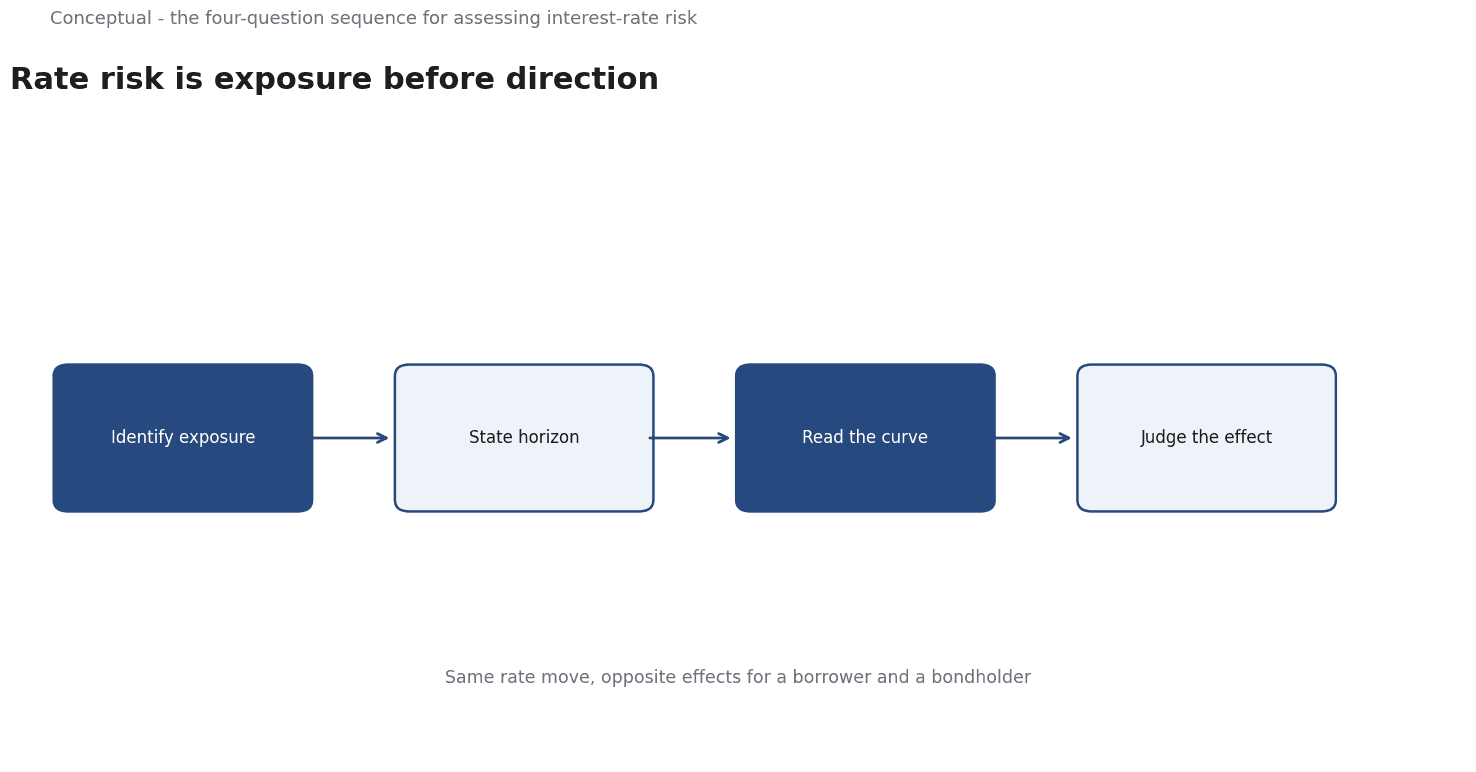
The sequence is: identify the exposure, state the horizon, read the curve, then judge the effect. The judgement is local, so the conclusions are inferred; the concepts are source-reported.
Worked examples
Illustrative. A company with floating-rate debt considers a rise in rates.
Three checks decide. First, when does the debt reprice, and how much of it is exposed? Second, what would happen to the cash obligation under a higher rate? Third, does the company's revenue rise with rates, which would offset the cost?
A second example: a holder of long-dated bonds sees market value fall while the contractual payments remain unchanged. The loss is a change in value, not a missed payment.
The outcome is a defined exposure rather than a general worry. The scenarios are hypothetical; the method is the contribution.
Evidence status
| Claim | Status | Source | Verified | Recheck when |
|---|---|---|---|---|
| Interest-rate risk is exposure to rate changes | source-reported | Wikipedia, Interest rate risk | 2026-11-18 | Definition changes |
| Yields vary across maturities | source-reported | Wikipedia, Yield curve | 2026-11-18 | Definition changes |
| Identify exposure before judging direction | inferred | Derived from the concepts | 2026-11-18 | Position changes |
Why a fixed rate is not no risk
A position locked at a rate can be worth less than a current alternative, which is a real effect even when the contractual payments are unchanged.
A further point is that a position's exposure changes over time. A loan that reprices monthly and one that reprices yearly face the same rate change on different schedules, and the timing affects the cash impact. Reading the terms is part of the assessment, not a detail to leave to a model.
The common questions also touch on hedging. A hedge can reduce one exposure while creating a basis risk, because the instrument and the underlying position do not move identically. Stating what remains after the hedge is the honest measure, and it is more useful than a claim that risk was eliminated.
None of this predicts the direction of rates. The assessment describes what happens under different moves, which is a different and more achievable goal than forecasting.
The horizon should be written down, since the same rate move means different things to a borrower and a lender.
A fixed rate removes repricing but not the change in market value, which is a separate exposure.
The assessment should name what would change it, since an exposure evolves with the instrument.
Dated yield data is the precondition for a reproducible assessment.
A hedge reduces one exposure while leaving another, which should be stated explicitly.
What it cannot do
It cannot predict rates. It does not remove the need to read the instrument's terms. And it cannot guarantee that a hedge will be perfect.
The counterargument that only floating-rate debt carries risk is fair for repricing and incomplete for market value.
A decision test
- Identify the exposure.
- State the horizon.
- Read the curve.
- Check cash and market effects.
- Use dated yields.
- Record the assessment and recheck condition.
For the measure, see Duration Risk.
References & Further Reading
- Wikipedia contributors, 2026. Interest rate risk - Wikipedia — Exposure of value to changes in rates.
- Wikipedia contributors, 2026. Yield curve - Wikipedia — The relationship between yields and maturities.