Insurance Basics for Small Teams
Insurance transfers a risk you cannot absorb. Read the basics, a worked review, and why a policy is not a substitute for controls.
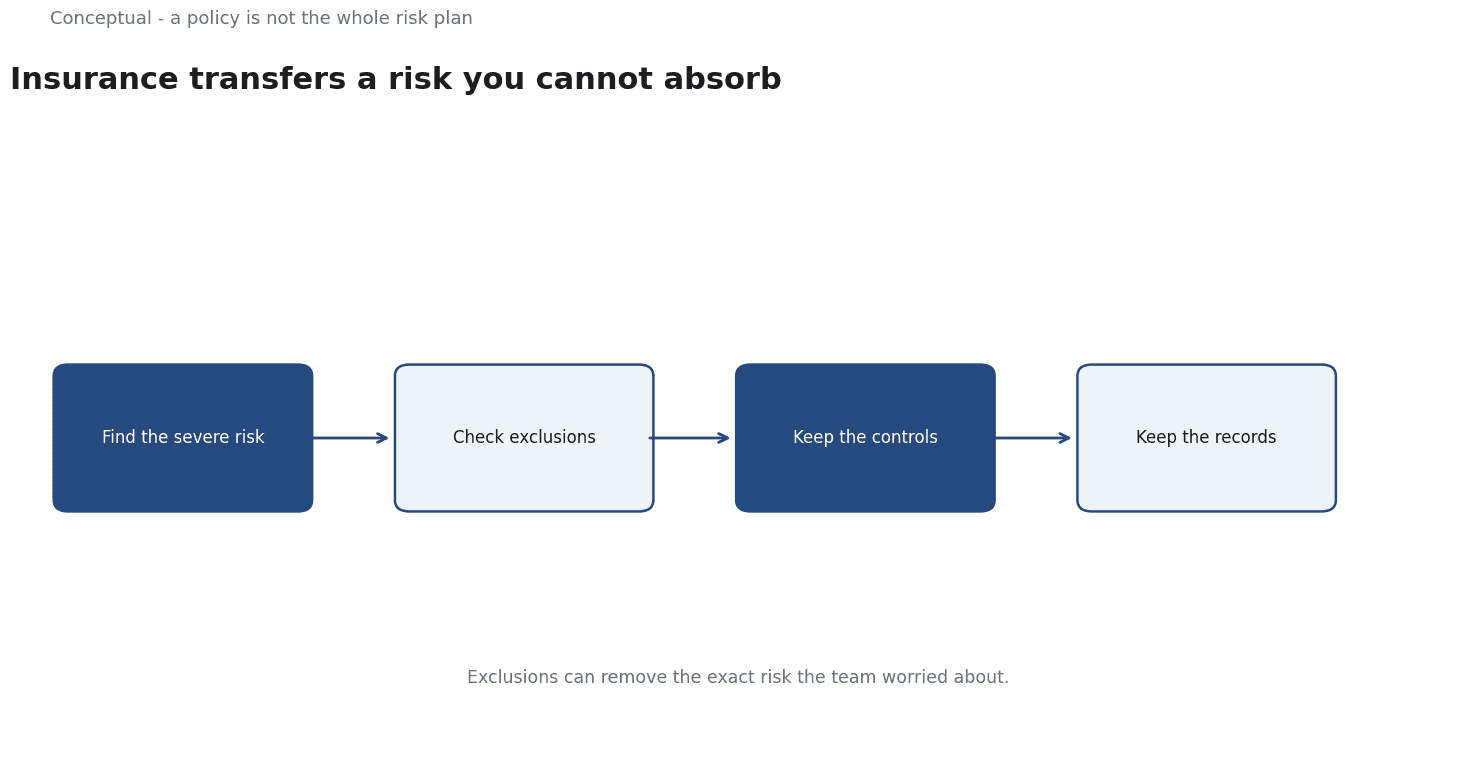
A small team buys insurance to handle a loss it could not absorb, which is the basic mechanism of risk transfer. The mistake is treating a policy as the whole risk plan: deductibles, exclusions, and limits decide what is actually covered, and the team still owns prevention and records, as AI Risk Assessment: A Pre-Deployment Checklist treats residual risk as something to state, as the incident-response article treats containment as a designed process.
Direct answer:
Buy insurance for risks that are severe and hard to self-insure, read the exclusions and limits, and keep the controls that reduce the chance of a claim.
Wikipedia's insurance entry explains the mechanism, and Investor.gov provides general investor education. The boundary: this is educational orientation, not insurance or legal advice — policies are jurisdiction-specific and change, as the legal and tax articles treat current terms as requiring a dated check, as the publication standard forbids guaranteed outcomes.
The basics
What is transferred. An insurer takes on a defined risk in exchange for a premium, which the insurance entry explains for the pooling mechanism, as the unit-economics article treats the premium as a cost with a rationale, as the cash-flow-forecasting article requires for a recurring expense.
What is retained. Deductibles and exclusions leave part of the risk with the team, which the insurance entry describes, as AI Risk Assessment: A Pre-Deployment Checklist requires you to state residual risk, as Emergency Fund: How Much You Actually Need treats a cash buffer as a separate layer.
What the limit means. A policy cap can be below the plausible loss, which the risk-assessment article treats as a residual exposure, as the scenario-analysis article advises for estimating severity, as the decision-memo article requires for a recorded judgement.
What still must be done. Controls that prevent the loss remain, which the incident-response article treats as containment, as the security-checklist article requires per-tool controls, as the data-governance article requires records for any claim.
Three consequences follow. The policy should match a real exposure, as AI Risk Assessment: A Pre-Deployment Checklist requires, as the scenario-analysis article advises for severity. The terms should be checked with current documents, as the legal article requires a dated check, as the term-sheet article treats formal conditions as the substance. And the coverage should be reviewed when the business changes, as the monitoring article treats as a trigger.
A worked review
The following is hypothetical and illustrative. A small consultancy holds client data and travels for work.
Three checks decide the review. First, what losses are plausible and severe, as the risk-assessment article asks, with scenarios for data loss and travel incidents, as the scenario-analysis article advises? Second, what do the policy's deductible, exclusions, and limit leave uncovered, which the insurance entry treats as retained risk, as the residual-risk rule requires? Third, do prevention controls and records exist, as the incident-response and data-governance articles require, so a claim can be supported?
Three conclusions follow. A policy with a low limit still leaves a large exposure, which the residual-risk check reveals.
And the review should be recorded with the assumptions, as the decision-memo article requires.
What insurance cannot do
It cannot remove risk, which the insurance entry treats as transfer, as AI Risk Assessment: A Pre-Deployment Checklist requires residual risk to be stated. It does not replace prevention, which the incident-response article treats as containment, as the security article requires controls. And it cannot guarantee a payout, which the publication standard forbids claiming, as the legal article requires a dated check of actual terms.
The counterargument that insurance is the whole risk plan is fair for severe risks and incomplete for the frequent small losses a team should prevent or buffer, which the emergency-fund article treats as a separate layer, as the worked review shows.
A decision test
- List plausible severe losses, as AI Risk Assessment: A Pre-Deployment Checklist requires.
- Check the deductible, exclusions, and limit, as the insurance entry advises.
- Identify what remains with the team, as the residual-risk rule requires.
- Keep prevention controls, as the incident-response article advises.
- Keep records that support a claim, as the data-governance article requires.
- Check current terms with qualified advice, as the legal article requires.
- Record the review and revisit on change, as the decision-memo article requires.
For the risk method, see AI Risk Assessment; for the buffer, see Emergency Fund.
References & Further Reading
- Wikipedia contributors, 2026. Insurance - Wikipedia — The mechanism of risk transfer, premiums and claims.
- U.S. Securities and Exchange Commission (Investor.gov), 2026. Introduction to Investing — Primary regulator guidance on market mechanics and investor protection.