Internal Linking: Common Questions
Internal links shape crawl and rank, but common questions recur. Read the mechanism, a worked check, a claim-status table, and what links cannot prove.
Internal linking attracts the same questions on almost every site: how many links are enough, does anchor text matter, should internal links be nofollowed, and do deep links help? The Wikipedia entry on internal and external links and Google's SEO Starter Guide answer these in terms of navigation and discovery rather than quotas. The real problem is replacing folklore about link counts with checks that show whether a page can be found and understood.
Direct answer: Internal links connect pages within one site and help crawlers discover content and understand structure. Google's starter guide emphasises crawlable pages and descriptive anchor text.
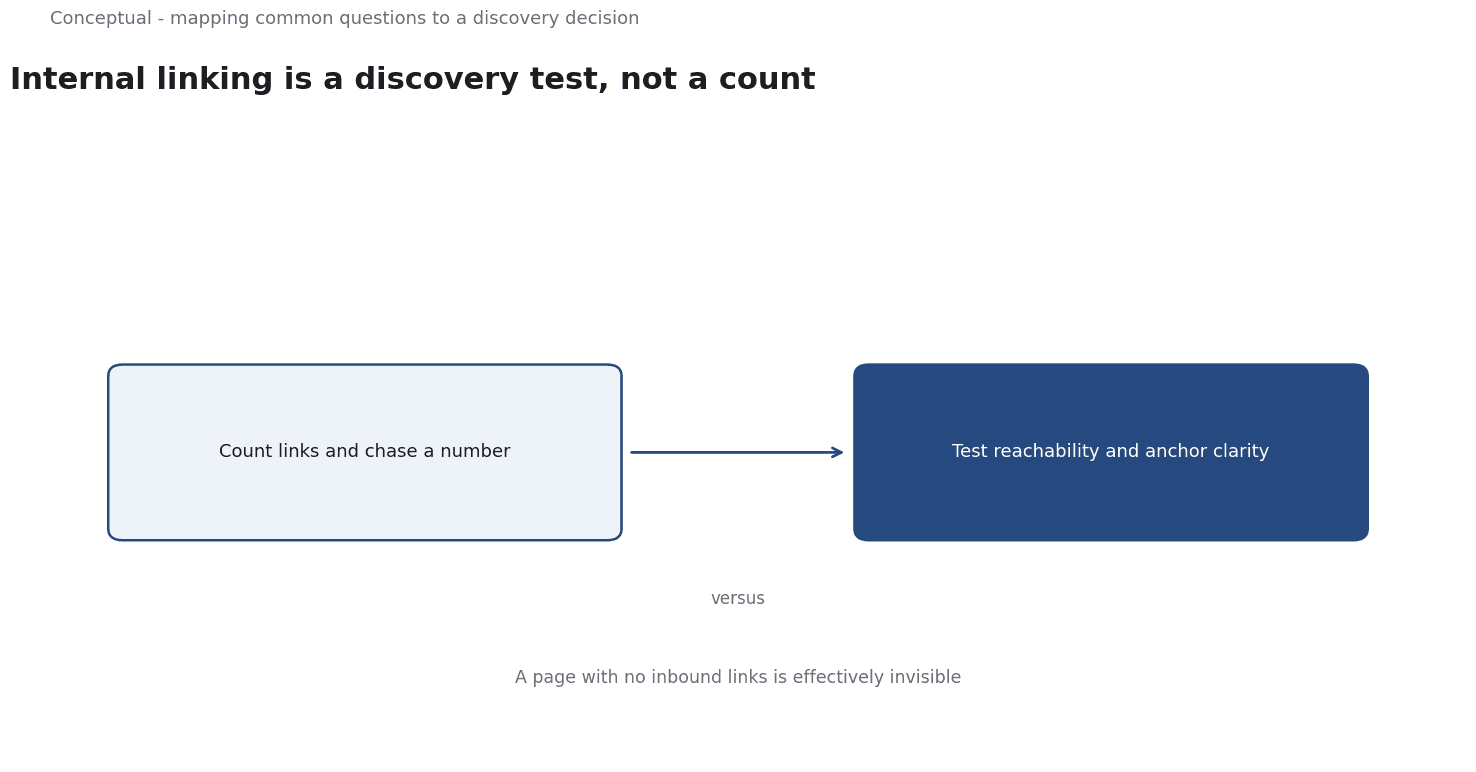
Answer the common questions by testing reachability and clarity, not by counting links or chasing a target number.
Delta: This article adds a reachability test beyond the sources: it maps common internal-linking questions to a discovery decision, with claim status explicit.
The mechanism
Wikipedia defines an internal link as a hyperlink from one page to another page on the same site, in contrast to an external link that points to a different domain. Its practical role is navigation and structure. Links let people and crawlers move between pages, and the pattern of links communicates which pages are central and how content is grouped. Link structure is one of the main ways a site expresses hierarchy without a formal map, and it is why a page with no inbound links can be effectively invisible.
Google's SEO Starter Guide focuses on the basics that make this work. Pages need to be crawlable and indexable, and descriptive anchor text tells both users and search engines what the destination is about. The guide treats internal links as a way to help discovery and recommends sensible structure, including navigation and breadcrumbs, so that both people and crawlers can move through a site. The emphasis is on usefulness: a link should help someone reach a relevant page, and the words used should describe that page.
The recurring questions are better answered by asking what a link accomplishes than by applying a rule of thumb. A link exists to be followed and understood. If a page cannot be reached by following links from the rest of the site, or if every anchor says "read more" and gives no clue about the target, the mechanism has failed whatever the link count. The nofollow question follows the same logic: a directive that stops a link from passing signals has a place for untrusted external links, but it works against the discovery purpose of an internal link.
The synthesis is to map each common question to a discovery decision. That mapping is a judgement about how to apply the two sources, not a claim that either source states. Marking it as inferred keeps the mapping distinct from the documented facts about links and crawlability, and it makes the boundary of the advice clear to a reader who wants to know what is guaranteed and what is a working method.
A worked example
The following is hypothetical and illustrative. A team finishes a new article and asks whether to add more internal links to it. The first check is reachability: can the article be found by following links from navigation or from related pages, or is it orphaned? The second check is anchor clarity: do the links pointing to it use words that describe the destination, rather than the same generic phrase repeated across the site? The third check is structure: does the article sit inside a coherent section, or is it detached from any topic grouping? The outcome is that the article is orphaned, and a few descriptive links from relevant pages fix discovery, while adding dozens of generic links would not. The scenario is invented; the concepts come from the sources.
Evidence status
| Claim | Status | Source | Verified | Recheck when |
|---|---|---|---|---|
| Internal links connect pages within a site and support navigation and hierarchy | source-reported | Internal and external links (Wikipedia) | 2026-11-18 | Entry is substantively revised |
| Google's starter guide recommends crawlable structure and descriptive anchors | source-reported | SEO Starter Guide: The Basics (Google) | 2026-11-18 | Google guidance is updated |
| Reachability and anchor clarity are better tests than link counts | inferred | Derived from the sources | 2026-11-18 | Site structure or guidance changes |
The first two rows are claims the sources make. The third is a test assembled from them, not a finding of either source, so it is marked inferred. Its usefulness depends on the site's structure and on current guidance, and it should be rechecked when either changes. Recording that condition keeps the advice from being treated as a permanent rule.
What it cannot do
Internal links cannot make a page rank. They help crawlers discover pages and help users navigate, and the starter guide frames them as part of the basics of an accessible site. Discovery is not a ranking guarantee. A perfectly linked page can still fail to rank because of its content, its competition, or factors outside the site's control. Evaluating internal linking as if it were a ranking lever will misread what the evidence supports, and a rise in links is not evidence that a ranking problem was solved.
The hidden cost is that more links are not neutral. Boilerplate links repeated in a footer or sidebar add volume without helping anyone choose a destination, and they dilute the clarity that descriptive anchors provide. Sitewide links can crowd the links that actually matter and make it harder for a crawler to identify which pages a site considers important. The sources emphasise structure and usefulness, so a link added only to satisfy a count works against the purpose the link is supposed to serve.
A page published without any inbound internal link can exist on the server yet be hard for crawlers and users to reach, and because nothing points to it, its absence from discovery looks like a content problem. Generic anchor text is a related failure: links that say "click here" or "learn more" give no information about the target, so both users and crawlers lose the signal the link could have carried. Broken links and misapplied nofollow directives compound the problem by removing or weakening paths that were meant to help.
The boundary is between discovery and influence, and between internal and external links. Internal links organise a single site; external links point beyond it and carry different considerations, including trust. A sitemap can list a page, but it does not replace the navigational context that links provide. Confusing these roles leads to the wrong fix: adding a sitemap entry when the real problem is an orphan page, or treating an internal nofollow as a ranking tactic when it mainly blocks discovery. The two sources describe distinct mechanisms, and each question should be answered with the right one.
Because sites change, link structure decays. Pages are added and removed, navigation is redesigned, and sections drift apart, so a structure that worked at launch can leave new pages isolated. That decay needs an owner and a review condition. The sources explain what internal links are and what basics Google recommends, but they do not provide a maintenance schedule. Setting one locally is what keeps internal linking a checked part of site structure rather than a one-time cleanup.
Counterargument: "The counterargument that internal linking is just navigation is fair for a small site where every page is one click away and incomplete where large structures decide which pages are discovered at all."
A decision test
- Name the page whose discovery you want to improve.
- Check that it can be reached by following links from the site.
- Inspect the anchors pointing to it for descriptive wording.
- Confirm the page sits within a coherent section or topic group.
- Look for broken links and internal links with nofollow on the path.
- Add a small number of relevant, descriptive links rather than many generic ones.
- Assign an owner and recheck the structure after navigation changes.
The test turns a recurring question into a short diagnostic. Each step asks whether a page is reachable and understandable, and the final steps keep the structure current. A passing check is not a ranking promise; it is evidence that the page is discoverable and that the links describing it were chosen deliberately.
For further reading, see What AI Search Actually Measures.
References & Further Reading
- Wikipedia contributors, 2026. Internal and external links - Wikipedia — Links within a site and their structure.
- Google, 2026. SEO Starter Guide: The Basics — The search engine's own description of what it needs from a site.