Inventory Financing for Beginners
Inventory ties up cash before it becomes revenue. Read how financing works, a worked example, and why more stock is not always growth.
Inventory financing is often treated as a way to buy more stock, which ignores that the stock must still sell. The Wikipedia entry describes inventory in operations, and the cash-flow entry covers the movement of money through a period. The decision starts with the cash cycle.
Direct answer: Finance inventory only when the expected sale covers the cost of capital and the risk of unsold stock. The sources describe inventory and cash flow; the decision rule is a synthesis.
Delta: This article adds a claim-status table and a worked example, separating documented concepts from local judgements about demand and cost.
The mechanism
The first point is that inventory is cash in another form. The inventory entry describes stock in operations and accounting. Money spent on goods is unavailable for other uses until those goods sell, which is the cost that financing addresses.
The second point is the cash cycle. The cash-flow entry describes how money moves through a period. Financing can bridge the gap between paying a supplier and collecting from a customer, but it does not remove the gap. It changes who carries it and at what cost.
The third point is risk. Stock that does not sell still has to be financed, stored, and eventually written down.
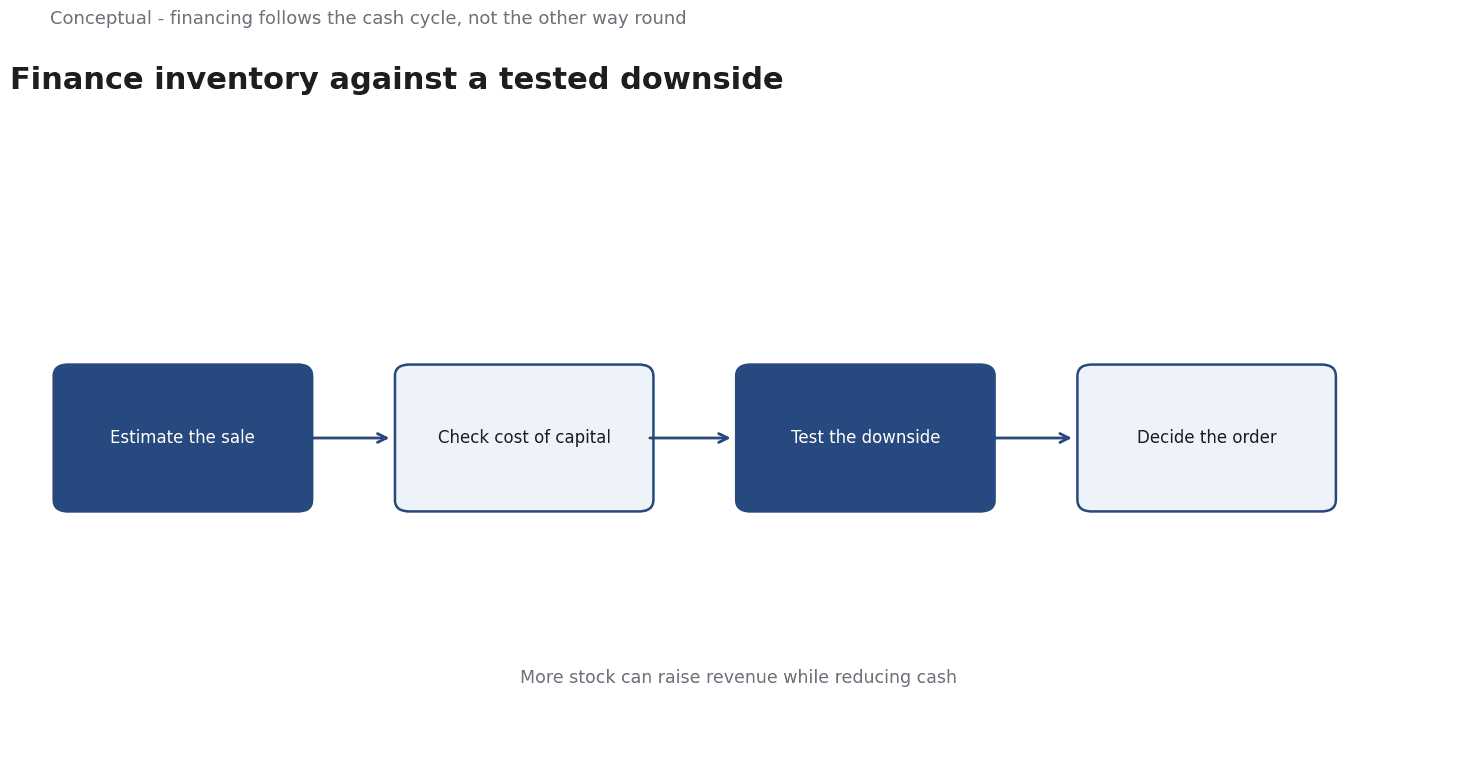
The sequence is: estimate the sale, check the cost of capital, test the downside, then decide. The estimates are local, so the conclusions are inferred; the concepts are source-reported.
A worked example
Illustrative. A retailer considers borrowing to double an order before a season.
Three checks decide. First, what is the expected sell-through and over what period? Second, what does the financing cost over that period, including interest and fees? Third, what happens if only half the stock sells, and can the remainder be disposed of without a loss?
The outcome is a decision with a recorded downside. The scenario is hypothetical; the method is the contribution.
Evidence status
| Claim | Status | Source | Verified | Recheck when |
|---|---|---|---|---|
| Inventory represents stock in operations | source-reported | Wikipedia, Inventory | 2026-11-18 | Definition changes |
| Cash flow describes money moving through a period | source-reported | Wikipedia, Cash flow | 2026-11-18 | Definition changes |
| Finance against a tested downside | inferred | Derived from the concepts | 2026-11-18 | Demand changes |
Why more stock is not growth
A larger order can raise revenue while reducing cash, which is why the financing question cannot be separated from the sell-through question. Growth that consumes cash faster than it generates it is a different proposition from growth that funds itself.
A practical concern is the cost of capital relative to the margin on the goods. A product with a thin margin cannot carry expensive financing for long, and a small delay in selling can erase the profit entirely. The comparison should therefore include the interest cost against the expected margin, not just against the purchase price.
The financing arrangement itself also has terms that matter. A facility that is withdrawable on short notice creates a risk that the stock cannot be sold in time to repay it, which is a mismatch between the asset and the liability. Reading those terms is part of the decision, and it is a task that belongs to the person making the order.
Finally, a Beginner should recognise that financing does not remove the need to understand demand. It makes the consequence of a mistake faster and larger, which is a reason to improve the forecast before increasing the order.
The order and the financing should be decided together, since each changes the risk of the other.
A conservative order with cheaper financing is often a better decision than a large order that assumes everything will sell.
The sell-through assumption should be tested against a conservative case, since that is the case that determines whether the financing can be repaid.
What it cannot do
It cannot create demand. It does not guarantee that the stock sells. And it cannot remove the cost of unsold inventory.
The counterargument that financing is free because the sale pays for it is fair when the sale is certain and incomplete when it is not.
A decision test
- Estimate sell-through and period.
- Compute the cost of capital.
- Test the downside.
- Check storage and disposal.
- Use dated figures.
- Record the decision and recheck date.
For the cash view, see Working Capital.
References & Further Reading
- Wikipedia contributors, 2026. Inventory - Wikipedia — The role of stock in operations and accounting.
- Wikipedia contributors, 2026. Cash flow statement - Wikipedia — Operating, investing and financing activities, and why net income and cash flow differ.