Working Capital for Small Teams
Working capital is the cash between paying suppliers and collecting from customers. Read how to manage it, a worked example, and why profit can coexist with a cash crisis.
A profitable business can still run out of cash, which is the problem working capital addresses. The Wikipedia entry describes working capital in accounting, and the cash-flow entry covers money moving through a period. The management question is how long cash is tied up in operations.
Direct answer: Manage working capital by measuring how quickly cash returns through receivables and inventory, and by keeping enough buffer for the gap. The sources describe the concepts; the method is a synthesis.
Delta: This article adds a claim-status table and a worked example, separating documented accounting concepts from local judgements about the cash gap.
The mechanism
The first component is receivables. The working-capital entry describes current assets and obligations. Money owed by customers is an asset, but it is not cash, and the delay between invoicing and collection is a gap that must be funded.
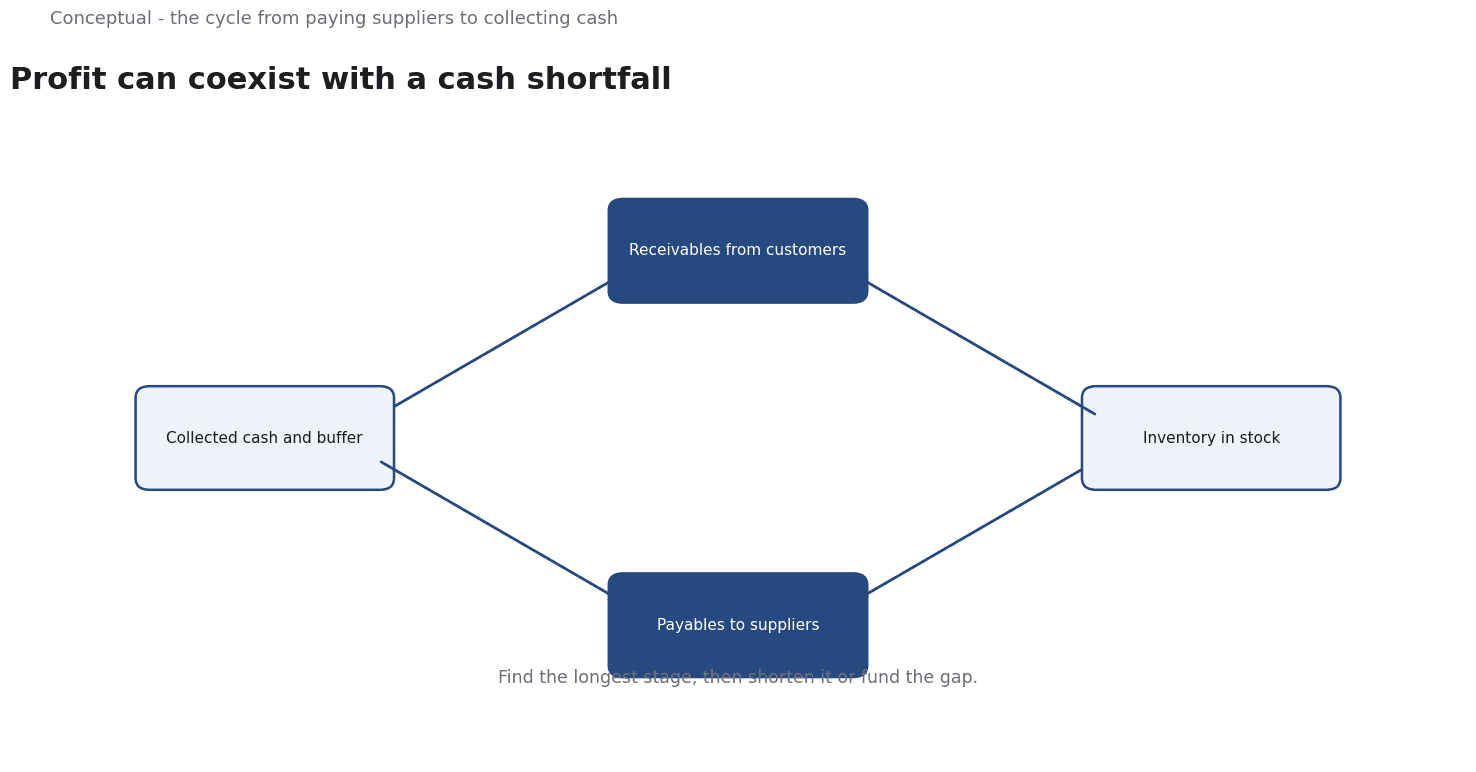
The second component is inventory. The cash-flow entry describes how money moves through a period. Stock that has been paid for but not sold is cash in another form, and the longer it waits, the longer the gap.
The third component is payables. Money owed to suppliers is a source of short-term funding, but it is also an obligation with a date.
The sequence is: measure the cash cycle, identify the longest stage, and decide whether to shorten it or fund it. The decisions are local, so the conclusions are inferred; the concepts are source-reported.
A worked example
Illustrative. A small team is profitable but struggles to pay suppliers on time.
Three checks decide. First, how long does cash sit in receivables and inventory, using dated records? Second, which stage has lengthened compared with the previous period? Third, is the response to shorten that stage or to arrange funding for the gap?
The outcome is a decision about the cash cycle rather than a general cost cut. The scenario is hypothetical; the method is the contribution.
Evidence status
| Claim | Status | Source | Verified | Recheck when |
|---|---|---|---|---|
| Working capital concerns current assets and obligations | source-reported | Wikipedia, Working capital | 2026-11-18 | Definition changes |
| Cash flow describes money moving through a period | source-reported | Wikipedia, Cash flow | 2026-11-18 | Definition changes |
| Measure the cycle before acting | inferred | Derived from the concepts | 2026-11-18 | Operations change |
Why profit and cash diverge
Profit is recognised when revenue is earned; cash arrives when the customer pays.
A business can report profit while waiting for payment, which is why the cash cycle matters more than the income statement for short-term survival.
A team should also recognise that shortening the cash cycle is not always possible. Customers with long payment terms may be necessary to win the business, and suppliers with short terms may be the only option. Working capital management in that case is about funding the gap deliberately rather than eliminating it, which is a different discipline.
The measurement should be repeated on a regular schedule, because a cycle that lengthens slowly can pass unnoticed until it becomes a crisis. A short monthly view of receivables, inventory, and payables is often enough to see the trend, and the trend matters more than any single figure.
A profitable quarter can still produce a cash shortfall, which is why the cash cycle deserves its own review.
The buffer should be sized from the cash cycle, not from a fixed rule that ignores how the business actually operates.
A longer cycle hides cash in receivables and stock, which is why the trend deserves a regular view.
The gap between paying and collecting is a structural feature of the business, not an error to be eliminated.
A dated view of the cycle is more useful than a precise figure taken once, because the direction of change is the signal.
The people who negotiate terms should see the cash effect of those terms, since the two decisions are the same decision viewed differently.
What it cannot do
It cannot remove the gap between paying and collecting. It does not guarantee that shortening a stage is possible. And it cannot replace a cash forecast.
The counterargument that profit ensures liquidity is fair over a long horizon and incomplete over a short one.
A decision test
- Measure the cash cycle.
- Identify the longest stage.
- Decide whether to shorten or fund it.
- Keep a buffer for the gap.
- Use dated figures.
- Record the decision and recheck date.
For the inventory side, see Inventory Management.
References & Further Reading
- Wikipedia contributors, 2026. Working capital - Wikipedia — Current assets minus current liabilities, and why a growing business can be cash-constrained; secondary reference.
- Wikipedia contributors, 2026. Cash flow statement - Wikipedia — Operating, investing and financing activities, and why net income and cash flow differ.