Inventory Accuracy without the Hype
Inventory accuracy is a condition for good decisions. Read what it means, a worked example, and why a percentage can hide the error that matters.
Inventory accuracy is often reported as a single percentage, which hides the errors that matter most. The inventory-control entry describes systems for tracking stock, and the inventory entry treats stock as cash. The question is which discrepancies change a decision.
Direct answer: Treat accuracy as the absence of decision-changing discrepancies, not as a number to raise, and verify it with counts that target the right items. The sources describe the systems; the rule is a synthesis.
Delta: This article adds a claim-status table and a worked example, separating documented tracking concepts from local judgements about materiality.
The mechanism
The first point is materiality. The inventory-control entry describes tracking systems, which can produce a high average accuracy while a few items are badly wrong.
An error on a fast-moving or high-value item matters more than many small errors on slow stock, and a single percentage treats them alike.
The second point is timing. The inventory entry treats stock as cash, which means a discrepancy discovered late has already affected purchasing and fulfilment. Counting more often on the items that matter is the practical response, not counting everything more often.
The third point is cause. A discrepancy is a symptom, and the cause may be a receiving error, a miscount, or theft. Recording the cause at the point of discovery is what allows a fix, whereas a correction to the number only restores the record.
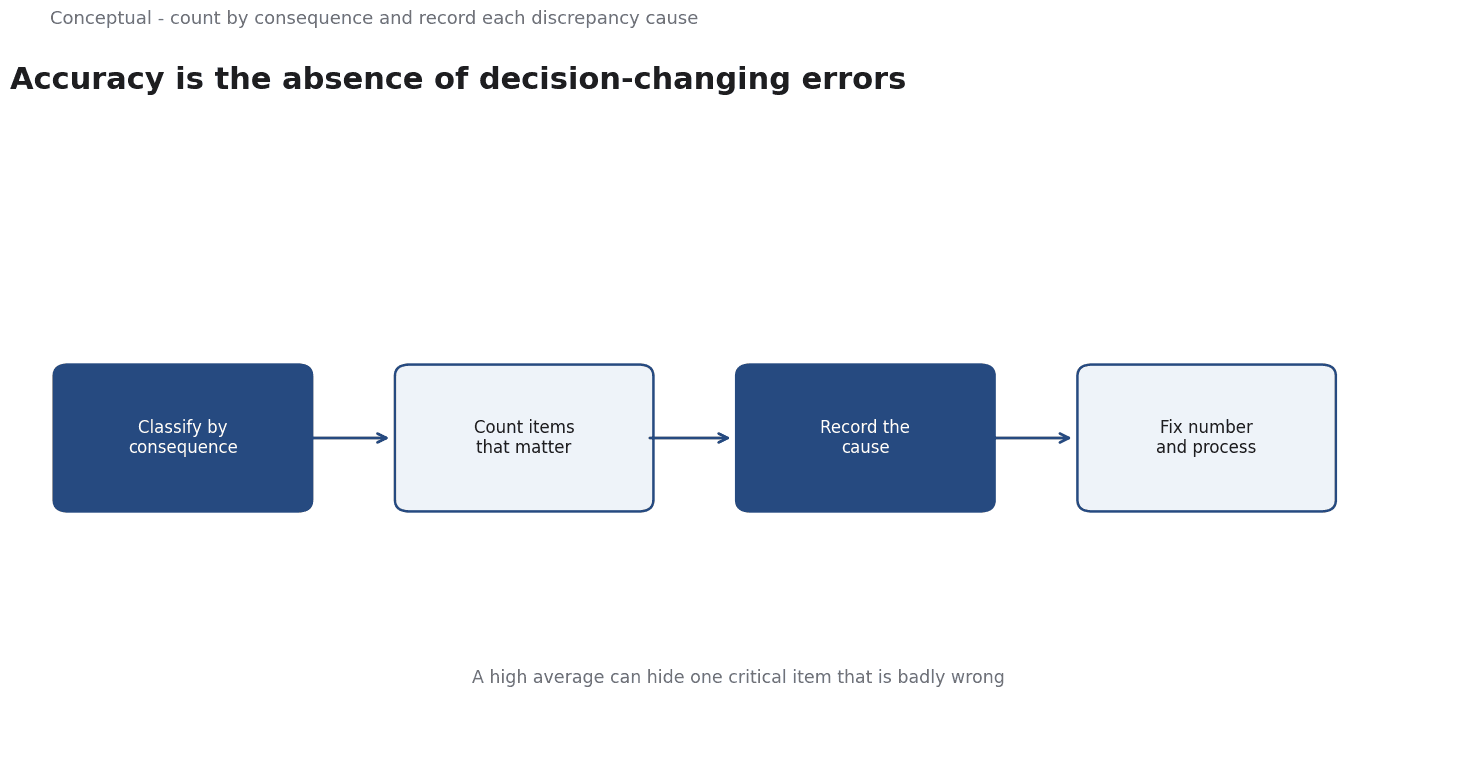
The sequence is: classify items by consequence, count the ones that matter, record causes, then correct both the number and the process. The classification is local, so the conclusions are inferred; the concepts are source-reported.
A worked example
Illustrative. A warehouse reports 98% accuracy but repeatedly runs out of one fast-moving item.
Three checks decide. First, is that item among the errors hidden by the 98%? Second, when was it last counted, relative to its rate of sale? Third, does the cause point to receiving, picking, or the record itself?
The outcome is a targeted count and a process fix. The scenario is hypothetical; the method is the contribution.
Evidence status
| Claim | Status | Source | Verified | Recheck when |
|---|---|---|---|---|
| Inventory control tracks stock | source-reported | Wikipedia, Inventory control | 2026-11-18 | Definition changes |
| Inventory represents cash tied up | source-reported | Wikipedia, Inventory | 2026-11-18 | Accounting changes |
| Count by consequence and record causes | inferred | Derived from both | 2026-11-18 | Range changes |
Why the average hides the error
An average weights every item equally, which is wrong when items have very different consequences. A small set of fast-moving products often deserves daily attention while slow stock can be checked occasionally, and the accuracy figure should reflect that difference.
A further point is that a count is itself an observation with error. A discrepancy after a count may reflect a miscount rather than a missing item, and treating the first number as truth creates a false problem. Sampling the same items twice is a cheap way to estimate that error before acting on it.
The cause of a discrepancy also changes over time. A receiving problem that was fixed may be replaced by a picking problem, and a rule written for one cause will miss the other. Reviewing the causes by period is what keeps the process relevant.
Finally, accuracy cannot be improved by reporting alone. A number that rises because the definition changed is not an improvement, and the definition belongs in the record so the trend can be read honestly.
The definition of accuracy should be recorded, since a change in definition can mimic an improvement.
Counting the items that matter most is more useful than counting everything occasionally.
A discrepancy should be traced to its cause before the record is corrected.
A high average can hide a critical item that is badly wrong.
What it cannot do
It cannot make a record correct without a process that keeps it correct. It does not identify a cause by itself. And it cannot guarantee that a count will match the system.
The counterargument that a single percentage is easier to manage is fair for reporting and incomplete for a decision.
A decision test
- Classify items by consequence.
- Count the important ones more often.
- Record the cause of discrepancies.
- Correct process as well as number.
- Review the classification.
- Record the decision and recheck date.
For the cause, see Shrinkage Metrics.
References & Further Reading
- Wikipedia contributors, 2026. Inventory control - Wikipedia — Systems for tracking and managing stock accuracy.
- Wikipedia contributors, 2026. Inventory - Wikipedia — The role of stock in operations and accounting.