Knowledge Graphs: Common Questions
A knowledge graph stores relationships, not just documents. Read the common questions, a worked example, and why a graph is not automatically true.
A knowledge graph is often described as a web of facts, which hides the work: defining entities, relationships, and provenance. The knowledge-graph entry describes structured entities and relationships, as the data-modeling entry covers structure, as the vector-database article contrasts embeddings, as the data-governance article requires provenance, as the risk article requires residual risk.
Direct answer:
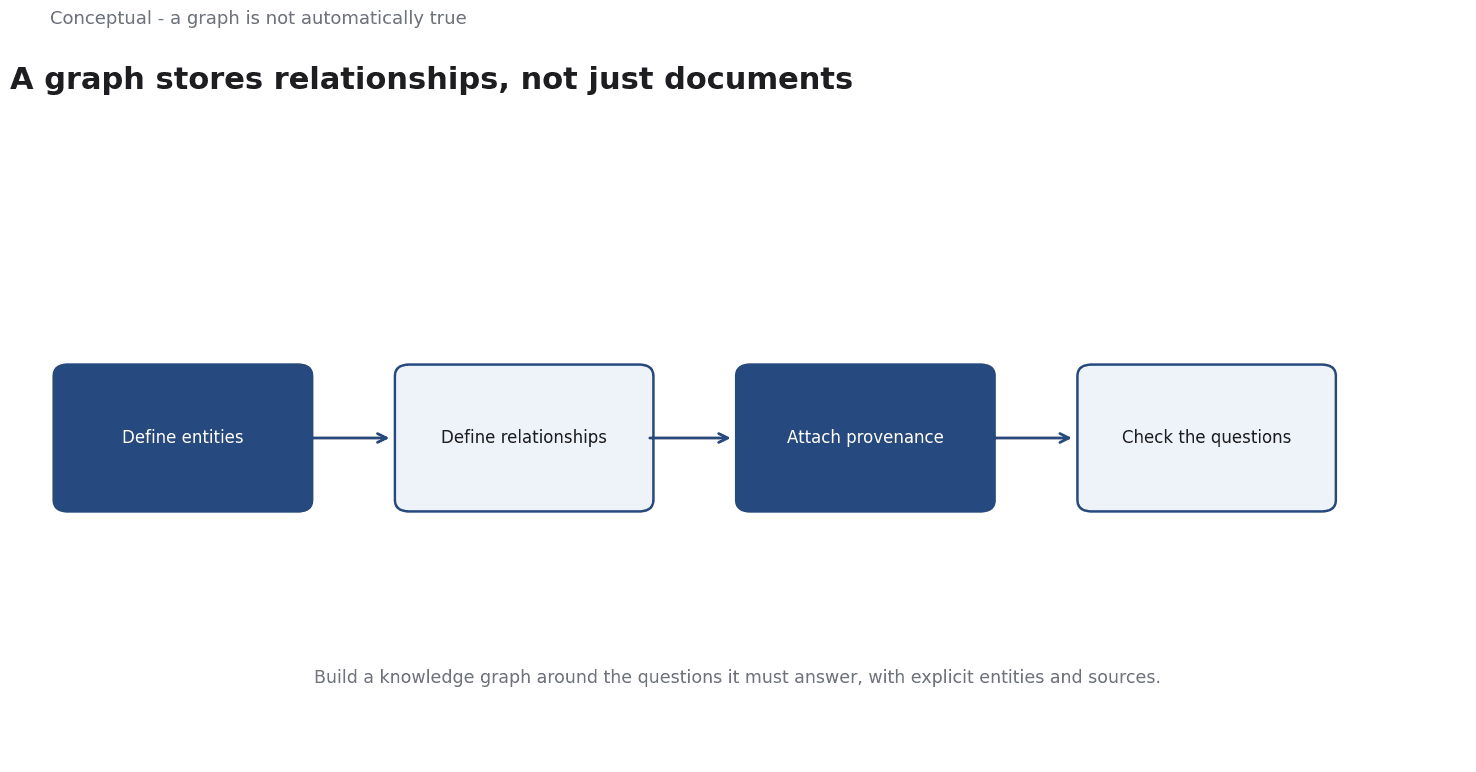
Build a knowledge graph around the questions it must answer, with explicit entities, relationships, and sources.
Wikipedia's knowledge-graph entry provides the concept, and data modeling covers the structure. The boundary: a graph stores what was put into it, which the data-quality article warns, as the causal-inference article distinguishes from a cause, as the publication standard forbids guaranteed outcomes.
Common questions
How is it different from a vector index? A vector index retrieves by similarity, which the vector-database article describes, while a graph stores explicit relationships, which the knowledge-graph entry treats, as the data-modeling entry advises, as the embedding-selection article advises for task-driven evaluation, as the rubric article requires criteria, as the risk article requires residual risk, as the decision-memo article requires for a record.
Where do the entities come from? From a defined model, which the data-modeling entry advises, as the knowledge-graph entry treats entities, as the data-governance article requires provenance, as the data-quality article warns about bad inputs, as the rubric article requires criteria, as the decision-memo article requires a dated definition, as the monitoring article advises for review.
Can a graph be wrong? Yes, which the data-quality article warns, as the knowledge-graph entry treats stored relationships, as the data-governance article requires provenance, as the causal-inference article warns about association, as the hallucination article warns about confident wrong detail, as the rubric article requires criteria, as the risk article requires residual risk, as the decision-memo article requires for a record.
Does a graph answer questions by itself? No, which the RAG and retrieval articles treat, as the reranking article advises, as the evaluation-rubric article requires criteria, as the analytics article recommends for observed behaviour, as the attribution article warns about credit rules, as the dashboard article argues for metrics tied to decisions, as the risk article requires residual risk, as the decision-memo article requires for a record.
Three consequences follow. The questions come first, as the data-modeling entry advises, as the rubric article requires, as the decision-memo article requires a question, as the vector-database and embedding articles advise, as the knowledge-graph entry treats entities, as the data-governance article requires provenance, as the data-quality article warns, as the causal-inference and hallucination articles warn, as the monitoring article advises for review, as the risk article requires residual risk, as the decision-memo article requires for a record.
A worked example
The following is hypothetical and illustrative. A team considers a graph to answer questions about product relationships.
Three checks decide. First, what questions require relationships rather than similarity, as the knowledge-graph and vector-database articles advise, with a criterion, as the rubric article requires? Second, where do entities and relations come from, as the data-modeling entry advises, with provenance, as data governance requires, as the data-quality article warns? Third, can the answers be evaluated, as the evaluation-rubric article requires, with observed cases, as the analytics article recommends, as the risk article requires residual risk, as the decision-memo article requires for a record?
Three conclusions follow.
The question type decides the structure, which the checks reveal.
Provenance is required, as data governance advises. And the decision should be recorded, as the decision-memo article requires.
What knowledge graphs cannot do
They cannot guarantee truth, which the data-quality and causal-inference articles warn, as the publication standard forbids guaranteed outcomes, as the risk article requires residual risk. They do not replace retrieval, which the RAG and reranking articles advise, as the evaluation-rubric article requires criteria, as the analytics article recommends, as the decision-memo article requires for a record. And they cannot create provenance that was never recorded, which the data-governance article treats, as the hallucination article warns, as the monitoring article advises for review, as the risk article requires residual risk.
A decision test
- Define the questions, as the rubric article requires.
- Model entities and relationships, as the data-modeling entry advises.
- Source every relation, as data governance requires.
- Compare with a vector baseline, as the embedding-selection article advises.
- Evaluate on real cases, as the evaluation-rubric article requires.
- Review on change, as the monitoring article advises.
- Record the decision and residual risk, as the decision-memo and risk articles require.
For the structure, see Data Modeling; for the alternative, see Vector Databases.
References & Further Reading
- Wikipedia contributors, 2026. Knowledge graph - Wikipedia — Structured representation of entities and relationships.
- Wikipedia contributors, 2026. Data modeling - Wikipedia — The structure and purpose of data models.