Keyword Research Costs Explained
Keyword research costs attention as well as tools. Read where the cost goes, a worked example, and why a larger list can be less useful.
Keyword research is often measured by the size of the list it produces, which ignores the work required to turn terms into decisions. The web-analytics entry describes collection and interpretation as separate, and Google's starter guide covers how pages are evaluated. The costs sit in the interpretation.
Direct answer: Budget keyword research by the decisions it supports, with time for intent, difficulty, and measurement — not by the number of keywords found. The sources describe measurement and site quality; the rule is a synthesis.
Delta: This article adds a claim-status table and a worked example, separating documented context from local choices about which terms matter.
The mechanism
The first cost is interpretation. The web-analytics entry describes collection and interpretation as distinct, which applies here. A list of terms is collected data; deciding which represent a real need, and which the site can serve, is the work that consumes time.
The second cost is validation. The starter guide describes how pages are evaluated, which means a term is only an opportunity if a page can satisfy the intent behind it. Checking that fit takes more effort than exporting a list, and skipping it produces content that never performs.
The third cost is maintenance. Demand and competition change, and a list that was useful last quarter can go stale. Reviewing it on a schedule is a continuing cost, not a one-time task.
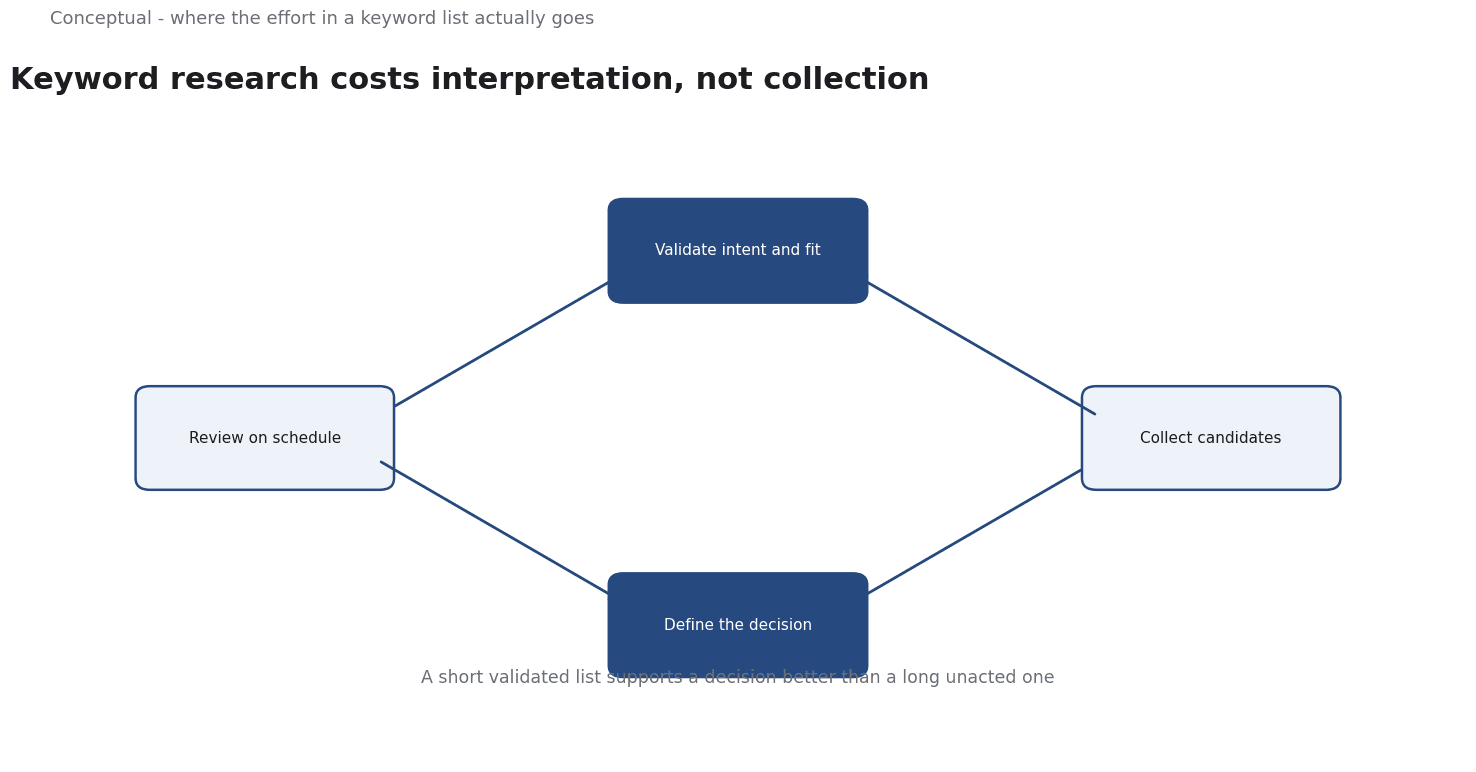
The sequence is: define the decision, collect candidates, validate intent and fit, then schedule a review. The choices are local, so the conclusions are inferred; the context is source-reported.
A worked example
Illustrative. A team produces a list of five hundred keywords and cannot decide what to write.
Three checks decide. First, which decisions should the research support — a new page, an update, or a product question? Second, for the top terms, is the intent clear and can the site serve it? Third, how will the team know whether a chosen term was worth the effort?
The outcome is a short list with a measure attached. The scenario is hypothetical; the method is the contribution.
Evidence status
| Claim | Status | Source | Verified | Recheck when |
|---|---|---|---|---|
| Analytics separates collection and interpretation | source-reported | Wikipedia, Web analytics | 2026-11-18 | Definition changes |
| Search evaluates pages against intent | source-reported | Google SEO Starter Guide | 2026-11-18 | Guide updated |
| Budget for interpretation and validation | inferred | Derived from both | 2026-11-18 | Goals change |
Why a larger list can help less
A long list spreads attention across terms that will never be acted on. A short list with validated intent and a measure of success is more useful, because each item can become a decision.
A further point is that a keyword list is a snapshot of demand, which changes with the market and with the product. A term that was valuable last quarter may no longer describe what customers want, and a list that is never reviewed becomes a record of an older decision.
The research also cannot decide whether the site deserves to rank. The starter guide describes how pages are evaluated, which depends on the content and the experience around it, not on the presence of a keyword.
Finally, the measure attached to a term should be a decision measure, such as qualified traffic or an enquiry, rather than a ranking position.
A position can rise while the business outcome stays flat, and the distinction is the difference between activity and result.
A term is an opportunity only when the site can serve the intent behind it, which is a separate check.
A short validated list supports a decision better than a long list nobody has time to act on.
The list should be reviewed as demand changes, since an old term can describe an older market.
A position is a proxy, and a decision measure is what the research is meant to support.
What it cannot do
It cannot create demand. It does not guarantee that a page will rank. And it cannot remove the need to write something useful.
The counterargument that more keywords mean more opportunities is fair for discovery and incomplete for the work of validation.
A decision test
- Define the decision the research supports.
- Collect candidates.
- Validate intent and fit.
- Choose a short list.
- Attach a measure to each.
- Record the choices and recheck date.
For the measurement, see What AI Search Measures.
References & Further Reading
- Wikipedia contributors, 2026. Web analytics - Wikipedia — Collection and interpretation of website behaviour data.
- Google, 2026. SEO Starter Guide: The Basics — The search engine's own description of what it needs from a site.