Loan Covenants Costs Explained
Covenants carry costs beyond interest; this article maps loan terms to default and restructuring exposure, with evidence status made explicit.
Borrowers often focus on the interest rate and overlook the costs built into covenants. A covenant can restrict ordinary decisions and, if breached, turn a manageable situation into a default that forces restructuring. The problem is understanding how specific terms translate into real costs and where default and restructuring enter the picture.
Direct answer: Loan covenants are conditions in a debt agreement that a borrower must satisfy or avoid breaching; a breach can trigger default and raise credit risk. Their costs include ongoing compliance and monitoring, reduced operating flexibility, and the possible expense of default or debt restructuring.
Read each covenant as a constraint with a consequence, and map it to the decision it limits.
Delta: This article adds a cost map beyond the sources: it maps covenant terms to default and restructuring exposure, with claim status explicit.
The mechanism
Debt covenants are conditions written into a loan agreement that require the borrower to meet certain obligations or refrain from certain actions. Common forms include requirements to maintain financial ratios and restrictions on further borrowing or asset sales. They exist because lenders face credit risk, the possibility that a borrower will fail to meet its obligations, and covenants give a lender an early signal or a contractual remedy. Debt restructuring is the modification of debt terms, typically negotiated when a borrower is in distress and cannot meet the original agreement. These three ideas form a chain: covenants monitor credit risk, a breach signals possible distress, and restructuring is one response to it.
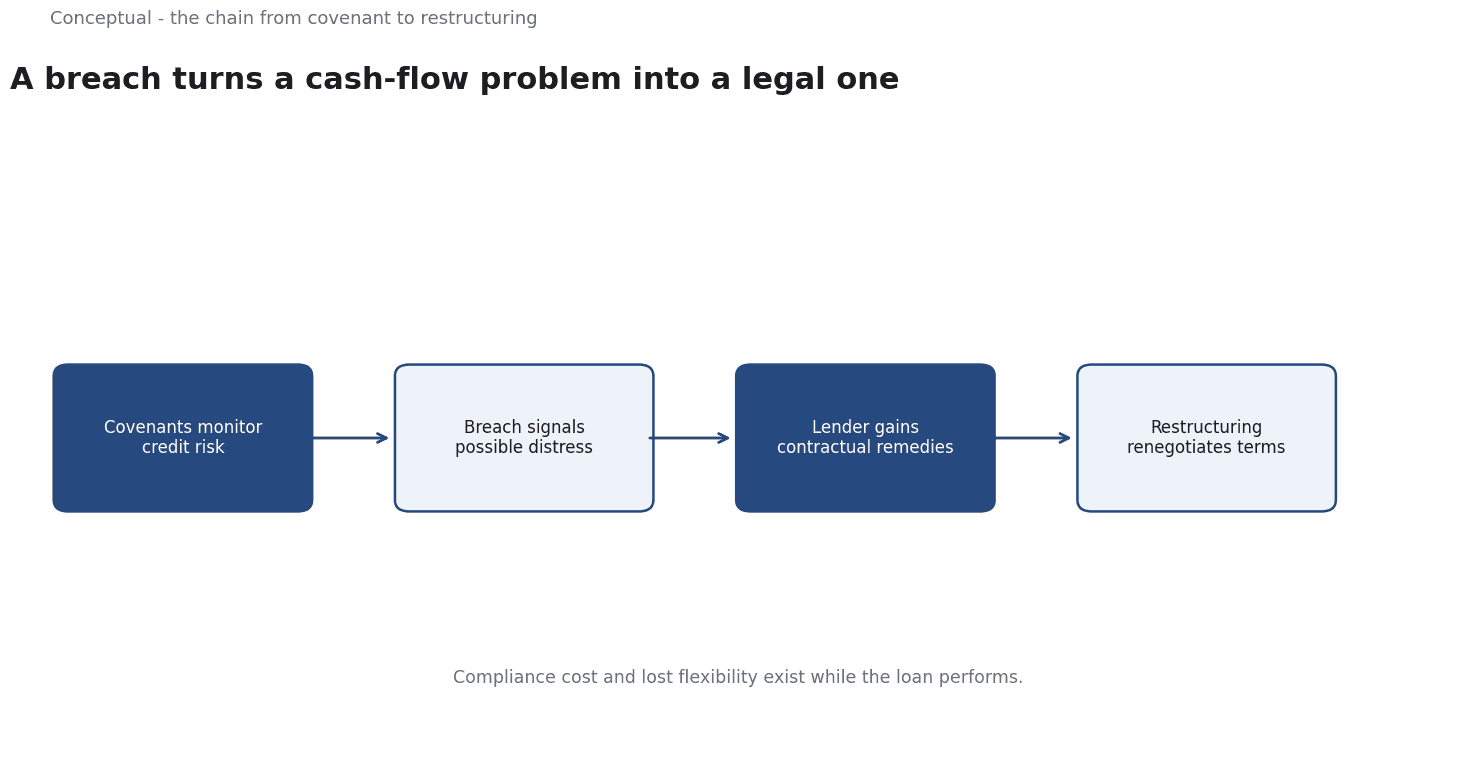
For a borrower, the practical consequence is that covenants are not passive paperwork. They impose a monitoring burden: figures must be calculated, reported, and certified on a schedule, and an error in that process can itself become a breach. They also constrain decisions, because a step that improves one part of the business might violate a ratio or restriction. The cost is therefore twofold, the direct cost of compliance and the opportunity cost of choices that cannot be made freely. Both exist even when the loan is performing normally, which is why a low headline rate can still be expensive.
The serious cost appears at breach. A covenant breach can amount to a default, which may accelerate repayment or give the lender rights the borrower did not have under normal conditions. That converts a cash-flow problem into a legal and negotiating problem. Debt restructuring becomes relevant here: when the borrower cannot meet the original terms, the two sides may renegotiate, changing maturities, payments, or the covenants themselves. Restructuring carries its own costs, including fees, possible asset sales or dilution, and terms that reflect the borrower's weakened position.
The decision implication is that each covenant should be read as a constraint with a price. A tight ratio lowers the lender's risk but reduces the borrower's room to maneuver; a loose one does the reverse. The sources describe the concepts of covenant, credit risk, and restructuring but do not quantify this trade-off. The bounded conclusion is that covenant strictness is linked to flexibility and to default exposure, and that the link has to be evaluated for the specific agreement rather than assumed from the label.
A worked example
The following is hypothetical and illustrative. A company holds a loan with a leverage ratio covenant and a restriction on new borrowing. Three checks map the costs. First, compliance: can the finance team produce the required figures on schedule and certify them accurately? Second, flexibility: would a planned acquisition push the leverage ratio beyond the limit, blocking an otherwise sound decision? Third, breach consequence: if a downturn caused a breach, what rights would the lender gain, and would restructuring be the likely outcome? The outcome is that the team treats the covenant as a real operating constraint, testing planned actions against the ratio and preparing for the possibility of renegotiation before it is forced. The example illustrates the cost map, not the terms of any actual loan.
Evidence status
| Claim | Status | Source | Verified | Recheck when |
|---|---|---|---|---|
| Debt covenants impose conditions that borrowers must meet or avoid breaching | source-reported | Debt covenant entry | 2026-11-18 | agreement terms or definitions change |
| Debt restructuring modifies terms when a borrower cannot meet original obligations | source-reported | Debt restructuring entry | 2026-11-18 | distress conditions or terms change |
| Covenant strictness trades operating flexibility for default exposure | inferred | Derived from the sources | 2026-11-18 | financial conditions or covenant terms change |
The first two rows rest on the concepts described in the reference entries and are treated as reported, not measured here. The third row is an inference: it follows from the purpose covenants serve but is not a quantified relationship stated by either source. Every row is dated and should be revisited when the loan terms, the borrower's condition, or the meaning of the underlying concepts changes.
What it cannot do
The framework cannot predict a default. It explains what covenants are and how breach and restructuring connect, but it offers no threshold or model that says when a given borrower will fail. Credit risk is a possibility, not a forecast produced by reading a term sheet. The cost map is a way to organize attention, not a substitute for a financial assessment, and it should not be presented as one.
The hidden costs extend beyond the interest line. Compliance needs staff time, reliable reporting, and sometimes external certification, all of which recur. The opportunity cost of a restrictive covenant can be larger than the direct fees, because it blocks actions that might otherwise improve the business. If a breach occurs, the expense can include legal and advisory fees, the terms demanded in a restructuring, and the loss of flexibility at the worst possible moment. These costs are rarely visible in a simple comparison of rates.
A figure calculated late or certified incorrectly can place the borrower in default even when the underlying position is sound. A related failure is managing to the ratio at the expense of the operation, such as deferring useful investment to preserve a metric. Both show why the monitoring burden is a real cost: it demands accuracy and can distort decisions even in a healthy period.
The boundary is that the sources are conceptual. They describe debt covenants, credit risk, and debt restructuring, not a legal interpretation or a quantitative model, and they do not supply the thresholds that would make the cost map precise. Any judgment about a specific agreement depends on its exact wording and on circumstances the sources do not cover. The framework therefore needs review by someone qualified to read the actual terms, and it should be treated as orientation rather than advice. It cannot replace a reading of the agreement itself.
The assessment also needs to be revisited. Covenants can be amended, waived, or replaced, and a borrower's room to maneuver changes with earnings and market conditions. A term that was harmless at signing can become binding later, and a restriction that seemed severe can become irrelevant. A practical review checks the figures against the covenants on a regular schedule and reopens the cost map whenever terms change. What it cannot do is deliver a settled answer at signing and remain valid as conditions move.
[Counterargument: "The counterargument that covenants only protect lenders is fair for risk control and incomplete for borrowers, because covenants also impose real compliance costs and constrain operating choices."]
A decision test
- List every covenant in the agreement and its trigger.
- Identify the figures and reports needed to monitor each one.
- Estimate the compliance effort on a recurring basis.
- Test planned actions against the constraints they impose.
- Define what a breach would mean under the agreement.
- Consider whether restructuring would be a realistic response.
- Record the map and revisit it when terms or conditions change.
A cost map is useful because it makes the non-interest expense of a loan visible. Keep it beside the financial model and update it as figures and terms change, so the constraint is weighed before a decision is taken rather than after a breach.
The discipline lies in reading each covenant as an active condition, not a line of boilerplate.
For further reading, see Cash Flow Forecasting: A 13-Week Operating Model.
References & Further Reading
- Wikipedia contributors, 2026. Credit risk - Wikipedia — Contractual conditions attached to a loan agreement.
- Wikipedia contributors, 2026. Debt restructuring - Wikipedia — The process of renegotiating debt terms between borrower and lenders.