Local SEO Trade-Offs
Local visibility has different levers from national search. Read what changes, a worked example, and why a template cannot guarantee a result.
Local search rewards a different set of signals from broad web search: proximity, relevance, and prominence in a specific place. A page that ranks nationally can still be invisible to someone searching nearby, which is why local SEO is a distinct discipline rather than a set of keywords added to a national campaign.
Direct answer: Optimise local visibility through accurate business information, location-relevant content, and genuine customer signals, using Search Console and server logs to verify what is happening. Google Search Central documentation is the primary source for technical guidance, and the tag-manager documentation covers measurement setup. The boundary: no structure guarantees a ranking or citation, which the publication standard states explicitly for SEO, and local results are personalised by location, which makes a single rank difficult to interpret.
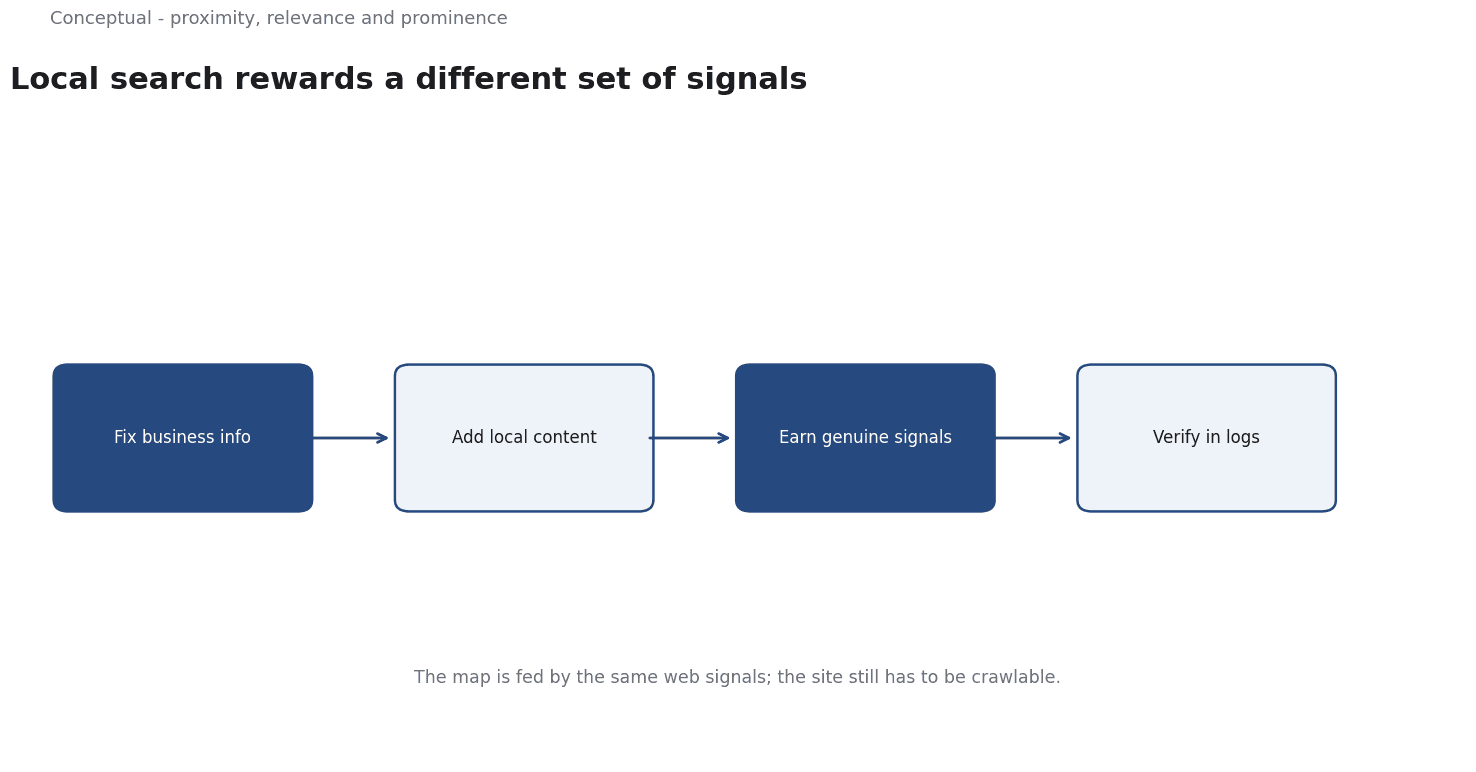
What changes in local search
Proximity. The searcher's location is a dominant factor, which means a single national rank is a poor summary, as the local-pack literature treats results as place-dependent. The practical response is to measure from the locations where customers actually search, using a defined set rather than an anecdotal check.
Business information consistency. Name, address, and phone details across directories affect prominence, which the citation-consistency literature treats as a trust signal. A mismatch creates ambiguity, as the data-governance article argues for a single reliable record.
Reviews and relevance. Genuine customer reviews and content that addresses local questions contribute to prominence, which the online-reviews article treats as a public record of experience.
Three consequences follow. A local page should contain information a visitor in that place needs, which the search-intent article explains for matching content to a decision. A template applied to dozens of locations with only the city name changed produces thin pages, which the thin-content article treats as a quality failure. And measurement must be geographically defined, as the geo-experiment guidance recommends for comparisons.
A worked example
The following is hypothetical and illustrative. A business with five locations wants more local enquiries. It considers two approaches.
The first is a set of near-identical city pages generated from a template, each with the same service description and a different city name. The second is one well developed service page plus distinct location pages that include local specifics — service area, local team, relevant constraints — and verified business information. Three checks decide. First, does each page answer a question a local visitor actually has, as the search-intent article requires? Second, is the business information consistent, as the citation literature advises? Third, do enquiries rise from defined locations against a baseline, which the geo-experiment guidance supports for a comparison?
Three conclusions follow. The template approach is cheap to produce and likely to be treated as thin, which the thin-content article warns about. The distinct approach costs more and produces evidence, as the content-operations article argues for roles and review. And the measurement should be geographic and dated, as the Search Console guide recommends for diagnosis.
What local SEO cannot do
It cannot guarantee a position in a local pack, which the publication standard forbids claiming for any SEO tactic. It cannot fix a poor service, which the reputation article treats as the underlying record. And it does not remove the need for a working website — access, crawling, and rendering still come first, as the request-path article explains for the stages of search.
The counterargument that local SEO is trivial because the map is the main surface is wrong.
The map is fed by the same web signals, and the underlying site still has to be crawlable and useful, which the technical-SEO guide covers.
A decision test
- Define the locations where customers actually search, as the geo-experiment guidance recommends.
- Check business information consistency across sources.
- Build location content around real local questions, as the search-intent article advises.
- Avoid templated thin pages, as the thin-content article warns.
- Encourage genuine reviews, as the online-reviews article recommends.
- Measure enquiries by location against a baseline, as the Search Console guide supports.
- Do not promise rankings, as the publication standard requires.
For the technical base, see Technical SEO Engineering; for the measurement, see Google Search Console for Technical SEO.
References & Further Reading
- Google, 2026. SEO Starter Guide: The Basics — The search engine's own description of what it needs from a site.
- Google, 2026. About Google Tag Manager | Tag Platform | Google for Developers — Primary documentation on tag management and server-side tagging options.