Local SEO without the Hype
Local SEO rewards accurate listings, crawlable pages, and clear intent matching. Learn the source definitions, a worked review, and where local search guidance stops.
Local SEO is often sold as a collection of tricks that only an insider can execute. The published basics are narrower and more durable: make business information accurate, make pages findable, and match what a nearby searcher actually wants. The real problem is that hype replaces this short list of fundamentals with a long checklist of tactics whose value is hard to verify.
Direct answer: Start with accurate business information and pages a search engine can crawl, then align page content with the intent of a location-based query. The Google starter guide covers crawlability and relevance; the Wikipedia entry defines local search as a query shaped by geography. Neither source promises rankings, so treat the guidance as a foundation rather than a guarantee.
Delta: This article adds a claim-status table beyond the sources: it maps each local signal to a concrete review decision, with claim status explicit.
The mechanism
The Google starter guide is organized around a simple premise: a page must be discoverable and must be worth showing. It describes crawlability and indexing, the role of titles and snippets in describing content, and the expectation that content will be useful and relevant to a query. The practical consequence for a local business is basic but often skipped. If a location page is blocked by a script, trapped behind a client-only shell, or given no descriptive title, then no amount of off-site work will make it a useful result. Discoverability comes first, and it is a property of the page itself.
The Wikipedia entry on local search describes a query whose results are shaped by the searcher's location. Such results are commonly triggered by a place name or a "near me" phrasing, and they draw on business listings, directory data, and review signals alongside ordinary web pages. The practical consequence is that the business's own listing information becomes part of the input. A search engine reconciling a query with a place needs consistent facts to work with.
From these two descriptions a working principle follows: the name, address, and phone number should agree across the website and any external listings the business controls. The sources do not publish a ranked list of local factors, so this consistency rule is an operational inference from the requirements that information be accurate and pages be crawlable. It is marked accordingly in the evidence table. The point is not that consistency alone earns a ranking, but that it is a condition a reviewer can actually inspect.
The output of the mechanism is a short review, not a score.
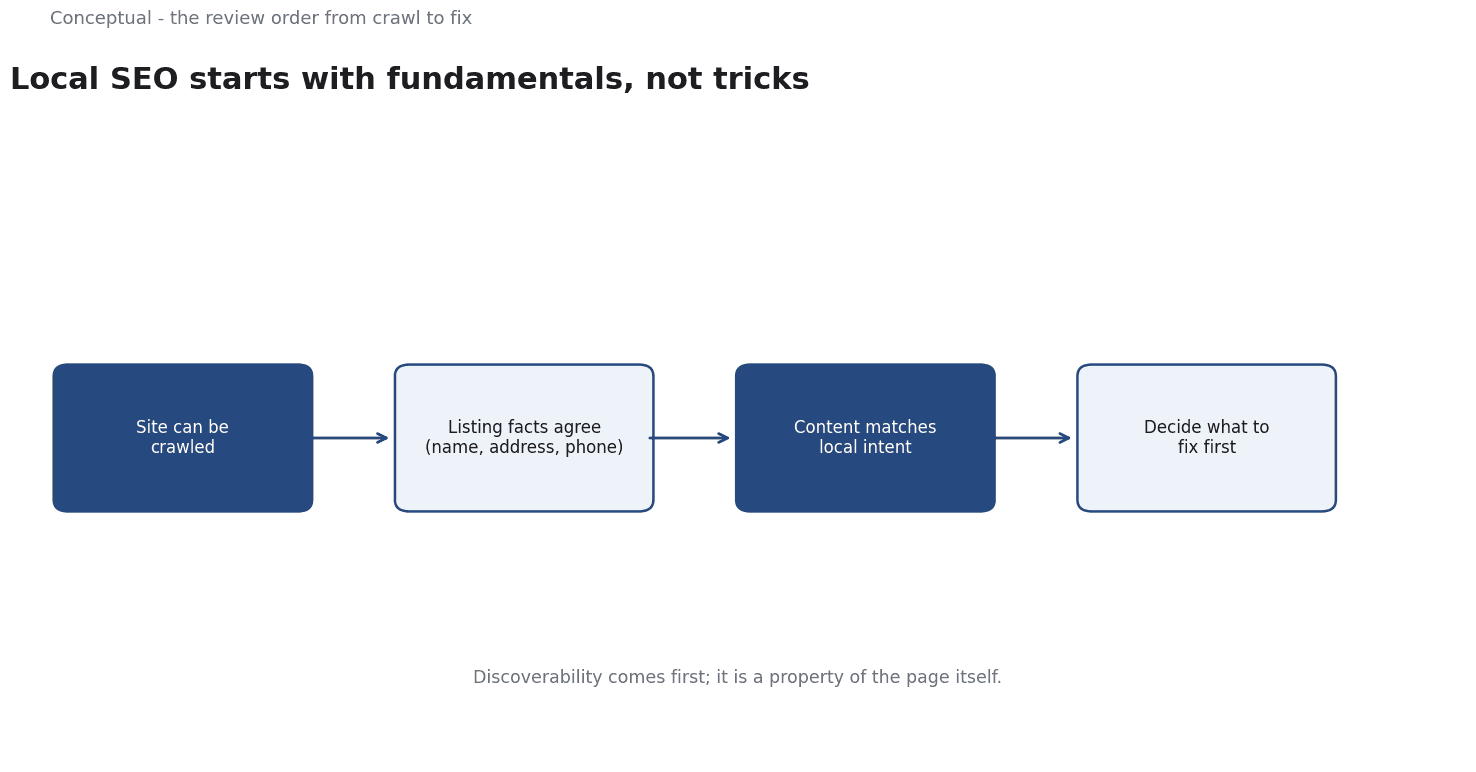
The sequence is: confirm the site can be crawled, confirm the listing facts agree, confirm the page content matches local intent, then decide what to fix first. The value lies in that order, because each step narrows the set of plausible problems before the next one begins.
A worked example
The following is hypothetical and illustrative. A neighborhood dental clinic wants more "dentist near me" visits and assumes it needs a content campaign. Three checks reframe the problem. First, is the contact page crawlable, with a plain HTML address and a descriptive title? Second, does the clinic's name, address, and phone number match across its website and its main listing? Third, does the page describe the service and the area, or is it a generic homepage? The review finds the address buried in an image and a phone number that differs from the listing. The team renders the address as text and corrects the number, then leaves content unchanged. The outcome is a concrete fix with a visible verification path. The numbers are hypothetical; the verification method is the contribution.
Evidence status
| Claim | Status | Source | Verified | Recheck when |
|---|---|---|---|---|
| Search pages must be crawlable and relevant | source-reported | Google SEO starter guide | 2026-11-18 | Guide revised |
| Local search results are shaped by geography | source-reported | Wikipedia, Local search | 2026-11-18 | Definition revised |
| Consistent listing facts improve trust | inferred | Derived from the sources | 2026-11-18 | Ranking guidance changes |
The first two rows are factual claims stated by the sources. The third is an inference: neither source asserts that consistency is a ranking factor, only that information should be accurate and pages discoverable. Recheck the first two rows when the guide or the entry changes, and the third when published ranking guidance shifts.
What it cannot do
Local SEO cannot manufacture demand. If few people want the service in the area, a perfectly configured listing will not create the need. The sources describe how pages are discovered and how local results are shaped; they do not claim that visibility converts into business. Treating a listing cleanup as a substitute for a viable offering is a category error, and it is a common one because the work is concrete and the alternative is not.
The hidden cost is maintenance. Listing data drifts: a phone number changes, a location moves, a duplicate profile appears. The discipline is recurring rather than one-time, and small teams often do the initial cleanup and never revisit it. The cost is paid in attention, not in software. A review that is not scheduled will quietly decay, and a duplicate profile created by a well-meaning employee can sit unnoticed for months. The team that cleaned up once may not be the team that notices the drift later.
The main failure mode is tactic chasing.
These actions are precisely the kind of shortcut that conflicts with the relevance and accuracy the starter guide emphasizes. They also create a cleanup problem later: the business must undo the artificial signal and recover trust. The safer path is to keep changes inspectable and defensible.
There is a boundary around what the sources cover. The starter guide addresses general search basics, not the specific ranking system behind a map package or a local result block. The Wikipedia entry defines the phenomenon of local search but is not an operator manual. So this article can tell a reviewer what to check; it cannot tell them which factor carries the most weight in a given market. That weight is undisclosed and varies by query, by market, and over time. A reviewer should resist turning a correlation observed in one neighborhood into a rule for every location.
Because both the guide and the market change, the review needs a recheck date. Each fix should be recorded with the condition that would invalidate it, so a future reviewer can tell which choices were deliberate. Without that record, a local SEO effort becomes a pile of unrelated edits.
The counterargument that local tactics are fair for quick wins is incomplete when those tactics trade accuracy for short-term visibility.
A decision test
- Confirm the key pages can be crawled and indexed.
- Check that the name, address, and phone number agree everywhere.
- Verify each location page matches local search intent.
- Record the discrepancy with the largest likely impact.
- Fix that discrepancy first, keeping changes inspectable.
- Recheck after a reasonable interval and note the condition for review.
The test turns a vague ambition into a short, repeatable review. Its value is not a score but an ordering: it makes the next fix obvious and the reason for it visible to anyone who reads the record. For further reading, see What AI Search Actually Measures.
References & Further Reading
- Google, 2026. SEO Starter Guide: The Basics — The search engine's own description of what it needs from a site.
- Wikipedia contributors, 2026. Local search (Internet) - Wikipedia — Search results tied to a geographic location.