Luxury Retail Metrics that Matter
Luxury retail is measured by desire as well as sales. Read the metrics, a worked example, and why conversion alone is a thin signal.
Luxury retail is often measured like any other retail, which misses that exclusivity is part of the product. The luxury-goods entry describes value tied to brand, and the customer-experience entry covers perception across interactions. The metrics have to include what the brand means.
Direct answer:
Measure desirability, experience quality, and price integrity alongside conversion, and keep them separate in the report.
The sources describe the category; the method is a synthesis.
Delta: This article adds a claim-status table and a worked example, separating documented category features from local judgements about brand value.
The mechanism
The first metric is desirability. The luxury-goods entry describes value tied to exclusivity, which means waiting lists and repeat interest can be more informative than a single quarter's sales. A brand that sells everything instantly may be losing the scarcity that supports its price.
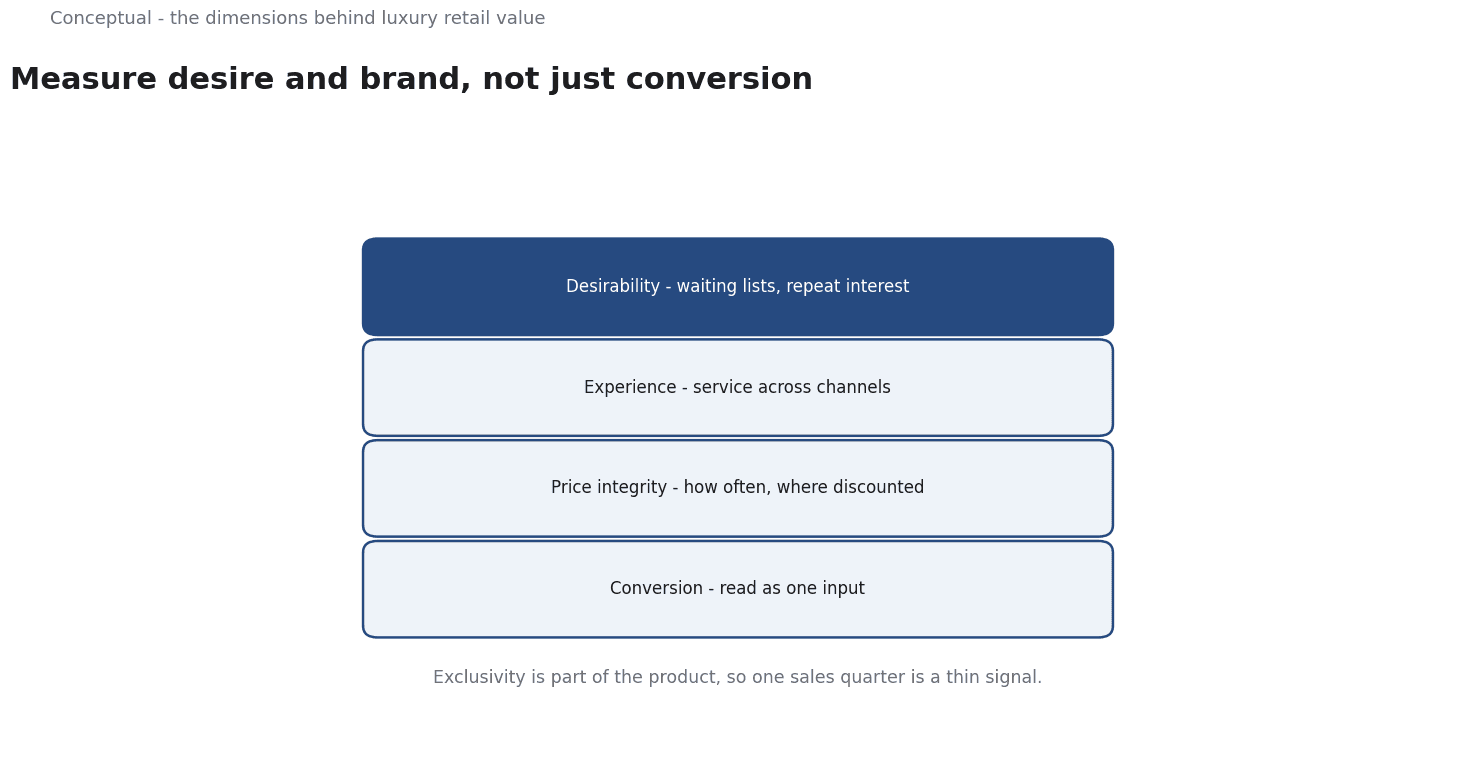
The second metric is experience. The customer-experience entry describes perception across interactions, which in luxury retail is part of the product. Service and presentation are outcomes to measure, not soft extras, and a failure in one channel colours the whole impression.
The third metric is price integrity. The luxury-goods entry describes value tied to brand, and a discount changes what the price signals. Tracking how often products are discounted, and where, is a measure of brand health rather than a promotional detail.
The sequence is: define the brand meaning, choose signals for each dimension, measure them separately, then read conversion as one input. The definitions are local, so the conclusions are inferred; the category is source-reported.
A worked example
Illustrative. A retailer reports record sales after a seasonal sale.
Three checks decide. First, did the sale train customers to wait, measured by full-price demand in the following period? Second, did the experience hold across channels during the peak? Third, did the brand's desirability signals rise or fall?
The outcome is a reading of the quarter with brand context. The scenario is hypothetical; the method is the contribution.
Evidence status
| Claim | Status | Source | Verified | Recheck when |
|---|---|---|---|---|
| Luxury value is tied to brand | source-reported | Wikipedia, Luxury goods | 2026-11-18 | Definition changes |
| Experience forms across interactions | source-reported | Wikipedia, Customer experience | 2026-11-18 | Definition changes |
| Track desirability and price integrity | inferred | Derived from both | 2026-11-18 | Brand changes |
Why conversion is a thin signal
Conversion records a purchase, which can be produced by a discount that weakens the brand.
A further consideration is that desirability changes slowly and can be damaged quickly. A brand can take years to build a signal and lose it in one badly handled promotion, which is why price integrity deserves its own measure rather than an occasional review.
The experience metric also has to span channels. A customer who receives careful service in a store and a generic experience online will form one impression, and a channel-by-channel report will miss the weaker moment that defines it.
The third limit is that these signals are not easily comparable. A waiting list and a conversion rate are different kinds of data, and a single score that combines them hides the trade. Keeping them side by side is less tidy and more honest.
Desirability can be damaged in one promotion and take years to rebuild, which is why it deserves its own measure.
A channel-by-channel report can miss the weaker moment that defines the whole impression.
The dimensions are different kinds of data, and keeping them side by side is more honest than a single score.
Price integrity is an asset that a discount spends, which belongs in the measure.
Conversion records a purchase, which can be produced by a discount that weakens the brand.
A sale that weakens the brand can be profitable in revenue and costly in brand value.
Scarcity that supports a price can be lost through availability, which is a measure of brand health.
The dimensions should be reported side by side, since a single score hides the trade.
A brand's meaning should be stated before the metrics are chosen.
An experience metric should span channels, since the customer forms one impression.
A desirability signal can fall quietly, which is why it deserves a regular view.
A decision test
- Define what the brand should signify.
- Measure desirability signals.
- Measure experience across channels.
- Track price integrity.
- Read conversion with these.
- Record the review and recheck date.
For the category basis, see Luxury Retail.
A counterargument
A fair objection is that the framework rests on thin evidence for a prescriptive claim: its evidence table marks the category as source-reported from a Wikipedia entry and the recommended metrics as inferred, so "measure desirability and price integrity" is a local judgement rather than a validated practice. A critic could challenge the exclusivity premise - the luxury-goods entry says value is tied to exclusivity, but that is a definition, not evidence that waiting lists predict demand, with no way to tell the cases apart. Selling out instantly could signal health rather than lost scarcity. The warning that discounts spend brand value is plausible, but the cited sources do not establish the size or timing of that cost, which a metric would need to be actionable.
References & Further Reading
- Wikipedia contributors, 2026. Luxury goods - Wikipedia — Goods whose value is tied to exclusivity and brand.
- Wikipedia contributors, 2026. Customer experience - Wikipedia — The overall perception customers form across interactions.