Loyalty Mechanics Trade-Offs
Points and repeat-purchase rewards are easy to count; genuine advocacy is not. Weigh measurable loyalty mechanics against the word of mouth they can crowd out.
Loyalty programs are attractive because their effects are visible. Points issued, rewards redeemed, and repeat-purchase rates all arrive as clean numbers, while the thing the program is supposed to build, durable preference and willing recommendation, does not. That asymmetry leads teams to optimize the visible mechanic and assume the invisible outcome follows. The real problem is deciding what a loyalty mechanic is actually buying and what it might be displacing.
Direct answer: Customer retention concerns keeping customers and reducing churn, while word of mouth is informal person-to-person communication about a product.
A mechanic that raises measured repeat purchase is not evidence of advocacy, and can sometimes weaken it.
The decision is which outcome you are buying, with the trade-off stated rather than assumed.
Delta: This article adds a trade-off map beyond the two sources: it links each observable loyalty signal to a decision about where to spend, with claim status made explicit rather than treated as settled fact.
The mechanism
The Wikipedia entry on customer retention describes the activity of keeping customers and reducing churn, commonly framed as less costly than acquiring new ones. Retention is usually observed through behaviour: repeat purchases, subscription renewals, and the length of a customer relationship. That observability is why loyalty mechanics are built around it. A points scheme or a repeat discount produces a trace in transaction data, and the trace can be counted, compared, and reported to stakeholders who want evidence that the program works.
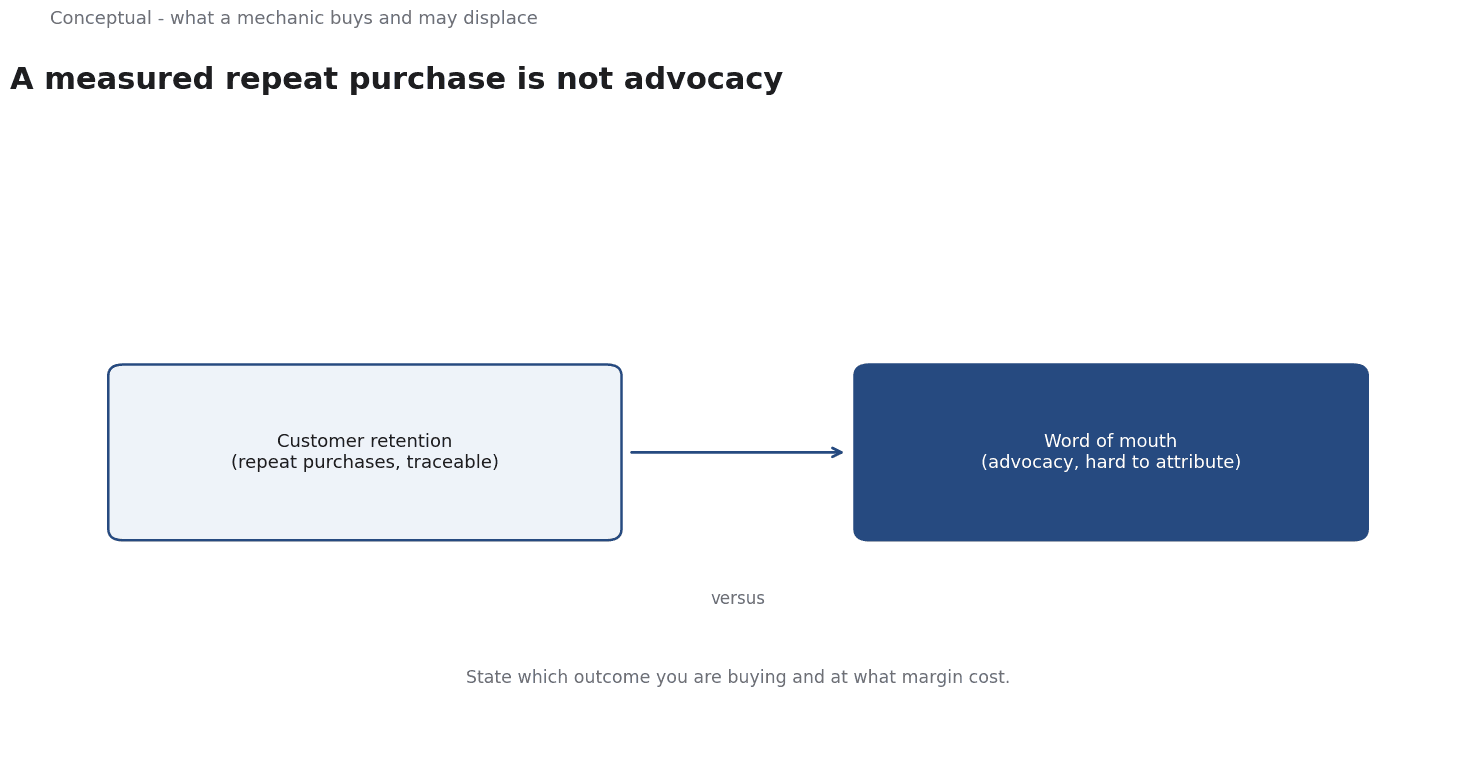
The Wikipedia entry on word of mouth describes informal communication about products or brands between people, which can be positive or negative and is shaped by experience and social motives. This is a different kind of outcome. Advocacy lives in conversations, not in transactions, and it is driven by satisfaction and a desire to be useful to others rather than by a reward schedule. The practical consequence is that a program can move the retention number while leaving advocacy untouched, or can even undermine it if customers come to see the relationship as purely transactional.
The trade-off follows from that difference. Transactional mechanics are measurable, controllable, and quick to change, but they can substitute an external reason to return for an internal one. When the reward ends, the behaviour may end with it, and customers acquired through discounts can be the most likely to leave for a better offer. Advocacy is more durable when it exists, but it is hard to attribute to a specific intervention, slow to influence, and easily confused with the background level of conversation a brand already enjoys. Neither outcome is free, and optimizing one does not guarantee the other.
The practical consequence is a discipline of separate accounting. Track the mechanic and the thing it is meant to produce as distinct claims, and do not let a clean number stand in for a messy one. Ask whether repeat behaviour would persist without the reward, and look for independent evidence of recommendation rather than inferring it from purchase frequency. When a team can state which outcome it is buying and at what margin cost, loyalty mechanics become a deliberate choice rather than a reflex.
A worked example
The following is hypothetical and illustrative. A subscription brand introduces a points program and sees repeat purchases rise over the following months. A manager proposes expanding the program, citing the increase as proof of stronger loyalty.
Three checks test that reading. First, is the repeat behaviour dependent on the points, or would it have occurred anyway? A look at behaviour after rewards expire, or among customers who never enrolled, helps separate reward-driven purchases from existing habit. Second, is there any independent sign of advocacy, such as unprompted recommendations or referrals, rather than an assumption that repeat purchase equals word of mouth? Third, what is the margin cost of the rewards relative to the incremental retention? A program can raise repeat purchase while reducing profit per customer.
The outcome is deliberately narrow. The evidence supports a claim that repeat purchases rose after the program, not that the program created durable loyalty or advocacy. The manager records the decision as a bounded bet, sets a date to test whether behaviour persists without the reward, and keeps the advocacy question open rather than closing it.
Evidence status
| Claim | Status | Source | Verified | Recheck when |
|---|---|---|---|---|
| Customer retention focuses on keeping customers and reducing churn and is often framed as less costly than acquisition. | source-reported | Wikipedia, Customer retention | 2026-11-18 | The cost comparison or retention metrics are revised in the source. |
| Word of mouth is informal person-to-person communication about a product that can be positive or negative. | source-reported | Wikipedia, Word of mouth | 2026-11-18 | The definition or its treatment of digital channels changes. |
| Transactional rewards can raise measured repeat purchase without increasing genuine advocacy. | inferred | Derived from the sources | 2026-11-18 | Evidence directly links the specific mechanic to advocacy outcomes. |
The reported rows reflect the two source definitions; the inferred row connects them and should not be read as a quotation. Keeping those categories distinct matters here because the two outcomes are routinely conflated in marketing reports. The recheck conditions flag the points at which a manager should revisit the table rather than assume it still holds.
What it cannot do
A loyalty mechanic cannot prove that it caused retention. A rise in repeat purchase after a program launches is an association, and the customers who enroll may already be the ones who would have stayed. Without a comparison that isolates the mechanic, the program's contribution is unknown. The same limitation applies to advocacy: even if recommendations rise at the same time, attributing them to points rather than to product quality or a competitor's misstep requires evidence the mechanic alone does not supply.
It carries a hidden cost that is easy to omit from the business case. Rewards have a direct margin cost, but also create a liability that sits on the balance sheet until redeemed, plus the operational expense of running the program and support for its rules. There is a behavioural cost as well: training customers to wait for discounts can shift purchases toward promoted moments and away from full-price buying. A program that looks successful on repeat-purchase rate can quietly reduce the value of each repeat.
If points are tied to purchase volume rather than to profitable or desirable behaviour, the program can encourage stockpiling, returns, or account sharing. Fraud and gaming appear wherever a reward has value, and the controls needed to prevent them add further cost. A related failure is the cliff: when a reward or tier is removed, the behavior it was sustaining can disappear, revealing that the mechanic was holding together something with no underlying preference.
The boundary is that this reasoning applies mainly to repeat-purchase settings where retention and advocacy are meaningful outcomes. For infrequent, long-cycle, or one-time purchases, the relevant signals look different, and a points scheme may be irrelevant. Advocacy is also shaped by factors outside any program, including product quality, service, and circumstance, so a mechanic is only one input. Treating it as the whole explanation is a category error, not a conservative assumption.
Finally, the approach needs review. Customer preferences shift, competitors change their rewards, and margins move, so a mechanic that was sound at launch can become expensive or ineffective. A responsible decision records the assumptions, states which claims are reported and which are inferred, and sets a date to revisit them. Without that, a program persists because it exists rather than because it still earns its cost.
The counterargument that measurable loyalty mechanics are worthwhile is fair for short-term repeat behaviour and incomplete for the durable advocacy they do not capture.
A decision test
- State the outcome the mechanic is meant to produce, separating retention from advocacy.
- Identify the signal that will be used to judge it and name what that signal actually records.
- Look for a comparison that isolates the mechanic from customers who would have stayed anyway.
- Check for independent evidence of recommendation rather than inferring it from purchases.
- Price the full cost, including margin, reward liability, administration, and fraud control.
- Decide whether the mechanic buys the intended outcome or merely a cheaper approximation of it.
- Record the decision with its limits and a date to review the assumptions.
The goal is not to abandon loyalty mechanics but to stop asking a single number to carry two different claims.
A team that distinguishes repeat behaviour from advocacy can spend with clearer intent and admit when a program is buying only the thing it can count.
For further reading, see Voice of Customer: Turning Feedback into Decisions.
References & Further Reading
- Wikipedia contributors, 2026. Customer retention - Wikipedia — Efforts to keep existing customers.
- Wikipedia contributors, 2026. Word of mouth - Wikipedia — How recommendations spread between customers.