What Luxury Retail Actually Measures
Luxury retail sells meaning as well as product. Read what it measures, a worked example, and why a discount can damage the thing being sold.
Luxury retail is often measured with the same metrics as ordinary retail, which misses that part of the value is exclusivity. The Wikipedia entry describes goods whose value is tied to brand, and the customer-experience entry covers perception across interactions. The measure has to include what the brand signifies.
Direct answer: Measure luxury retail by desirability, experience, and price integrity, with conversion as one signal rather than the goal. The sources describe the category; the method is a synthesis.
Delta: This article adds a claim-status table and a worked example, separating documented category features from local judgements about brand meaning.
The mechanism
The first point is that price carries meaning. The luxury-goods entry describes value tied to exclusivity, which means a discount is not just a smaller margin. It can change what the price signals, and the effect is difficult to reverse once customers have seen it.
The second point is experience. The customer-experience entry describes perception formed across interactions. In luxury retail, the interaction is part of the product, which makes service and presentation measurable outcomes rather than soft extras.
The third point is desirability over time. A brand can sell steadily while becoming less desired, and a volume metric will not show the change. Watching signals of interest, waiting lists, and repeat behaviour gives a fuller picture.
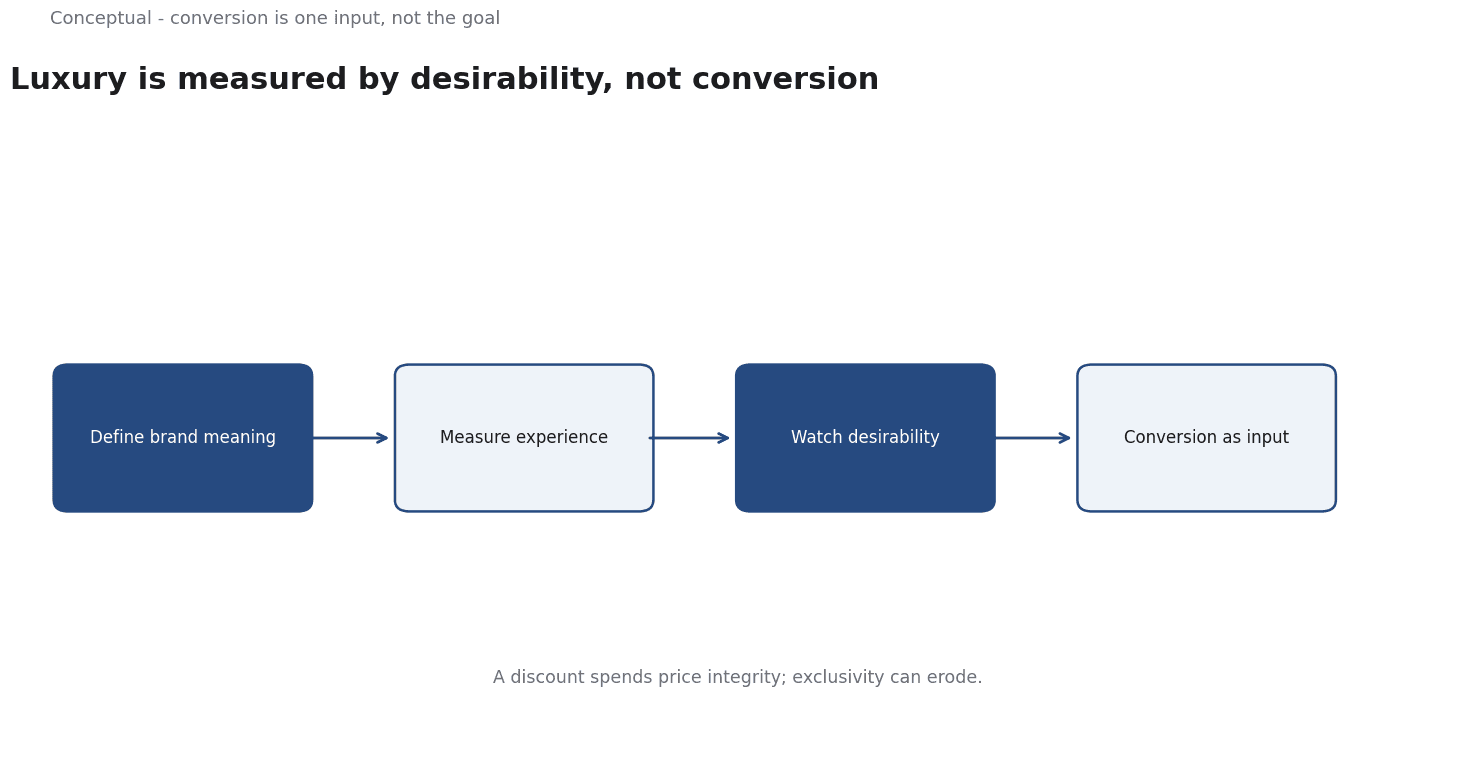
The sequence is: define what the brand should signify, measure the experience that supports it, watch desirability, then treat conversion as one input.
The definitions are local, so the conclusions are inferred; the category features are source-reported.
A worked example
Illustrative. A luxury retailer considers a promotion to clear old stock.
Three checks decide. First, what does a public discount do to the price signal for the rest of the range? Second, is the stock being sold through a channel where the brand can control the presentation? Third, will the decision generate repeat customers or train them to wait?
The outcome is a decision with a brand rationale, not just a margin calculation. The scenario is hypothetical; the method is the contribution.
Evidence status
| Claim | Status | Source | Verified | Recheck when |
|---|---|---|---|---|
| Luxury value is tied to brand and exclusivity | source-reported | Wikipedia, Luxury goods | 2026-11-18 | Definition changes |
| Experience forms across interactions | source-reported | Wikipedia, Customer experience | 2026-11-18 | Definition changes |
| Measure price integrity and desirability | inferred | Derived from both | 2026-11-18 | Brand changes |
Why a discount can damage the product
A price that can be reduced loses some of its signal about status.
A further consideration is that desirability can be damaged by scale. A brand that becomes too available may lose the exclusivity that supported its price, which is a different problem from selling too little. Managing availability is therefore part of the measure, not an operational detail.
The experience also has to be consistent across channels. A customer who receives careful service in a store and a generic experience online will form a single impression, and the weaker one will dominate. Measuring the whole journey is harder than measuring each channel, and it is the view that matters.
Finally, a brand's meaning changes with the people it attracts. A shift in customer mix can be read as growth while changing what the brand signifies, and a review should look at who is buying, not only how much they spend.
Availability should be measured as carefully as sales, since too much of one can erode the other.
A brand's meaning can shift with its customers, and a review should note who is buying.
Price integrity is an asset that a discount spends, which is why it belongs in the decision.
The experience has to hold across channels, since the customer forms one impression.
Exclusivity can be lost faster than it is built.
What it cannot do
It cannot manufacture desirability. It does not guarantee that a good experience will be remembered. And it cannot make a brand exclusive by pricing alone.
The counterargument that selling more stock is always better is fair for cash and incomplete for the brand asset.
A decision test
- Define what the brand signifies.
- Measure experience by stage.
- Watch desirability signals.
- Check the effect of any discount.
- Use dated records.
- Record the decision and recheck condition.
For the experience, see Customer Experience.
References & Further Reading
- Wikipedia contributors, 2026. Luxury goods - Wikipedia — Goods whose value is tied to exclusivity and brand.
- Wikipedia contributors, 2026. Customer experience - Wikipedia — The overall perception customers form across interactions.