Market Research for Beginners
Market research turns questions about buyers into evidence. Read the research cycle, a worked example, and why a sample cannot answer every business question.
Market research gathers information about customers, competitors, and a market to support decisions. The general reference describes research methods and their uses, while AAPOR sets standards for public opinion research. The real problem is that beginners often begin with a survey and work backward, so questions are vague, samples are convenience-based, and results are read as more certain than the method allows.
Direct answer:
Begin with a decision, then choose the method that can inform it.
The sources describe research approaches and professional standards; linking each method to a specific decision is a synthesis. A beginner's first task is to state what would change if the answer came back one way or the other, because a finding that changes nothing is not research that supports a decision.
Delta: This article adds a claim-status table and a question-to-method decision test beyond the sources: it maps each research question to a suitable method, with claim status explicit.
The mechanism
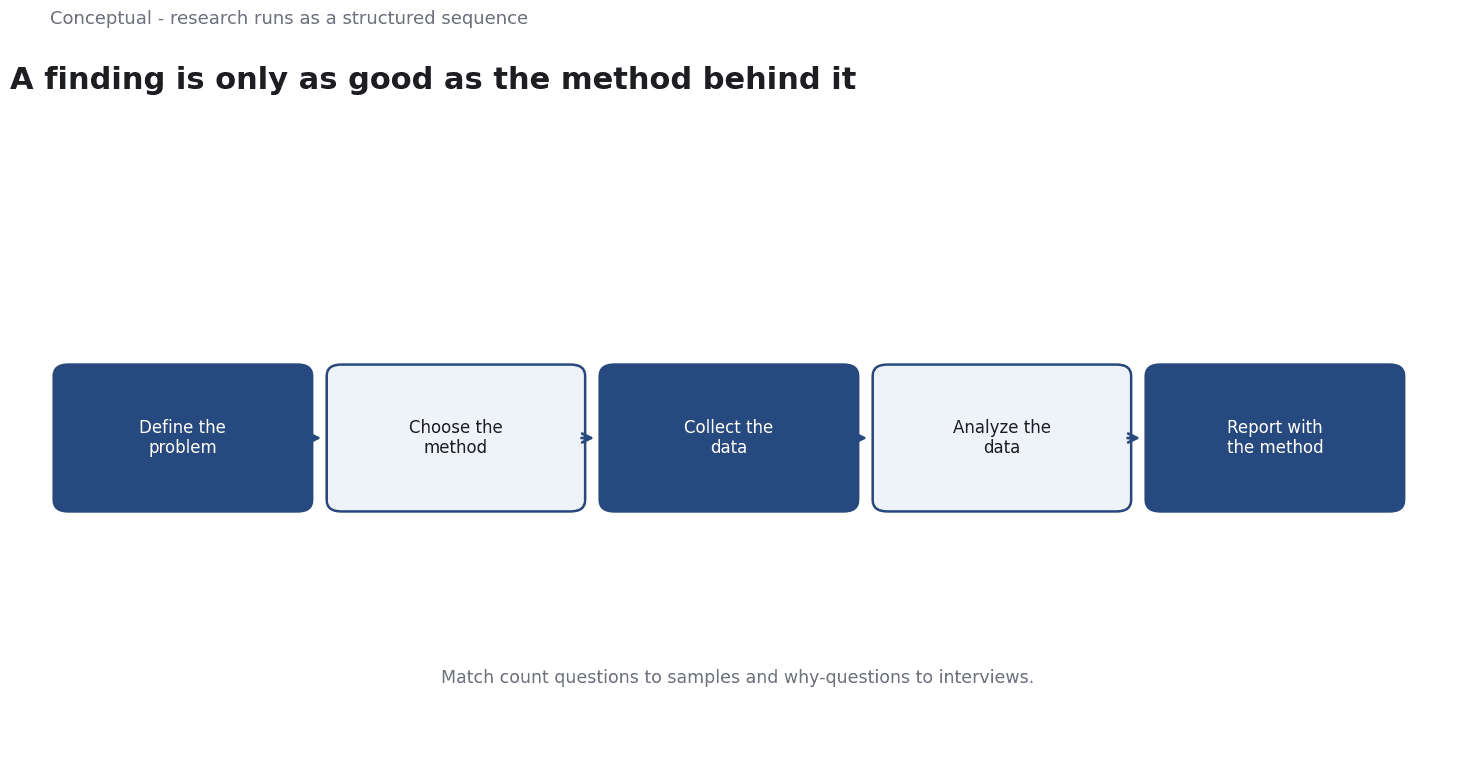
The reference describes market research as a structured process: define a problem, choose a method, collect data, analyze it, and report findings. Methods divide broadly into primary research, which gathers new data from respondents, and secondary research, which uses existing sources. The practical consequence is that method choice follows question type. A question about how many people hold a view calls for a representative sample; a question about why they hold it calls for exploratory interviews. Using the wrong method produces an answer that may be precise but irrelevant to the decision.
AAPOR's standards concern transparency in how a study was conducted, how a sample was drawn, and how results are reported. The consequence for a beginner is that a research finding should travel with its method: who was asked, how they were selected, when, and with what question wording. A percentage without those fields cannot be judged, because sampling and wording determine what it actually represents. The discipline of reporting method is what separates a usable finding from an impression.
The sources describe research processes and opinion-research standards; they do not prescribe a workflow that maps each business question to a method. That mapping is a synthesis and is marked inferred. The mark matters because it is a local choice: a team in a different market or budget may pair questions with methods differently. The claim here is that the mapping keeps a beginner honest, not that the sources require it.
The output of a research plan is a list of questions, each with a chosen method, a sample description, and the decision it will inform. That list is the decision instrument. Without it, a study can collect interesting data that nobody can connect to a choice, and the review ends with a slide deck rather than a decision.
A worked example
The following is hypothetical and illustrative. A small team wonders whether a new price would be accepted. Three checks decide the review. First, is the question descriptive, asking how many buyers would accept the price, or exploratory, asking why they resist it? Second, does the method match the question, with a defined sample for a count and interviews for reasons? Third, will the report state who was asked and how, so the finding can be judged? The team finds that the original question mixes a count with a reason, so it splits the study into a short survey of a defined customer list and a handful of interviews. The outcome is a pair of findings tied to different decisions. The respondents and results are hypothetical; the verification method is the contribution.
Evidence status
| Claim | Status | Source | Verified | Recheck when |
|---|---|---|---|---|
| Market research follows a process of defining problems, collecting and analyzing data | source-reported | Wikipedia, Market research | 2026-11-18 | Source definition revised |
| Opinion research standards call for transparency in method and reporting | source-reported | AAPOR, American Association for Public Opinion Research | 2026-11-18 | Standards updated |
| Matching each question to a suitable method and decision improves research use | inferred | Derived from the sources | 2026-11-18 | Decisions or questions change |
The first two rows are factual claims drawn from the sources and should be rechecked when those references change. The third is an inference about research practice, because neither source defines a question-to-method workflow. Recheck it when the underlying decision or question set changes.
What it cannot do
Market research cannot decide for you. It supplies evidence about a question, but the choice still rests on judgment about cost, timing, and strategy. The sources describe methods and standards, not decision rules, so treating a survey result as an automatic verdict is a category error. A well-run study narrows uncertainty; it does not remove the need for a decision maker to weigh the result against other considerations.
The hidden cost is sample quality. A convenient sample is quick to gather but may not represent the people the decision concerns, and no amount of analysis repairs that. Building a defensible sample takes time and often money, and beginners routinely underestimate both. The cost is paid before data collection, not after, and a study that skimps here produces numbers that look authoritative but cannot be generalized.
The main failure mode is question wording. Small changes in phrasing can shift responses, and a question that leads the respondent produces a result that reflects the wording rather than the market. The source standards emphasize reporting method precisely for this reason.
A beginner should test wording for neutrality before launching.
There is a boundary around what research can cover. A sample can estimate a view within a population, but it cannot speak to people outside that population, and it cannot predict every future behavior. AAPOR's standards are concerned with transparent reporting, not with guaranteeing truth. Where the question concerns a different population or a future condition, a new study is the more honest instrument.
Because decisions and markets change, the mapping needs periodic review. Each research question should carry a recheck condition tied to the decision it serves, and the method should be revisited when the population shifts. Without that record, a future reviewer cannot tell whether a finding still applies or whether the sample was only a convenience.
The counterargument that quick informal research is fair for exploring a new idea is incomplete when the finding is used to justify a decision that needs a representative answer.
A decision test
- State the decision the research must inform.
- Write the question in plain language.
- Decide whether the question needs a count or a reason.
- Choose a matching method and describe the sample.
- Check question wording for leading language.
- Report the finding with its method, timing, and sample.
- Record the decision, the result, and a recheck date.
Research is useful only when each question is tied to a decision and a method that can answer it. The test turns a vague impulse to "ask customers" into a set of questions a reviewer can follow, so a convenient sample is not mistaken for a representative one. For further reading, see Decision Memos That Survive Review.
References & Further Reading
- Wikipedia contributors, 2026. Market research - Wikipedia — Gathering information about markets and customers.
- American Association for Public Opinion Research, 2026. AAPOR — The professional association for public opinion and survey research; its standards and resources underpin the survey-design discussion.