Marketing Budgets for Beginners
A beginner's budget needs objectives, not a fixed percentage; this article maps campaign goals to budget lines, with evidence status made explicit.
Beginners often set a marketing budget as a fixed percentage or copy a competitor, without connecting the spend to what it is meant to achieve. Media planning and demand generation answer different questions: one buys reach, while the other creates qualified interest. Conflating them produces a budget that cannot be evaluated after the fact.
Direct answer:
A marketing budget should follow objectives.
Media planning allocates spend to reach and frequency in chosen channels, while demand generation funds activity that turns awareness into qualified interest. Separate reach-oriented spend from demand-oriented spend, give each a measurable objective, and review the allocation against results. Neither source prescribes a fixed percentage, so any split is a decision rather than a rule.
Delta: This article adds an allocation sequence beyond the sources: it maps campaign objectives to budget lines, with claim status explicit.
The mechanism
Media planning is the process of deciding where and when advertising will appear in order to reach a target audience. It deals with reach, how many people see a message, and frequency, how often they see it, together with channel choice and scheduling. Demand generation describes marketing activity designed to create awareness and interest and to develop qualified prospects over time. The two are complementary: one secures attention through placements, and the other develops that attention into a sales-ready state.
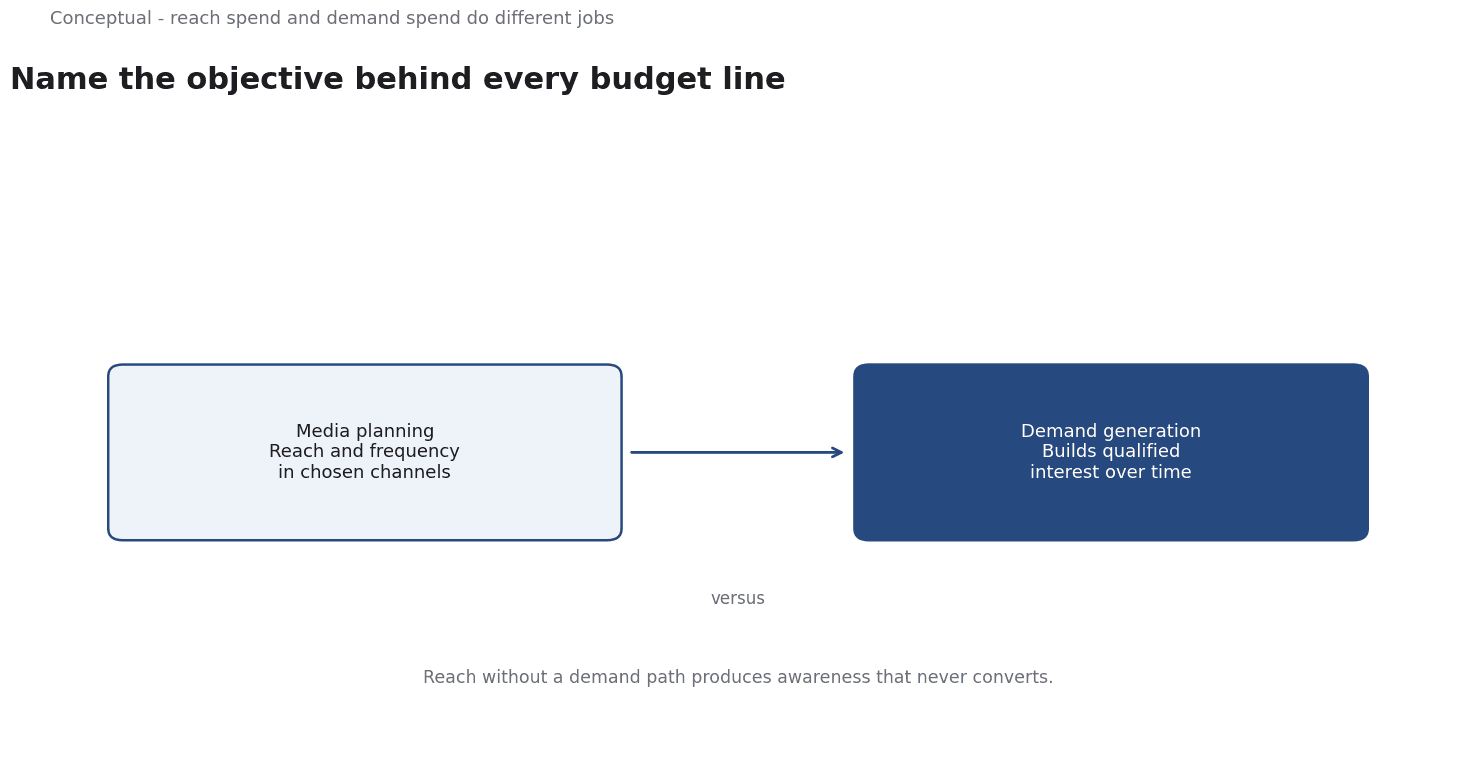
Treating them as one budget hides whether money is buying visibility or buying intent. A campaign can generate broad reach yet fail to produce qualified interest if the demand step is weak. Conversely, demand tactics cannot work without an audience that knows the product exists. A beginner's budget should therefore name which objective each line serves. Naming makes evaluation possible: reach can be judged against exposure goals, while demand activity can be judged against the volume and quality of the interest it creates.
In practice, allocation is a sequence. Start with the objective, then pick the channels that can serve it, then set the spend and schedule that deliver the intended reach or inquiry volume, and finally define the measure that will judge the result. Media planning contributes the discipline of matching placement to audience and timing; demand generation contributes the discipline of following what happens after awareness.
The sources describe concepts, not a formula. Neither supplies a universal split between reach and demand spend or a fixed share of revenue. The practical content of a budget is therefore a set of hypotheses about which activities will produce which outcomes. Those hypotheses should be written down, funded at a scale that can be tested, and revisited when the measures show that one line is underperforming.
Budgeting is closer to a managed experiment than to a one-time calculation, and that is precisely why beginners benefit from making the objectives explicit before the numbers.
A worked example
The following is hypothetical and illustrative. A small team has a limited quarterly budget and must choose between a broad awareness campaign and targeted content aimed at collecting qualified inquiries. Three checks decide the split. First, objective: is the immediate need visibility in a new market or a steady flow of interested prospects? Second, measurability: can the team observe reach and frequency for the campaign, and can it trace inquiries from the demand activity? Third, capacity: can the team handle the follow-up that demand generation requires once inquiries arrive? The outcome is a split, with part of the budget funding reach against exposure goals and the rest funding demand activity against inquiry goals, followed by a review at a fixed date. The example is illustrative, not advice for any specific business.
Evidence status
| Claim | Status | Source | Verified | Recheck when |
|---|---|---|---|---|
| Media planning decides where and when advertising appears to reach a target audience | source-reported | Media planning entry | 2026-11-18 | channel mix or scheduling changes |
| Demand generation creates awareness and interest that develops into qualified prospects | source-reported | Demand generation entry | 2026-11-18 | funnel definitions or goals change |
| Objectives should determine the split between reach spend and demand spend | inferred | Derived from the sources | 2026-11-18 | business goals or measurement changes |
The first two rows rest on definitions in the reference entries and are treated as reported, not measured here. The third row is an inference: it follows from the distinct purposes the sources assign to each activity but is not stated as a budget rule. Each row is dated and should be revisited when the available channels, the measurement approach, or the business objective changes.
What it cannot do
A budget built this way cannot predict a return. The sources describe how media planning and demand generation work as concepts; they do not provide conversion rates or a model that turns spend into revenue. Naming objectives and measures makes a budget testable, but the outcome still depends on execution and on factors outside the plan. A beginner should not read the framework as a forecast, only as a way to make the spending decision transparent and reviewable.
There are costs that a simple budget line tends to hide. Creative production and ongoing management take time that is not captured by a media rate. Demand generation in particular needs follow-up capacity: inquiries that arrive without a process to qualify and answer them are wasted spend. Measurement also has a cost, because tracking inquiries and exposure requires tools and discipline. A budget that lists only the purchase price of placements will overstate what the team can actually deliver.
The common failure is funding one side of the system without the other. Reach without a demand path produces awareness that never converts. Demand activity without awareness asks prospects to respond to an organization they do not recognize. A second failure is treating exposure numbers as outcomes: reach and frequency describe whether a message was delivered, not whether it changed anything. Judging the budget on those numbers alone rewards activity rather than results.
The boundary is that no universal split exists in the material. Neither source says what fraction of a budget should go to reach versus demand, or what share of revenue is correct. Those are choices that must be made against a specific goal and then tested. Presenting a split as if it came from the sources would overstate the evidence, so the framework stops at the allocation sequence and leaves the numbers to the decision maker.
Budgets also need regular review. Channel costs, audience behavior, and the team's capacity all change, and an allocation that worked last quarter can drift out of alignment. A practical schedule revisits each line against its stated measure, checks whether follow-up capacity is still sufficient, and shifts spend where the evidence supports it. What it cannot do is run on autopilot; the value comes from the cycle of setting a hypothesis and checking it, not from the initial allocation.
[Counterargument: "The counterargument that a fixed percentage of revenue is a safe budget rule is fair as a starting constraint and incomplete for allocation, because it says nothing about what each line is meant to achieve."]
A decision test
- State the single objective the budget must serve.
- Decide which part is reach and which part is demand.
- Choose channels that can serve each part.
- Set spend and schedule to deliver the intended level.
- Define a measure for each line before spending.
- Confirm the team can handle the resulting inquiries.
- Review the allocation against its measures on a fixed date.
A budget is a set of testable choices, and the beginner's advantage is being able to state them plainly. Write the objective, the measure, and the review date beside each line so the result can be judged without hindsight. That record is more useful than any rule of thumb about the right percentage.
For further reading, see Marketing Dashboards without the Hype.
References & Further Reading
- Wikipedia contributors, 2026. Media planning - Wikipedia — Selecting channels and scheduling advertising.
- Wikipedia contributors, 2026. Demand generation - Wikipedia — An overview of demand generation as a marketing discipline distinct from lead generation; secondary reference used with the lead-generation entry.