Marketing Mix Models for Small Teams
Marketing mix modeling estimates channel contribution, but small teams often lack the data it needs. Read the method, a worked example, claim status, and its limits.
Marketing mix modeling is often presented as a large-company tool, which leaves small teams unsure whether it applies to them. The sources describe the modeling approach and the demand-generation activity it aims to explain. The practical question is what a small team can conclude when its data is thin.
Direct answer:
A marketing mix model estimates how channels contribute to an outcome over time, and a small team can use its logic even when it cannot support a full statistical fit.
The sources describe the method and demand generation; the scaled-down use is a synthesis.
Delta: This article adds a claim-status table and a worked example beyond the sources: it maps channel data to a budget decision, with claim status explicit.
The mechanism
Marketing mix modeling uses historical data to relate an outcome, such as sales or conversions, to marketing inputs and other influences. Those other influences can include price, distribution, seasonality, and competitor activity. The goal is an estimate of each channel's contribution, which then informs how a budget is allocated. The practical consequence is that the model needs enough history and enough variation to tell channels apart.
Demand generation describes the activities that build awareness and interest in a product, often before a purchase is made. These upper-funnel efforts can have delayed and indirect effects, which makes them difficult to read from a short window of results. A model that ignores the lag between an activity and its outcome will understate channels whose effects arrive later.
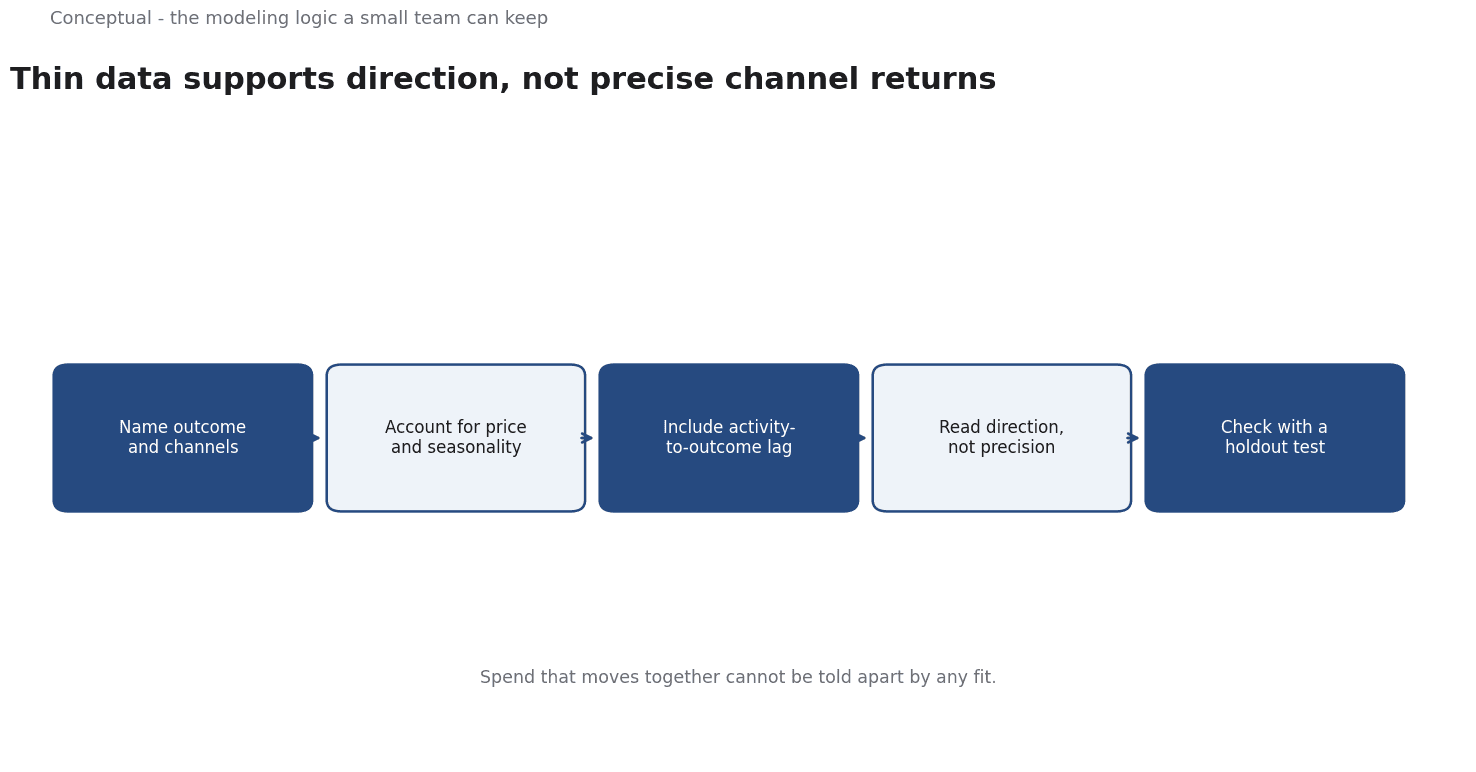
For a small team, the binding constraint is data. Estimating several channel effects alongside seasonality and price requires more observations than a young or low-volume operation usually has. When spend across channels moves together, their effects cannot be separated reliably. The logical response is to treat output as directional and to lean on simpler reads rather than precise coefficients.
The method still has value at this scale. It forces the team to name the outcome, list the channels, account for other drivers, and consider timing. Even a rough version makes hidden assumptions visible. Combined with a holdout test, it can support a cautious allocation decision without pretending to a precision the data cannot carry.
A worked example
The following is hypothetical and illustrative. A small team runs three channels and wants to decide where to put the next budget increment, but it has only a short history of weekly results.
Three checks decide how far to trust a model. First, did channel spend vary enough on its own to separate effects, rather than rising and falling together? Second, were other drivers, such as a price change or a seasonal peak, accounted for? Third, was the lag between activity and outcome included? The outcome is a directional reallocation paired with a holdout test, not a confident return figure. The scenario is hypothetical; the method is the contribution.
Evidence status
| Claim | Status | Source | Verified | Recheck when |
|---|---|---|---|---|
| Marketing mix modeling estimates channel contribution from historical data | source-reported | Wikipedia, Marketing mix modeling | 2026-11-18 | Method definition changes |
| Demand generation builds awareness and demand for a product | source-reported | Wikipedia, Demand generation | 2026-11-18 | Definition changes |
| Small teams should treat output as directional without enough variation | inferred | Derived from the sources | 2026-11-18 | Data volume changes |
The two source-reported rows describe the method and the activity it measures; the inferred row is the small-team application. One source explains what a model estimates, and the other explains what demand generation is. Recheck conditions follow changes to the definitions or to the team's data, not a set schedule.
What it cannot do
A marketing mix model cannot separate effects that never varied independently. If two channels always increased together, the data contains no information that distinguishes them, and no modeling choice can recover that distinction. Small teams are especially exposed to this because their spend is often concentrated and changed in step. Recognizing the problem is more useful than fitting a model that silently divides credit between channels it cannot tell apart.
It cannot prove causation on its own. The estimate depends on assumptions about which drivers matter and how effects are spread over time. If an important driver is omitted, its influence is absorbed by the channels that remain in the model, and the allocation advice becomes misleading. The model is a structured estimate, not an experiment, and its output should be framed that way in any decision.
There is a hidden cost in maintenance. Historical data must be assembled, cleaned, and kept consistent as channels and definitions change. A small team may spend more effort maintaining the model than it would on a simple test, and the model can drift out of date quickly in a fast-moving channel mix. That cost should be weighed before committing to a recurring practice.
A single return figure looks authoritative and invites a large budget move, even when it rests on a short history and correlated inputs. The safer use is a range with a stated caveat, paired with a holdout test that can confirm or contradict the direction. Precision that the data cannot support is a liability in a budget conversation, not an asset.
The boundary is that these sources describe a method and a demand-generation concept, not a small-team recipe. They do not specify a minimum sample size, an acceptable level of correlation, or a lag structure. Those are local choices that depend on the channels and the horizon of the outcome. A team should set them from its own data and review them when the channel mix, the volume, or the sales cycle changes.
The counterargument that a full model is too heavy for a small team is fair when data is thin and incomplete when the structured thinking behind it is discarded along with the model.
A decision test
- Name the outcome the model is meant to explain.
- List the channels and the other drivers that affect the outcome.
- Check that spend varied enough to separate channel effects.
- Account for the lag between activity and outcome.
- Read the result as a direction, not a precise figure.
- Pair the read with a holdout test where feasible.
- Record the assumptions and the recheck condition.
Marketing mix modeling is most useful to a small team as a way of thinking about contribution, not as a source of exact answers. The structure it imposes, naming the outcome, the channels, the other drivers, and the timing, is valuable even when the fitted result is rough. A team that pairs that structure with a test gets a defensible allocation decision without claiming precision it does not have.
For further reading, see Marketing Dashboards without the Hype.
References & Further Reading
- Wikipedia contributors, 2026. Marketing mix modeling - Wikipedia — Statistical attribution of sales to marketing inputs.
- Wikipedia contributors, 2026. Demand generation - Wikipedia — An overview of demand generation as a marketing discipline distinct from lead generation; secondary reference used with the lead-generation entry.