Marketing Operations in Practice
Marketing operations turns strategy into repeatable execution. Read how CRM and demand generation connect, where handoffs fail, and a test for tightening the system.
Marketing operations is often treated as the administrative layer that buys tools and maintains dashboards. The real problem is that it is where strategy either becomes repeatable execution or quietly falls apart at the handoffs. Without clear definitions of customer data and demand stages, teams accumulate activity that looks busy but cannot be traced to a decision.
Direct answer:
Marketing operations is the discipline of designing the processes, data, and systems that turn strategy into repeatable campaigns.
Wikipedia's "Customer relationship management" entry frames CRM as the systems and practices for managing interactions with current and potential customers, while its "Demand generation" entry describes the process of creating awareness and interest that converts into pipeline. The boundary: these are frameworks for organizing work, not guarantees of revenue.
Delta: This article adds a process map beyond the sources: it maps the CRM and demand-generation concepts to the specific operational decisions about data ownership and stage definition, with claim status explicit.
The mechanism
Wikipedia's "Customer relationship management" entry describes CRM as the approaches, technologies, and processes companies use to manage interactions with current and potential customers, typically supported by software that records contact history, tracks opportunities, and coordinates sales and service. The mechanism is a shared customer record: interactions are captured in one place so that different teams see the same history. The practical consequence is that every downstream process depends on the quality of that record. When customer data is fragmented across spreadsheets and tools, marketing and sales operate from conflicting pictures of the same account.
Wikipedia's "Demand generation" entry describes the marketing activities that create awareness and interest in a product and convert that interest into qualified leads or pipeline. The mechanism is a staged progression: an anonymous audience becomes a known contact, then a qualified lead, then an opportunity, with each stage narrowing the pool. The practical consequence is that every stage needs a definition and an owner. Without agreed criteria for what counts as qualified, the number of leads becomes a vanity measure, and the handoff to sales becomes a point of argument rather than a routine.
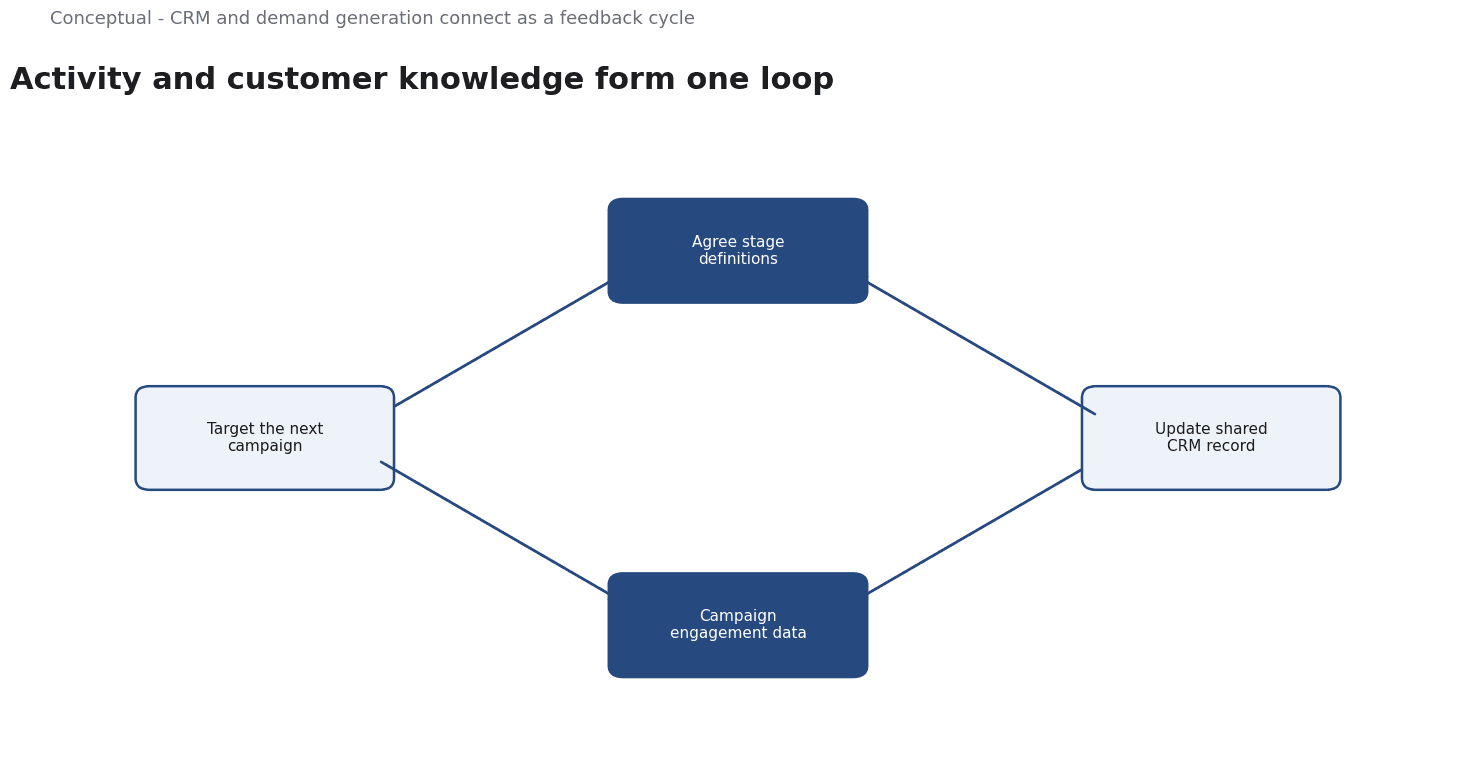
The two concepts connect as a loop. Demand-generation campaigns produce engagement data that should update the CRM record, and the accumulated record should inform whom the next campaign targets. The mechanism is a feedback cycle between activity and customer knowledge. The practical consequence is that the boundary between marketing and sales is where the system either holds or fails. If the two functions define a qualified lead differently, the same contact is counted as a win by one and rejected by the other, and the loop carries noise instead of signal.
The fourth element is that tooling does not substitute for process definition. CRM platforms and automation tools can enforce a workflow only after someone has specified the stages, the ownership, and the data standards. The practical consequence is that the operational work precedes the technology purchase. A team that buys a platform before agreeing on what a qualified opportunity means has automated its ambiguity, and the resulting dashboards will report inconsistent numbers with great precision.
A worked example
The following is hypothetical and illustrative. A B2B team sees a rise in marketing-qualified leads while sales complains that pipeline quality has not improved. Three checks are run. First, the definition check: do marketing and sales use the same written criteria for a qualified lead, and is the criterion based on fit and intent rather than form completion? Second, the data check: does the CRM record capture the source and engagement history of each lead, or are fields blank where attribution should be? Third, the handoff check: is there an agreement on how quickly accepted leads are contacted and how rejections are coded? The outcome is a process fix rather than a new tool: align the definition, enforce required fields, and instrument the handoff. The limitation is that cleaner process reveals problems but does not by itself create demand.
Evidence status
| Claim | Status | Source | Verified | Recheck when |
|---|---|---|---|---|
| CRM manages interactions with current and potential customers | source-reported | Customer relationship management - Wikipedia | 2026-11-18 | when the entry's scope or technology coverage changes |
| Demand generation builds awareness that becomes qualified pipeline | source-reported | Demand generation - Wikipedia | 2026-11-18 | when the described funnel stages change |
| Shared stage definitions make the marketing-to-sales handoff reliable | inferred | Derived from the sources | 2026-11-18 | when new evidence on lead handoff effectiveness appears |
The first two rows report what the reference entries state directly and can be checked against them. The third is an inference: it follows from treating the shared record and the staged funnel as a single system, but neither source presents it as a rule. Recheck conditions point back to the sources or to new evidence, which keeps the status of each row explicit rather than implied.
What it cannot do
Marketing operations cannot create demand on its own. It organizes the capture, routing, and measurement of interest that originates in the product, the market, and the sales effort. A perfectly instrumented funnel with no real audience interest will report its own emptiness accurately. The limit is that process discipline amplifies the underlying demand rather than generating it, so an operations team judged on lead volume alone is measured on something it does not control. Honest scorecards separate the quality of demand from the quality of its handling.
A hidden cost is the labor of maintaining the system. CRM hygiene, deduplication, field validation, and integration upkeep are continuous work that rarely appears in a campaign plan. Teams underinvest in this layer and then wonder why reports disagree. The cost is not the software license but the ongoing attention required to keep data usable. Under-resourced operations produces a system that is technically live and practically unreliable, where every report needs a manual reconciliation before it can be trusted.
When a team is rewarded for the number of leads it passes to sales, the definition of a qualified lead quietly loosens until the number grows and the quality collapses. The same mechanism appears when sales rejects leads without coding a reason, so marketing never learns which criteria were wrong. The system then optimizes the wrong behavior. The practical symptom is a dashboard that shows improving volume alongside flat revenue, which should immediately prompt a check of the stage definition rather than a call for more activity.
The boundary is that a heavy operations apparatus is not appropriate for every stage of a company. Early teams exploring a market may benefit from informal, direct contact more than from elaborate scoring models, because the definitions are not yet stable enough to encode. The frameworks in these sources describe mature functions with known stages, not the discovery phase where the stages are still being learned. Applying enterprise-grade process too early adds overhead without insight, and the discipline should scale with the complexity of the motion rather than be imposed from the start.
Finally, the system needs scheduled review because markets, channels, and definitions change. A qualification criterion that fit one buyer profile may exclude a new segment, and an attribution rule that worked for one channel may misreport another. The practical requirement is to revisit stage definitions, ownership, and data standards on a fixed cadence, and to record which decisions relied on which numbers. Without that review, operations becomes a set of inherited conventions that nobody remembers choosing, and the metrics drift silently away from the reality they were meant to describe.
The counterargument that strong operations can rescue weak demand is fair for improving conversion of existing interest and incomplete for creating interest that does not exist, which is a product and market problem.
A decision test
- State the decision the operational metric is meant to inform.
- Write down the definition of each funnel stage and who owns it.
- Confirm marketing and sales use the same qualification criteria.
- Check that required CRM fields are populated and the source is recorded.
- Verify the handoff has a response time and a rejection-reason code.
- Separate demand quality from handling quality on the scorecard.
- Set a cadence to review definitions and record changes.
These steps convert a vague aim such as improving marketing operations into checks on the specific places where process fails. The mapping from CRM and demand-generation concepts to data ownership and stage definitions is what makes the review actionable. A passed test leaves a system whose numbers can be trusted and whose handoffs have owners, not just a stack of tools.
For further reading, see Marketing Dashboards without the Hype.
References & Further Reading
- Wikipedia contributors, 2026. Customer relationship management - Wikipedia — Systems for managing customer relationships.
- Wikipedia contributors, 2026. Demand generation - Wikipedia — An overview of demand generation as a marketing discipline distinct from lead generation; secondary reference used with the lead-generation entry.