MaxDiff Analysis for Small Teams
MaxDiff forces trade-offs to rank what customers value, but it answers a narrower question than conjoint. Learn what it measures, a worked example, and where it breaks.
Small teams often need to know which features or messages customers value most, but they lack the budget for large-scale research. MaxDiff is attractive because it forces respondents to choose rather than rate, producing a ranking from relatively simple tasks. The problem is that a ranking of what matters is not the same as a measure of how much it matters, and the two support different decisions.
Direct answer: MaxDiff asks respondents to pick the most and least preferred items from small sets, and the pattern of choices yields relative importance scores across the items tested. Conjoint analysis instead estimates the value of attributes by observing choices among product combinations, which can support trade-off and willingness-to-pay questions. MaxDiff is cheaper and simpler to field; conjoint answers more but costs more in design and sample.
Delta: This article adds a method-selection decision beyond the MaxDiff and conjoint sources: it maps the question a team can answer to the method that can answer it, with claim status explicit.
The mechanism
As the source describes it, MaxDiff, or maximum difference scaling, presents respondents with a subset of items and asks which is most preferred and which is least preferred. Repeating this across many balanced sets produces data on relative standing, because each choice is a forced trade-off rather than an unrestricted rating. Rating scales let every item score high; MaxDiff prevents that by requiring a winner and a loser in every task. The practical consequence is a cleaner ordering of items by importance, with less of the ceiling effect that plagues rating questions.
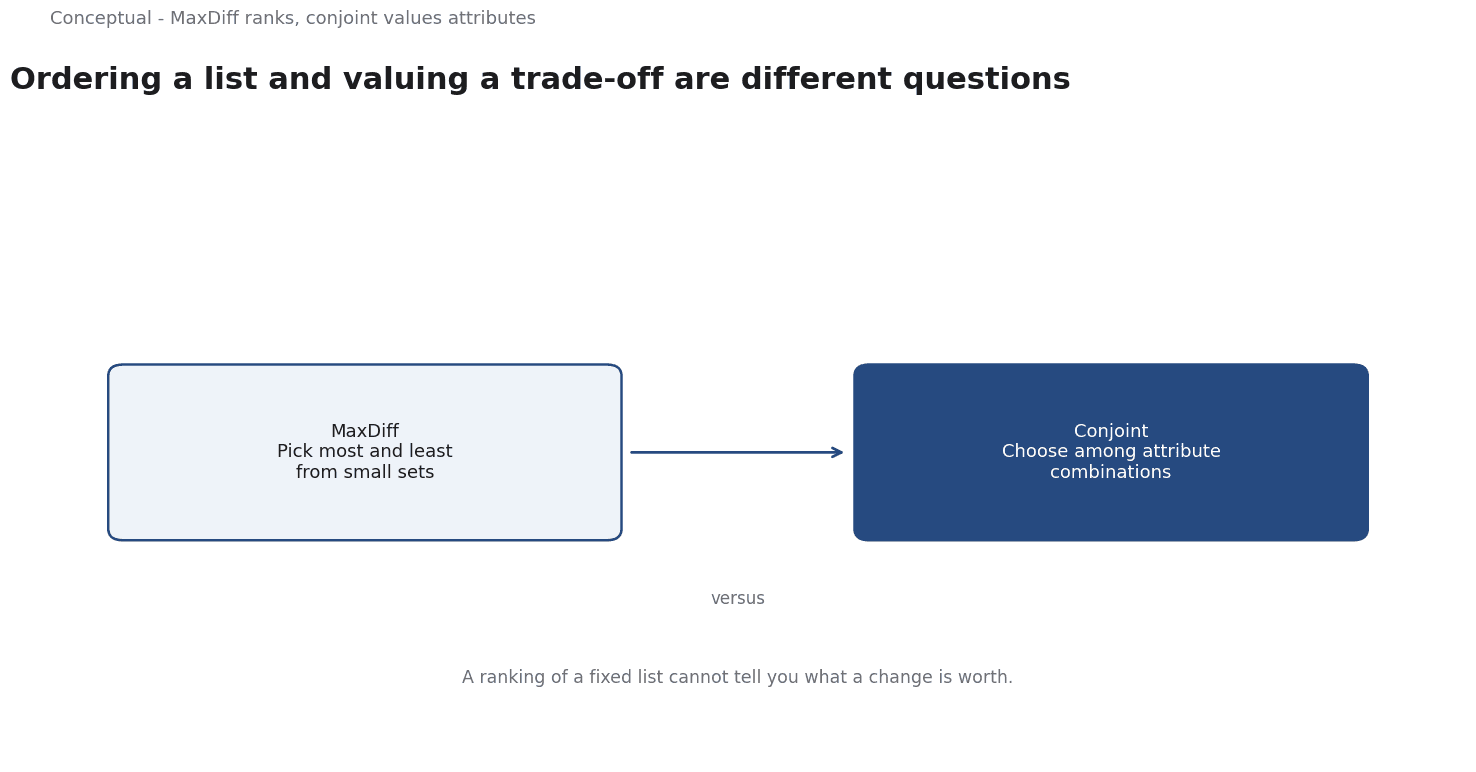
Conjoint analysis works differently. It presents combinations of attributes, such as price, brand, and features, and asks respondents to choose among them or rank them. From those choices it estimates the contribution of each attribute level to overall preference, which is why it is used for product design and pricing questions. The practical consequence is that conjoint can estimate how much a change in one attribute is worth relative to another; MaxDiff only orders a fixed list.
The trade-off for small teams is design and sample. MaxDiff tasks are short and the analysis yields scores that are easy to communicate, so it can run with a modest respondent pool. Conjoint requires careful selection of attributes and levels and more choices per respondent to estimate utilities reliably, which raises both design effort and the sample needed for stable estimates.
The practical decision follows from that limit.
Use MaxDiff to prioritize a list and conjoint to understand the structure of a choice.
A team deciding which ten messages to test first has a ranking problem. A team deciding what combination of price and features to launch has a trade-off problem. Choosing the wrong method produces an answer that is precise about the wrong question.
A worked example
The following is hypothetical and illustrative. A small software team has twelve candidate onboarding improvements and can build only three this quarter. It runs a MaxDiff exercise in which respondents repeatedly see four improvements and pick the most and least valuable, then computes relative importance scores. Three checks decide whether to act. First, sample adequacy: if the respondent pool is too small, the scores will be unstable and reorder with a few more responses. Second, design balance: if some items never appear together, their comparison is weak. Third, decision fit: if the team actually needs to know how much each improvement raises retention, a ranking cannot supply that and a conjoint design would be required. The outcome is a defensible shortlist of three, not a claim about the value of each.
Evidence status
| Claim | Status | Source | Verified | Recheck when |
|---|---|---|---|---|
| MaxDiff produces relative importance scores from forced most and least choices | source-reported | Wikipedia MaxDiff | 2026-11-18 | When survey methodology references change |
| Conjoint analysis estimates attribute values from choices among combinations | source-reported | Wikipedia Conjoint analysis | 2026-11-18 | When conjoint methodology guidance changes |
| MaxDiff is cheaper to field but cannot estimate willingness to pay | inferred | Derived from the sources | 2026-11-18 | When study design or sample size changes |
The first two rows restate the methods as the references describe them. The third row is an inference about cost and scope drawn from the design differences, not a statement the sources make. Recheck the source-reported rows if the reference material is revised; recheck the inferred row when the team's sample budget or the decision being supported changes.
What it cannot do
MaxDiff cannot tell you how much anything is worth. Its output is a relative scale with no natural zero and no unit, so a score twice as large does not mean twice the preference or twice the revenue. Teams that read the scores as cardinal values overinterpret the result. The ranking is useful for ordering items and little else.
The hidden cost is in design and fatigue. To compare items fairly, each must appear in balanced sets, and a large item list means many tasks per respondent. Long surveys introduce fatigue, and fatigued respondents choose superficially, which degrades the very data the method is meant to clean up. A small team may field a MaxDiff expecting simplicity and discover it still needs careful item design and a respondent pool large enough to stabilize the scores.
MaxDiff assumes respondents can meaningfully compare the items in a set; mixing vague and concrete items, or items at different levels of abstraction, produces scores that reflect the confusion rather than preference. Another failure is treating a sample of convenience as representative and projecting the ranking onto a whole market.
The boundary is decision scope. MaxDiff ranks a fixed list you supply, so it cannot reveal an option you forgot to include or explain why one item wins. If the real question is why customers prefer one feature or what they would give up to get it, the ranking is silent, and a conjoint or qualitative approach is needed.
Preferences change, and a ranking is a snapshot. Items that were unknown when the study ran can enter the market, and a short study can overrepresent a seasonal or recent concern. A review cadence that re-fields the exercise when the product or market shifts keeps the ranking useful; otherwise it hardens into an assumption.
The counterargument that MaxDiff is good enough for prioritization is fair when the decision is only an ordering and incomplete when the choice depends on magnitude, trade-offs, or willingness to pay.
A decision test
- State the decision and whether it needs a ranking or a magnitude.
- List the items or attributes that belong in the study.
- Choose MaxDiff for ordering a fixed list and conjoint for attribute trade-offs.
- Design balanced tasks so comparisons are fair and tasks stay short.
- Check that the respondent pool is large enough for stable results.
- Validate that respondents can compare the items in each set.
- Re-field when the product or market changes.
Match the method to the question before designing the study. If the decision needs a number, a ranking will not supply it, and if it only needs an ordering, a conjoint design is wasted effort. The test keeps a small team from paying for precision it cannot use or trusting precision it does not have.
For further reading, see Voice of Customer: Turning Feedback into Decisions.
References & Further Reading
- Wikipedia contributors, 2026. MaxDiff - Wikipedia — Maximum difference scaling for preference measurement.
- Wikipedia contributors, 2026. Conjoint analysis - Wikipedia — Measuring preferences across product attributes.