Martech Stacks Trade-Offs
A marketing stack trades coverage against complexity. Read the trade-offs, a worked audit, and why more tools can mean less insight.
A marketing stack is often grown by adding a tool for each new need, which increases coverage and cost together. The demand-generation entry describes the stages a stack supports, and the cloud-cost framework treats waste as a design problem. The trade-off is what each tool adds beyond the ones already there.
Direct answer:
Choose tools by the decision they change, map the data between them, and count ownership and integration cost before adding another.
The sources describe the purpose; the rule is a synthesis.
Delta: This article adds a claim-status table and a worked audit, separating documented channel stages from local judgements about tool value.
The mechanism
The first trade is coverage against overlap. The demand-generation entry describes the stages from interest to purchase, and several tools often claim the same stage. Overlap is not necessarily waste, but it needs a reason, and a tool without a distinct decision is a cost.
The second trade is integration. The cloud-cost framework treats waste as a design concern, which applies to the effort of keeping data consistent across systems. A tool that requires manual reconciliation may cost more in attention than it saves in automation.
The third trade is ownership. Each tool needs someone accountable for configuration and data, which is a continuing cost. A stack that outgrows the team's capacity to own it produces reports nobody trusts.
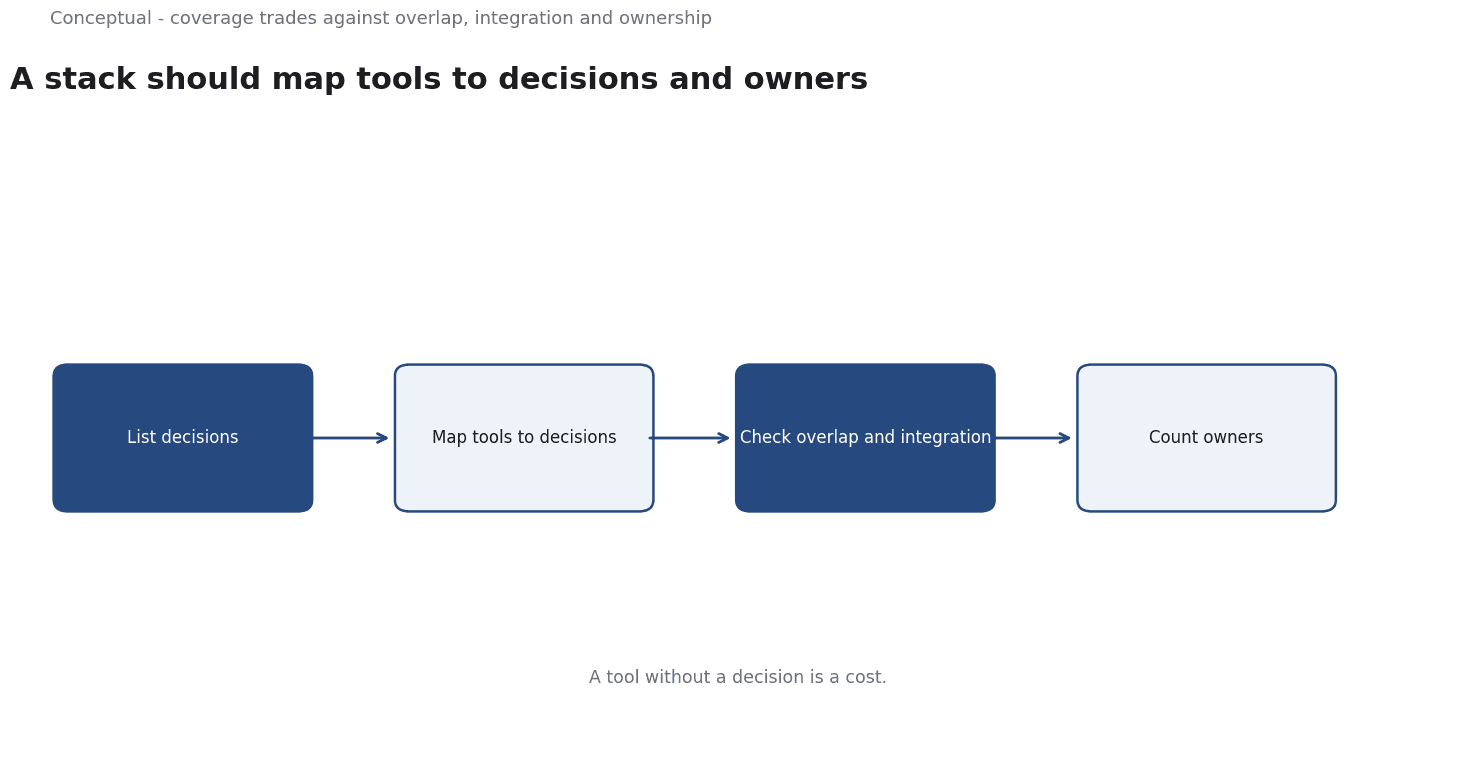
The sequence is: list the decisions, map the tools to them, check overlap and integration, then count owners. The mapping is local, so the conclusions are inferred; the stages are source-reported.
A worked audit
Illustrative. A team uses five tools and cannot explain where a reported metric comes from.
Three checks decide. First, which decision does each tool support, and does any two support the same one? Second, where is data moved manually between them, and what is the error rate? Third, who owns each tool's configuration and definitions?
The outcome is a removal decision and an ownership map. The scenario is hypothetical; the method is the contribution.
Evidence status
| Claim | Status | Source | Verified | Recheck when |
|---|---|---|---|---|
| Demand generation describes stages before purchase | source-reported | Wikipedia, Demand generation | 2026-11-18 | Definition revised |
| Waste is a design concern | source-reported | AWS cost framework | 2026-11-18 | Pricing changes |
| Map tools to decisions and owners | inferred | Derived from both | 2026-11-18 | Stack changes |
Why more tools can mean less insight
Reducing the stack makes the remaining numbers easier to trust, which is a form of insight that coverage does not provide.
A further consideration is that tools change. A platform that was useful at one point can add features that duplicate another tool or remove the feature the team depended on, and a stack that is never reviewed drifts into overlap. A scheduled audit is the control, not an occasional cleanup after a problem.
The cost of switching is another trade. Removing a tool may lose historical data or break a workflow, and that cost belongs in the decision. A tool that is expensive but hard to replace may be worth keeping while a cheaper alternative is evaluated, which is a reason to record the exit path when a tool is adopted.
The third limit is that a stack cannot fix a measurement question that was never asked. Adding a platform to answer an undefined question produces dashboards, not decisions, which is why the decision comes first in the audit.
The map of tools to decisions should be reviewed on a schedule, since a stack that is never revisited drifts into overlap that nobody owns.
A tool without a decision is a cost, and the audit exists to make that visible.
The data map between tools matters more than the number of tools in the stack.
Ownership should be assigned before a tool is added, not discovered after a report breaks.
The audit should end with a removal decision, not only with a list of tools.
A tool that cannot name the decision it supports has no place in the map.
A decision test
- List the decisions the stack supports.
- Map each tool to a decision.
- Check overlap and manual integration.
- Assign an owner to each tool.
- Remove what has no decision.
- Record the map and recheck date.
For the starting point, see Getting Started with Martech.
A counterargument
The article's evidence table concedes its central rule - map tools to decisions and owners - is inferred, a synthesis rather than something the sources establish, and a critic can press on what that leaves out. The AWS framework treats waste as a design problem but says nothing about redundancy: two tools covering the same demand-generation stage may insure against the vendor changes the article itself flags as a real risk, and a strict one-decision-per-tool test would remove that hedge. The audit prices ownership and integration but cannot price the data or workflow lost on removal, a cost it acknowledges. The objection is that the framework exposes unjustified tools but cannot say when overlap is justified, so removal rests on the judgment the method claims to discipline.
References & Further Reading
- Wikipedia contributors, 2026. Demand generation - Wikipedia — An overview of demand generation as a marketing discipline distinct from lead generation; secondary reference used with the lead-generation entry.
- Amazon Web Services, 2026. Cost Optimization (AWS Well-Architected Framework) — Vendor primary documentation on right-sizing and commitment models.