Mental Models Metrics that Matter
A mental model is useful when it changes a decision. Read how to evaluate one, a worked example, and why recognising a model is not using it.
Mental models are often collected as names, which gives the impression of understanding without changing behaviour. The Wikipedia entry describes models as representations used in reasoning, and the decision-making entry covers the structure of a choice. The measure is whether a model changes a decision.
Direct answer: Evaluate a mental model by whether it predicts something you could not otherwise predict and changes a decision you actually make. The sources describe reasoning; the test is a synthesis.
Delta: This article adds a claim-status table and a worked evaluation, separating documented reasoning concepts from the local test of usefulness.
The mechanism
Three points matter:
- A model is a representation. The mental-model entry describes how people represent the world. A representation can be useful and still be incomplete.
- Decisions have structure. The decision-making entry describes owners and evidence. A model earns its place when it changes the evidence or the choice.
- Prediction is the test. A model that explains the past but predicts nothing is hard to distinguish from a story.
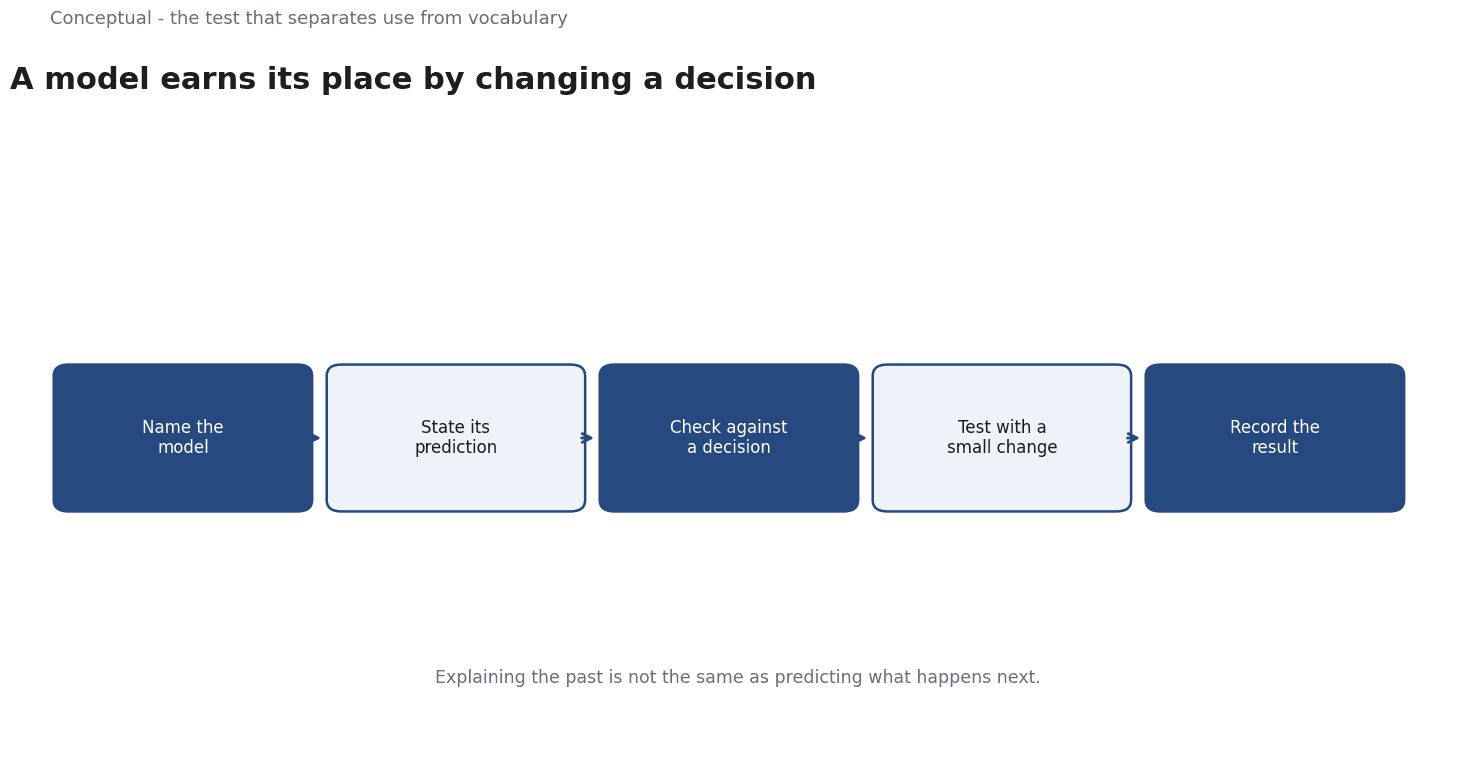
The sequence is: name the model, state its prediction, check it against a decision, then record the result.
The choice of model is local, so it is inferred; the concepts are source-reported.
A worked example
Illustrative. A team invokes "incentives" to explain a drop in referral volume.
Three checks decide. First, what does the model predict specifically — that a changed reward will change behaviour in a direction? Second, can that prediction be checked against a small change? Third, did the team actually change a decision because of it?
The outcome is a test, not a label. The scenario is hypothetical; the evaluation method is the contribution.
Why prediction separates use from vocabulary
A model that explains an outcome after the fact is easy to find, because many models fit any single event. The stronger test is what it would have predicted beforehand and whether the prediction was distinctive. A model that predicts everything predicts nothing useful for a decision.
Where models fail
Most models are local to a domain. A model that works for network effects can mislead in a market where scarcity comes from capacity instead. Knowing the boundary of a model is part of using it, and that boundary is learned by checking where the prediction breaks.
Evidence status
| Claim | Status | Source | Verified | Recheck when |
|---|---|---|---|---|
| Mental models are representations used in reasoning | source-reported | Wikipedia, Mental model | 2026-11-18 | Definition revised |
| Decisions have structure and evidence | source-reported | Wikipedia, Decision making | 2026-11-18 | Source revised |
| Test a model by its prediction and decision effect | inferred | Derived from the concepts | 2026-11-18 | Decision context changes |
Why recognising a model is not using it
The harder test is whether the model would have predicted the outcome beforehand and whether anyone acted on it. That is the difference between vocabulary and method.
A final issue is that models can conflict. Two useful models will sometimes predict opposite outcomes, and choosing between them requires knowing which assumptions hold in the current situation. That judgment is not supplied by the models themselves, which is why a record of the reasoning matters more than a list of the models used.
The evaluation also has a cost. Testing every model on every decision is impractical, so a team must decide which models are worth testing. That choice should follow the decisions that matter most, not the models that are most familiar.
A recorded prediction is more useful than a remembered one, because memory tends to fit the outcome. Writing down what a model predicted before the result is the cheapest way to make the evaluation honest.
The record should include which model was used and what it predicted, so a later decision can be evaluated against the reasoning rather than the outcome alone.
The point of tracking a model is to learn where it applies, not to collect the models themselves. A short record of prediction and outcome is enough.
A model earns its place by changing a decision, not by being named in a meeting.
Testing one model well is more useful than collecting ten that are never checked against a decision.
The boundary of a model matters as much as the model, because the same reasoning can mislead outside the conditions where it was learned.
What it cannot do
It cannot guarantee a correct decision. It does not replace data. And it cannot make a model universal — most are local to a domain.
The counterargument that more models always help is fair for breadth and incomplete when none are tested.
A decision test
- Name the model.
- State its prediction.
- Check it against a decision.
- Test with a small change.
- Record the result.
- Set a recheck condition.
For the decision form, see Decision Memos.
References & Further Reading
- Wikipedia contributors, 2026. Mental model - Wikipedia — How people represent and reason about the world.
- Wikipedia contributors, 2026. Decision-making - Wikipedia — Overview of decision processes, trade-offs and the distinction between the decision and its outcome; secondary reference.