Monetary Policy without the Hype
Central banks set rates to influence inflation and activity. See how the Fed's mandate and tools work, a worked financing decision, and where the mechanism breaks.
Monetary policy is often discussed as if a single committee decision sets the cost of borrowing for everyone. The real problem is that policy acts through a chain of rates, expectations, and lags, so a headline about a rate move says little about what it means for a specific financing decision. Reading the mechanism, rather than the headline, is what makes the topic useful.
Direct answer: Monetary policy is the process by which a central bank manages money and credit conditions to influence inflation and economic activity. The Federal Reserve states that it conducts policy to promote maximum employment and stable prices, using tools that steer short-term rates. The boundary: policy influences conditions; it does not set every borrowing cost or guarantee an outcome.
Delta: This article adds a claim-status table and a mapping from policy stance to a financing decision beyond the sources: it maps the policy signal to a borrowing choice, with claim status explicit.
Treating policy as a direct dial for every rate is a category error, and the sources describe influence over conditions rather than control over outcomes.
The mechanism
Wikipedia's monetary policy entry describes the use of monetary instruments by a central bank to influence economic activity, inflation, and employment. The Federal Reserve's own page frames the goal in terms of its statutory mandate: maximum employment and stable prices, with moderate long-term interest rates. The practical consequence is that policy is evaluated against goals, not against a single number. A rate move is a means, and its merit depends on whether it moves the economy toward those ends.
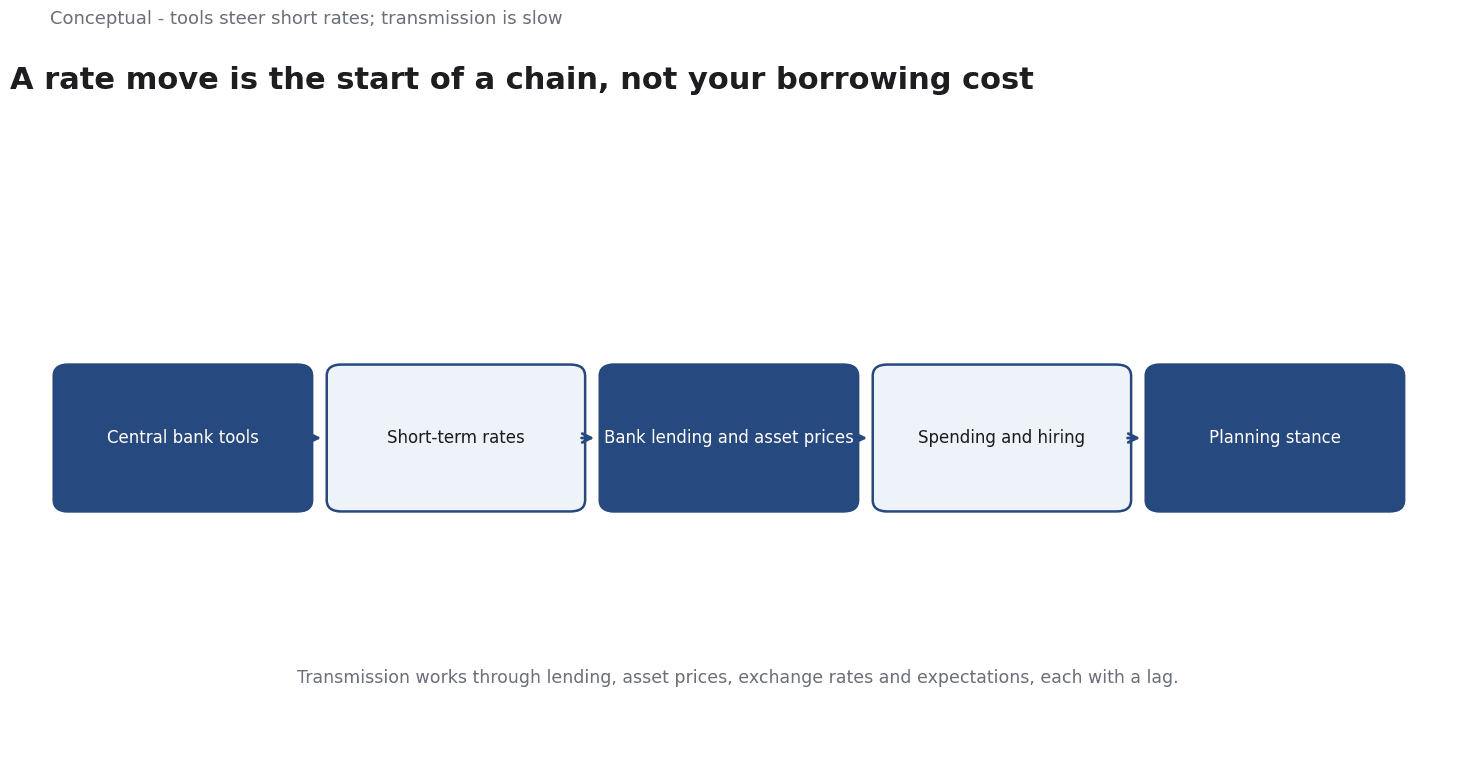
The tools work on the price of money. Traditional levers include open market operations, the discount rate, and reserve requirements; the Fed also uses administered rates such as interest on reserve balances and the reverse repurchase rate to keep the federal funds rate within its target range. The practical consequence is that the central bank directly influences short-term rates. Longer-term rates, which matter more for a business loan or a mortgage, are set by markets and reflect expectations and risk, not by the central bank alone.
Transmission is indirect and slow. A change in the policy rate filters through bank lending, asset prices, exchange rates, and expectations before it reaches spending and hiring, and each step has a lag. The practical consequence is that the effect of a decision is spread over time and is hard to attribute to a single meeting. A manager who reads a rate decision as an immediate change in their own borrowing cost is confusing the start of a chain with its end.
The output is a stance, not a prescription. The sources describe the goals, tools, and general transmission of policy; they do not prescribe how a particular firm should finance itself. The useful move is to translate the stance into a planning assumption: what is likely to happen to short-term rates, and how exposed is the balance sheet to that path. That translation is a local decision built on the described mechanism, not a rule the sources supply.
A worked example
The following is hypothetical and illustrative. A mid-size manufacturer is deciding whether to refinance a floating-rate loan into a fixed-rate one. Three checks structure the review. First, the stance check: is the current policy position described by the central bank's published target range and stated goals, rather than inferred from a single headline? Second, the transmission check: does the firm's lending spread actually track the policy rate, or is it driven mostly by its own credit profile? Third, the lag check: how long before a policy change would reach the firm's refinancing window? The analysis shows that the firm's spread is largely credit-driven and that its refinancing date sits beyond the near-term policy path. The outcome is a staggered refinancing plan, not a bet on one meeting. The numbers are hypothetical; the mapping from stance to decision is the contribution.
Evidence status
| Claim | Status | Source | Verified | Recheck when |
|---|---|---|---|---|
| Central banks use monetary policy to influence inflation and economic activity | source-reported | Monetary policy - Wikipedia | 2026-11-18 | the definition is revised |
| The Fed conducts policy to promote maximum employment and stable prices | source-reported | Federal Reserve, Monetary Policy | 2026-11-18 | the mandate or framework is updated |
| Policy rate changes reach business borrowing conditions with variable lags | inferred | Derived from the sources | 2026-11-18 | the rate regime or borrowing conditions change |
The first two rows report what the sources state directly and can be checked against them. The third is an inference about transmission lags, which the sources describe in general terms but do not quantify for any particular borrower. Recheck the source rows when the mandate or framework changes, and the inferred row when the rate regime or the firm's own borrowing conditions change.
What it cannot do
Monetary policy cannot set long-term interest rates or specific asset prices. The central bank steers short-term rates, but longer-term borrowing costs are determined in markets that price expectations, term premia, and risk. A firm whose financing is tied to long-term yields can therefore see its costs move for reasons unrelated to a policy decision.
It cannot solve supply-side inflation or real economic shocks. Policy mostly works on aggregate demand, so a price rise driven by constrained supply or a disruption in production is only partly reachable by changing rates. Tightening can damp demand, but it does not repair a broken supply chain or a labor shortage. The sources frame policy as influencing activity and prices; they do not claim it can resolve the underlying cause of every price movement. A reader who expects one tool to fix every macro problem will overestimate what a policy decision can deliver.
The main failure mode is misjudging lags. Recognition, implementation, and impact lags mean the effect of a decision arrives well after the announcement, and it arrives while conditions have already changed. Policy can therefore be tightening into a slowdown or easing into inflation because the information it responds to is stale. For a planner, this means a rate decision is an input to a scenario, not a forecast of next quarter's borrowing cost. The precise length of each lag is not something the sources provide.
There is a boundary near the effective lower bound. When short-term rates are close to zero, conventional rate cuts lose room, and central banks turn to unconventional tools whose effects are less certain. The sources describe tools and goals, not a guarantee that policy can always stimulate demand.
Because the framework and toolkit evolve, the reading needs periodic review. Mandates, target ranges, and administered rates are revised, and a decision that was reasonable under one regime may not hold under another. Each assumption about the policy path should carry a recheck condition tied to a source update. Without that record, a financing plan silently inherits an outdated view of how policy works, and a reviewer has no way to tell which inputs were deliberate.
The counterargument that monetary policy is the main lever for the economy is fair for demand-driven inflation and incomplete when the problem is a supply shock or a long-term structural change.
A decision test
- State the policy stance from the central bank's published target and goals, not from a headline.
- Identify which of your borrowing costs actually track the policy rate.
- Estimate the lag before a policy change reaches your refinancing or funding window.
- Separate the demand-side problem you face from any supply-side driver.
- Check whether your plan assumes rates can move in both directions from here.
- Record each assumption with a recheck condition tied to a source update.
- Choose a financing action that survives more than one plausible policy path.
The point of the test is to convert a policy narrative into a bounded assumption. Each step ties a claim to a source or marks it as inferred, so a reviewer can see which part of the financing decision rests on policy and which part rests on the firm's own credit situation.
For further reading, see Cash Flow Forecasting.
References & Further Reading
- Wikipedia contributors, 2026. Monetary policy - Wikipedia — Central bank management of money and credit.
- Board of Governors of the Federal Reserve System, 2026. Monetary Policy — The Federal Reserve’s monetary policy framework, tools, and reporting, including the Monetary Policy Report and the Beige Book.