Net Promoter Score in Practice
NPS is a stated intention, not a behaviour. Read how to use it, a worked example, and why the number is harder to interpret than it looks.
Net Promoter Score is often treated as a direct measure of loyalty, which overstates what a survey response can tell you. The Wikipedia entry describes the measure, and AAPOR's standards cover wording and transparent reporting. The practice is to read it as one signal among others.
Direct answer: Treat NPS as a stated intention with known limits, word the question neutrally, and read it beside behaviour. The sources describe the instrument; the method is a synthesis.
Delta: This article adds a claim-status table and a worked example, separating documented measurement from local judgements about what a score means.
The mechanism
The first point is the gap between statement and behaviour. The NPS entry describes a score based on willingness to recommend, which is a statement made at a moment. A customer may answer positively and never recommend anyone, or recommend without answering the survey, and the difference matters for a decision.
The second point is wording. AAPOR's standards require neutral wording and transparent reporting, which applies to the survey context and the sample as much as the question itself. A score from a self-selected group is not the same as one from a representative sample, and reporting the response rate is part of interpretation.
The third point is movement over time. A single score is hard to interpret without a baseline, and a change of a few points may be noise. Reading the trend with the sample size attached is more useful than reacting to each wave.
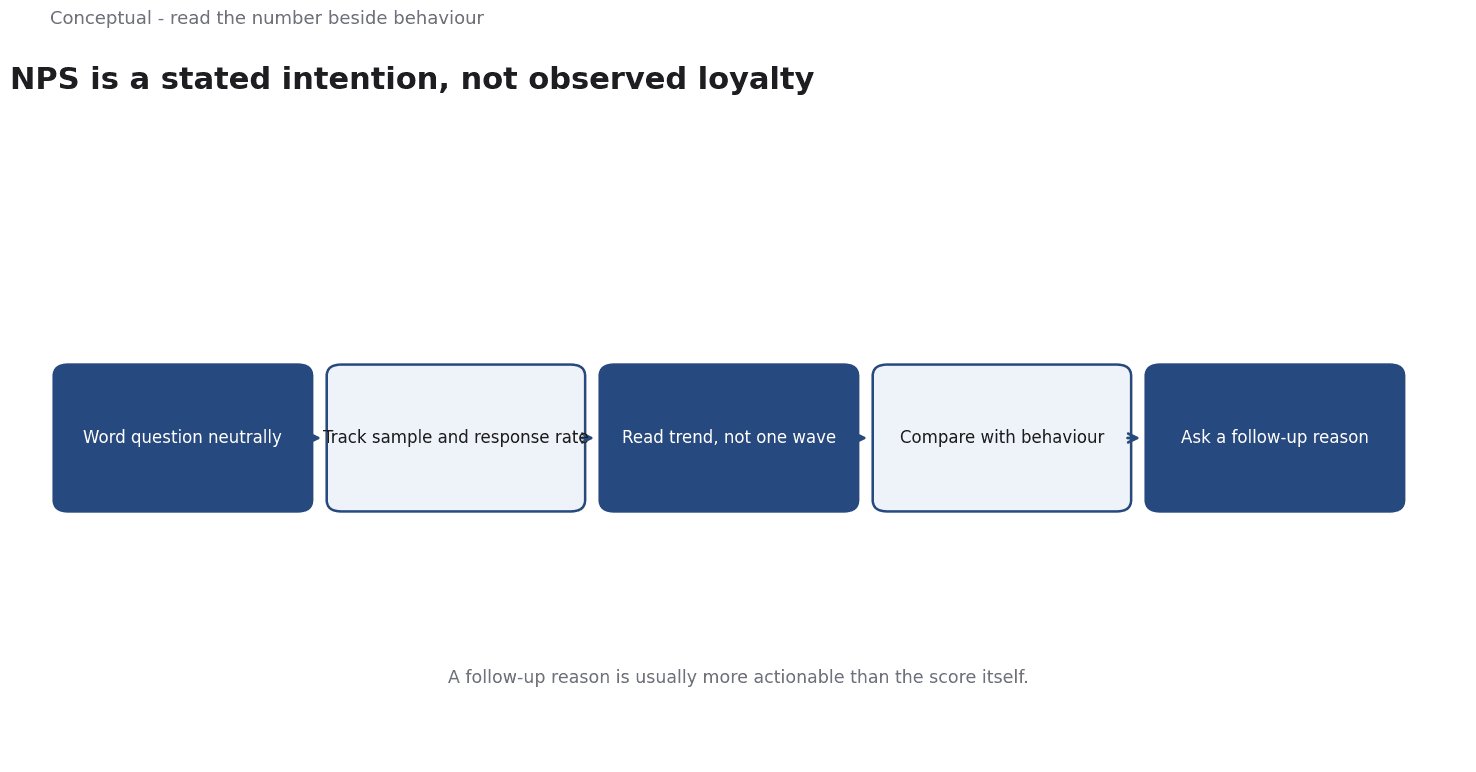
The sequence is: word the question neutrally, track the sample, read the trend, then compare with behaviour. The interpretation is local, so the conclusions are inferred; the instrument is source-reported.
A worked example
Illustrative. A company reports a rise in NPS after a service change.
Three checks decide. First, was the wording and the sample the same in both periods? Second, is the change larger than the variation expected from the sample size? Third, did retention or referrals actually change, or only the stated intention?
The outcome is a qualified reading rather than a verdict on the change. The scenario is hypothetical; the method is the contribution.
Evidence status
| Claim | Status | Source | Verified | Recheck when |
|---|---|---|---|---|
| NPS is based on stated willingness to recommend | source-reported | Wikipedia, Net promoter score | 2026-11-18 | Definition changes |
| Surveys need neutral wording and transparency | source-reported | AAPOR standards | 2026-11-18 | Standards updated |
| Read the score beside behaviour | inferred | Derived from the gap | 2026-11-18 | Survey changes |
Why a score is not loyalty
A number summarises answers to one question. Loyalty is observed in repeat behaviour and recommendations, which may or may not align with the answer, and the gap is the reason to keep other measures.
A further issue is that the question invites a social answer. People may answer how they think they should respond rather than what they would do, especially when the survey is sent by a company they want to support. That is a property of stated measures, and it is the reason to keep behaviour alongside the score.
The sample also matters more than the calculation. A score from a small or self-selected group can move substantially without any change in the customer base, and reporting the response rate is part of interpretation rather than an optional detail.
Finally, a score cannot explain itself. A follow-up question about the reason is often more useful than the number, because it points to something the team can change.
The reason behind an answer is usually more actionable than the score itself.
A score should be read with its sample and response rate, not as a standalone figure.
Behaviour remains the stronger evidence when a score and actions disagree.
A follow-up reason is often more useful than the number itself.
A stated intention is not a promise to recommend.
What it cannot do
It cannot predict behaviour reliably on its own. It does not explain why customers answered as they did. And it cannot fix a service that needs work.
The counterargument that a single number is easy to track is fair for simplicity and incomplete for interpretation.
A decision test
- Word the question neutrally.
- Record the sample and response rate.
- Read the trend, not a single wave.
- Compare with behaviour.
- Ask a follow-up about reasons.
- Record the interpretation and recheck date.
For the measurement, see Voice of Customer.
References & Further Reading
- Wikipedia contributors, 2026. Net promoter score - Wikipedia — A measure based on stated recommendation likelihood.
- American Association for Public Opinion Research, 2026. AAPOR — The professional association for public opinion and survey research; its standards and resources underpin the survey-design discussion.