Network Effects Metrics that Matter
Network-effect metrics matter only when tied to a valuation decision. Read which signals to track, a worked example, and why raw user counts mislead.
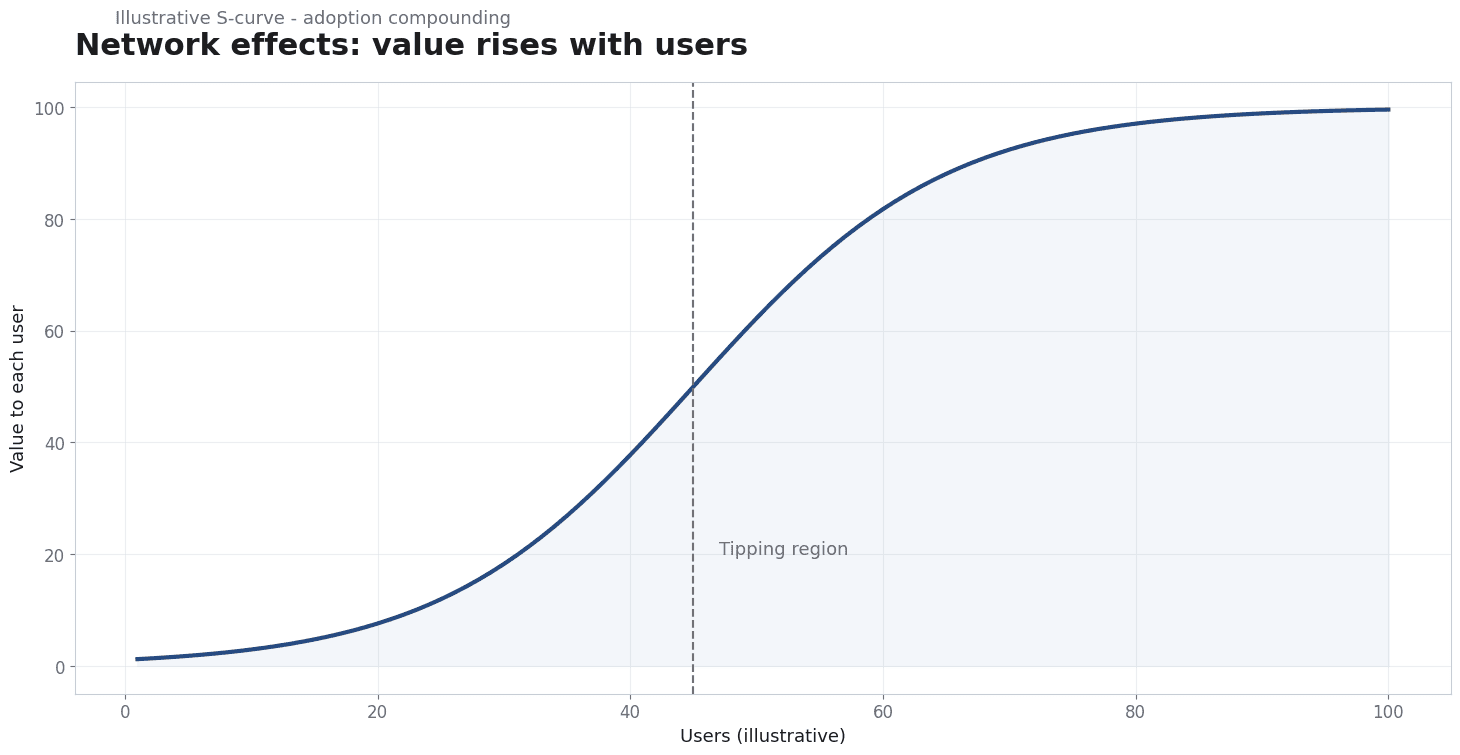
Network effects are routinely described with the same headline numbers used for any growing product: total users, sign-ups, and engagement. The problem is that a network's value depends on the relationships between its participants, not on the size of the crowd alone. A metric that counts heads without measuring connection density, balance, or quality can make a fragile network look healthy.
Direct answer: Measure the properties that create network value: active connected participants, the balance between sides, and the strength of the connections that produce repeat use. Tie each metric to a valuation decision, because a number that does not change an investment or pricing choice is decoration. The sources define networks and valuation; the metric-to-decision mapping is a synthesis.
Delta: This article adds a claim-status table and a worked example beyond the sources: it maps network metrics to valuation decisions, with claim status explicit.
The mechanism
The network effect entry describes a situation where a product becomes more valuable to each user as more users join.
That definition has a practical consequence: the unit of value is the connection, not the account.
A social product with ten million dormant accounts can be worth less than one with a million active, interacting ones. Counting registrations treats all accounts as equal, which the concept itself does not support. The first measurement task is therefore to define what an active participant is and to count the relationships that make participation worthwhile.
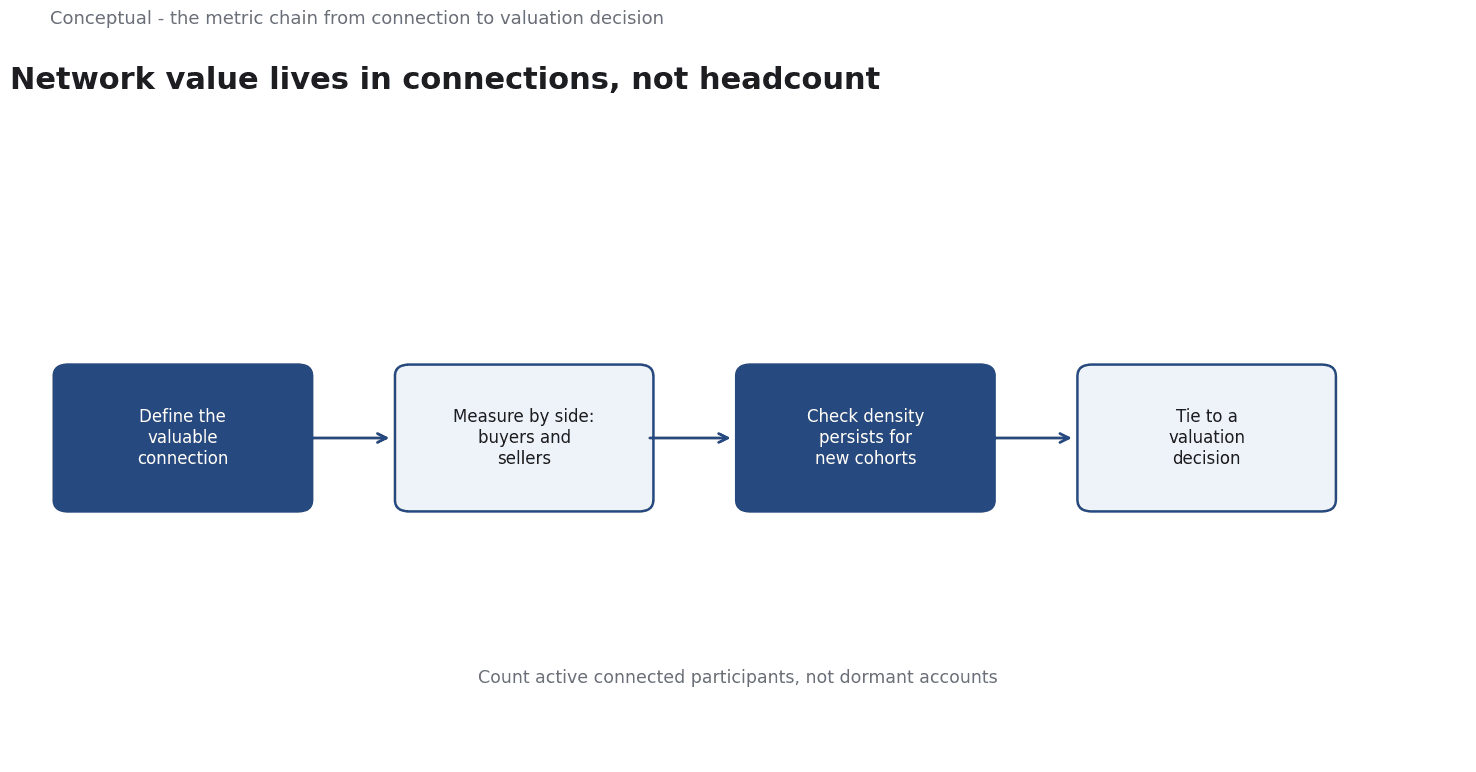
Directed networks add a second requirement: balance between sides. In a marketplace, value depends on both buyers and sellers being present in useful proportion. Growth on one side without the other can degrade the experience, because more buyers competing for scarce sellers raise prices and slow fulfilment, while more sellers with no buyers produce no transactions. A single aggregate total hides this imbalance. The practical consequence is that metrics should be reported by side and by the ratio that connects them.
Valuation adds a discipline about what a number is for. The valuation entry frames valuation as the process of determining the worth of an asset or company, which implies a decision: an investment, a pricing change, or a budget allocation. A network metric earns its place only if it could change such a decision. Connection density might justify a higher valuation because retention looks durable; a lopsided user base might justify a lower one because the growth looks purchased rather than organic. The metric and the decision should be stated together.
Taken together, the mechanism is a chain: define the valuable connection, measure it by side, check that it persists, and connect the result to a valuation judgement. Each step is a local choice rather than something the sources prescribe. That is why the claims derived from the chain are marked as inferred rather than reported.
A worked example
The following is hypothetical and illustrative. A marketplace operator reports strong user growth and asks for a higher internal valuation ahead of a funding round. Three checks decide whether the growth reflects a real network effect. First, what fraction of participants transacted in the last thirty days, and how many distinct counterparties did each engage? Second, is growth balanced across buyers and sellers, or is one side accumulating without the other? Third, does connection density hold when the newest cohort is measured on its own, rather than being averaged into the established base? The outcome is a valuation judgement with a recorded rationale: if active connections are dense and balanced, the growth supports a higher internal value; if the totals are driven by one side or by dormant accounts, the same headline number supports a lower one. No figures here are real; the diagnostic sequence is the contribution.
Evidence status
| Claim | Status | Source | Verified | Recheck when |
|---|---|---|---|---|
| Network value rises with additional users | source-reported | Wikipedia, Network effect | 2026-11-18 | Definition revised |
| Valuation determines the worth of an asset or company | source-reported | Wikipedia, Valuation (finance) | 2026-11-18 | Definition revised |
| Map connection metrics to valuation decisions | inferred | Derived from the sources | 2026-11-18 | Pricing or funding model changes |
The two source-reported rows describe concepts: a network whose value grows with users, and valuation as the determination of worth. Neither prescribes a metric. The inferred row is the local addition, linking connection quality to a decision. Recheck the mapping if the business changes how it prices access or how investors value growth, because the decision a metric serves can shift even when the definitions do not.
What it cannot do
These metrics cannot establish causation on their own. An observed rise in connection density might come from the network effect, or from a price cut, a seasonal campaign, or an external event that brought users together. The network effect entry describes a mechanism; it does not say that every correlation with growth is produced by that mechanism. A valuation built on the assumption that density caused retention can overstate durability if the real driver was a temporary subsidy. Separating cause from coincidence needs a comparison that the sources do not supply.
There is a measurement cost that dashboards tend to hide. Counting meaningful connections requires identity resolution, event tracking, and definitions that survive changes to the product. Each definition is a choice: a connection might be a message, a transaction, or a follow, and each produces a different number. Maintaining those definitions across teams is real work, and the cost is invisible in a headline chart. A team that adopts the metric without funding the instrumentation will report a number that looks authoritative and means something different from month to month.
Once connection count becomes a target, teams can manufacture connections that satisfy the definition without creating value, which mirrors the way any simple proxy invites gaming. The metric then rises while the underlying experience stagnates. This failure is not a flaw in the sources but a consequence of using any measure as an incentive. The practical guard is to keep more than one indicator and to review the definition when behaviour changes around it.
There is also a boundary between what the sources support and what a local analysis can claim. The network effect and valuation entries are general descriptions. They do not supply thresholds, benchmarks, or a rule that says a given density justifies a given multiple. Any such threshold is a decision made in the specific market, and it should be labelled as such. Presenting a locally chosen threshold as if it came from the literature would blur the line the claim table is designed to keep clear.
Finally, the mapping needs periodic review. Products change, sides change, and the connection that created value last year may not be the one that matters now. A marketplace that adds a new participant type changes what balance means. A review does not require rebuilding the model; it requires asking whether the metric still connects to the decision it was chosen to serve. If it no longer does, the number should be retired or redefined rather than inherited.
The counterargument that raw user counts are a useful proxy for network value is fair for an early product with no transaction data and incomplete for a mature network where composition, balance, and quality determine whether growth is durable.
A decision test
- Define the connection that creates value for a participant.
- Count active participants by side, not as a single total.
- Measure the balance between the sides.
- Check whether connection density holds for new cohorts.
- Name the valuation decision the metric is meant to inform.
- Record the claim status and the condition that would trigger a recheck.
A decision test is not a formula. It is a short sequence that forces the analyst to state what the network produces, which participants produce it, and which decision the number will change. Running it before a chart is built prevents the common reverse error, in which a convenient metric is chosen first and a justification is attached afterwards. The recheck condition keeps the mapping alive as the product changes.
For further reading, see Marketing Dashboards without the Hype.
References & Further Reading
- Wikipedia contributors, 2026. Network effect - Wikipedia — Value growing with the number of users.
- Wikipedia contributors, 2026. Valuation (finance) - Wikipedia — Overview of absolute and relative valuation approaches; secondary reference.