Omnichannel Retail: Selling Wherever Customers Are
Omnichannel is an operational problem disguised as a marketing idea. Read the inventory and attribution mechanisms, a fulfilment worked example, and the limits.
"Be wherever the customer is" is good advice until someone asks what it costs. A retailer that adds a second channel without changing its inventory, fulfilment, and measurement systems does not become omnichannel; it becomes two disconnected businesses sharing a brand. The hard work is in the middle.
Direct answer: Omnichannel retail means presenting a consistent offer across channels while sharing the operational backbone — inventory, customer records, and fulfilment — behind them. The U.S. Census Bureau reported that e-commerce was 17.1% of total retail sales in the second quarter of 2026, which makes the online channel significant but makes the other 82.9% impossible to ignore. The boundary: integration has real costs, and not every product or customer benefits from every channel.
What integration actually requires
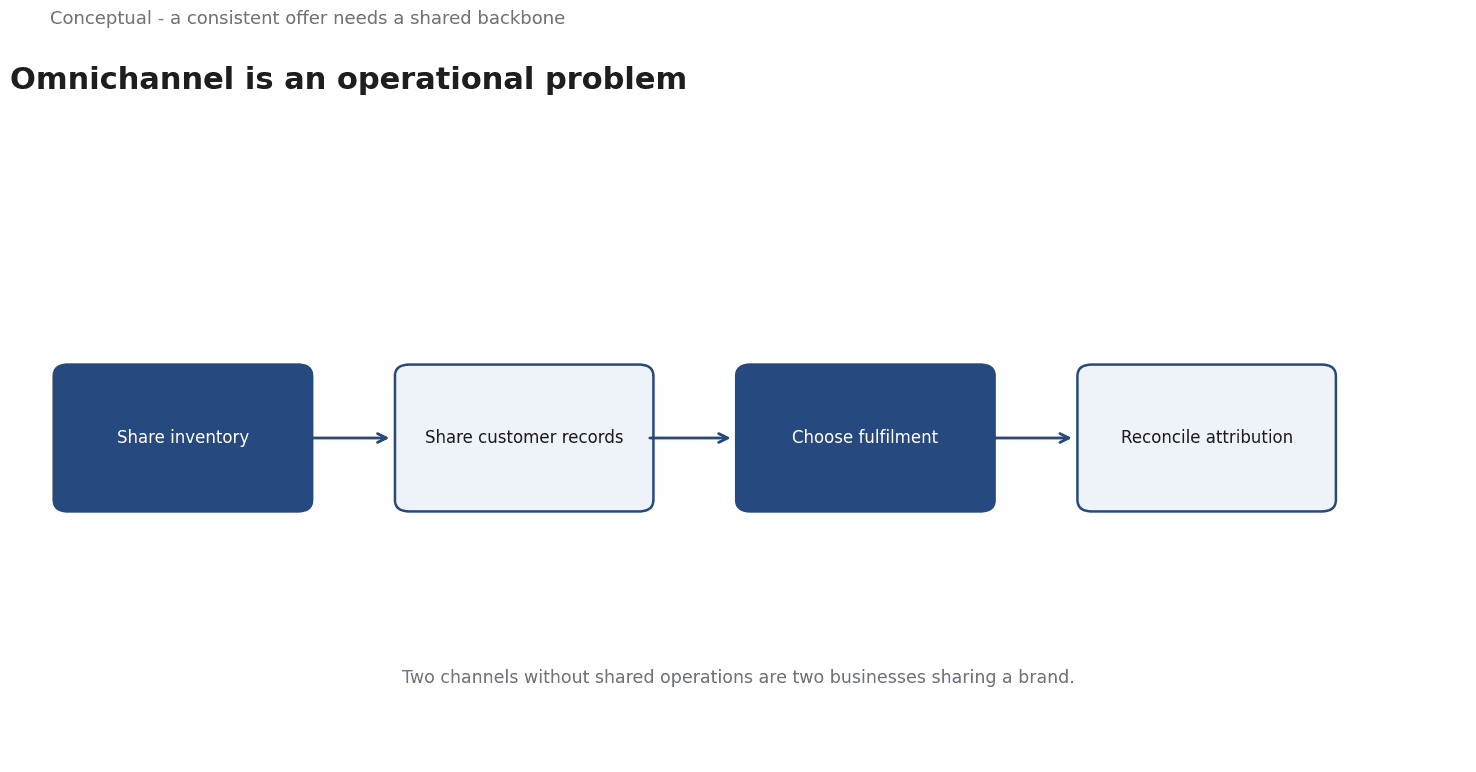
Four capabilities separate an omnichannel operation from several parallel channels:
A single inventory view. Each location and warehouse must report available stock to every channel. Without this, a product shown as available online may already have been sold in a store.
A shared customer record. A customer who browses online and buys in a store should be recognisable as the same person, or the retailer cannot measure the path to purchase.
Flexible fulfilment. The system must be able to ship from a warehouse, ship from a store, or prepare an order for pickup, choosing based on cost and speed.
Consistent measurement. Orders, returns, and attribution must be reconcilable across channels, or the retailer cannot tell which channel is profitable.
The Census figure above is a useful reminder of scale but not a strategy. A retailer that treats 17.1% as a target to migrate all sales into will misread what the other channel contributes — particularly inspection, immediacy, and service.
A worked example of fulfilment choice
The following numbers are hypothetical and illustrative.
A customer orders a product online. The retailer can fulfil it two ways:
| Option | Handling | Transport | Delivery time |
|---|---|---|---|
| Ship from warehouse | 4 | 6 | 3 days |
| Ship from store | 6 | 3 | 1 day |
Warehouse fulfilment costs 10 and takes three days; store fulfilment costs 9 and takes one day. On these numbers the store is both cheaper and faster — but only if the store actually has the item and the staff can pick it without disrupting in-store service.
Add two frictions:
- Inventory accuracy. If store stock records are wrong 10% of the time, one in ten ship-from-store orders fails and must be rerouted, adding an average of 5 to the cost. Expected store cost becomes 9 + 0.1 × 5 = 9.5 — still competitive, but the margin has narrowed.
- Staff time. If picking an online order takes 15 minutes during a peak period and delays in-store customers, the true cost includes lost in-store conversion. That cost is real and usually unmeasured.
The decision therefore depends on data quality and labour conditions, not on the nominal handling cost. A retailer with poor inventory accuracy should fix that before expanding ship-from-store; a retailer with spare capacity in quiet stores may find the option highly attractive.
The general lesson: omnichannel economics are determined by the accuracy of shared data and the flexibility of operations.
Attribution is the measurement trap
A customer sees an ad online, visits a store, and buys two weeks later. Which channel gets credit? A last-click model credits the store; a first-touch model credits the ad. Neither describes what happened.
Three problems follow:
Double counting.
Wrong optimisation. If digital is never credited for store conversions, the retailer may cut the advertising that generated them. If the store is never credited for the service that closed the sale, it may be treated as a cost centre.
Platform-reported lift is not lift. Ad platforms attribute conversions using their own models. Those numbers are useful for platform optimisation, not as a measure of incremental revenue.
The practical response is to maintain channel-specific metrics for operations and an experimental measure — holdout groups or geo tests — for incrementality. Observational attribution is a hypothesis, not a causal result.
The store as an operational asset
The most useful reframing in omnichannel is to stop treating stores as sales channels only. A store is also a fulfilment node, a returns point, a service location, and a source of demand data. Each of these roles changes how its performance should be measured.
As a fulfilment node, the relevant metrics are pick accuracy, order readiness time, and the cost per unit shipped — not sales per square metre. A store that looks unprofitable on sales may be valuable as a distribution point with already-paid rent.
As a returns point, a store converts a costly reverse-logistics flow into an opportunity for exchange or an in-person service interaction. The cost saving can exceed the value of the original sale.
As a service location, it supports high-consideration purchases that begin online. A customer who can inspect a product and ask a question in person may convert at a much higher rate than an online-only funnel predicts.
This reframing explains why a simple "online versus store" margin comparison misleads. A store's contribution includes effects that appear in other channels' numbers, and a retailer that measures each channel independently will systematically undervalue the store.
The implication for measurement is to report channel economics both standalone and after allocating shared benefits, and to state which view is being used for a given decision.
What omnichannel does not guarantee
Three qualifications matter.
More channels are not automatically better. Each channel adds fixed costs and operational complexity. A product with low online search demand and high in-store inspection value may gain little from a large digital investment.
Consistency can be expensive. A uniform price across channels is simple for customers but removes a retailer's ability to reflect different cost structures. The decision should be explicit, not assumed.
Integration creates concentration risk. A single inventory system used by every channel is efficient until it fails, at which point all channels stop working. The architecture needs a defined fallback.
The counterargument to integration — that each channel should be optimised independently — wins in some categories. A luxury brand may deliberately keep channels separate to control experience.
The honest question is whether the customer's journey actually crosses channels; if it does not, integration buys little.
A decision test
- Map the real customer journey across channels before adding another one.
- Check inventory accuracy at the level required by the fulfilment option you want.
- Compare fulfilment costs including failure rates and staff time, as in the worked example.
- Reconcile channel metrics so total revenue is not double counted.
- Measure incrementality with a holdout rather than last-click attribution.
- Decide pricing consistency deliberately with the cost structure in view.
- Define the fallback when the shared system fails.
For the channel comparison, see E-commerce vs Brick and Mortar; for the measurement discipline, see Marketing Attribution.
References & Further Reading
- National Retail Federation, 2026. NRF Press Releases | Latest Statements & Announcements | NRF — Primary retail-sales and channel data for sell-in versus sell-out definitions.
- U.S. Census Bureau, 2026. Quarterly Retail E-Commerce Sales — The official definition and estimates for retail e-commerce sales.
- Colin Bryar and Bill Carr, 2019. Amazon Company News — Primary company material on how the working-backwards method is applied.