Online Review Strategy Pitfalls
Reviews are a public record, not a campaign channel. Read the pitfalls, a worked response, and why asking for five stars corrupts the signal.
A review strategy often focuses on collecting positive ratings, which ignores that reviews are a public record. The customer-review entry describes how reviews form a record, and the word-of-mouth entry covers how recommendations spread. The pitfalls concern what a strategy can honestly do.
Direct answer:
Respond to reviews with a resolution, invite honest feedback from all customers, and measure whether the underlying problem was fixed.
The sources describe the record; the method is a synthesis.
Delta: This article adds a claim-status table and a worked response, separating documented channel facts from local choices about asking and responding.
The mechanism
Inviting only satisfied customers produces a record that looks good and tells the truth about nobody. The customer-review entry describes reviews as a record, which means their value lies in being representative. A curated set loses that value.
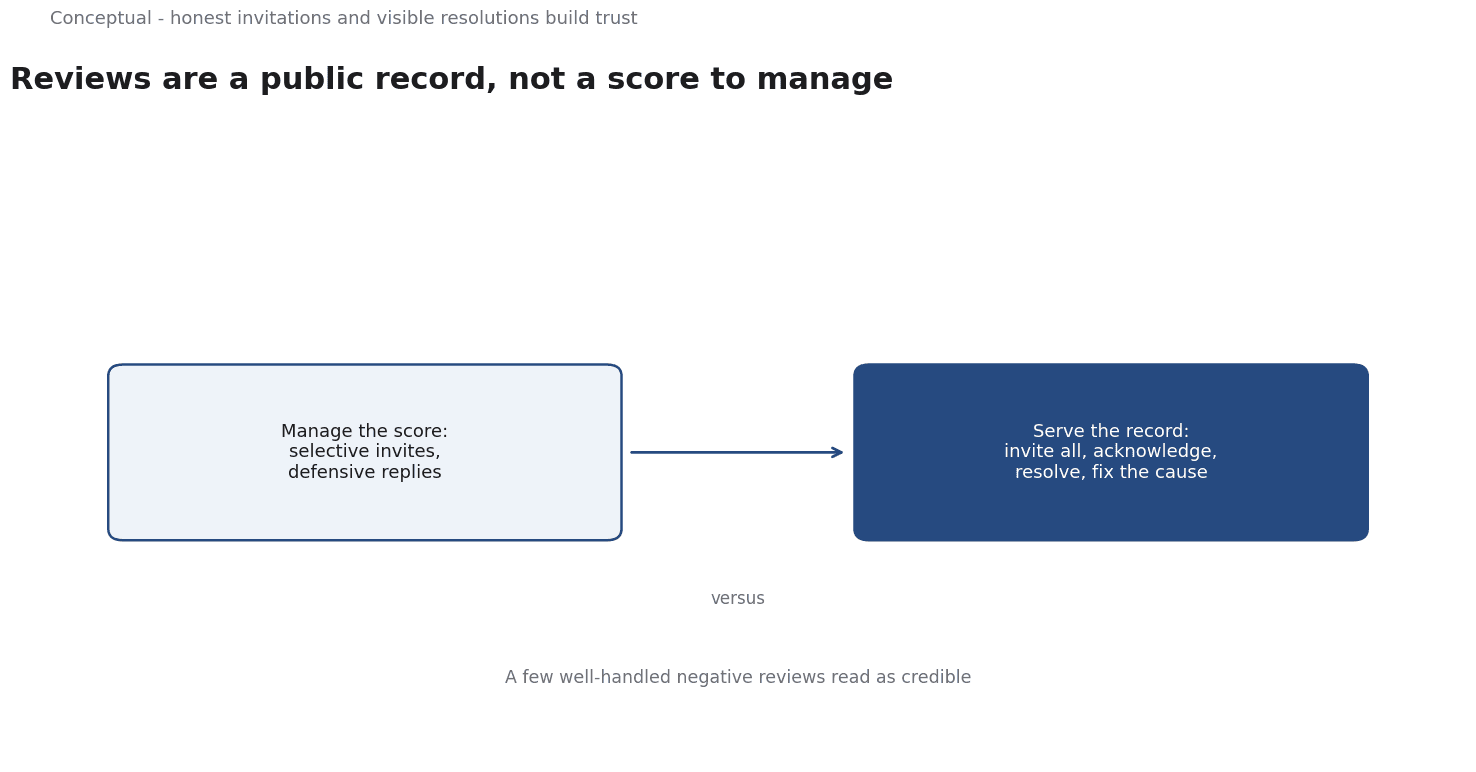
The second pitfall is treating the average as the goal. A higher average can conceal a worse pattern in a segment, and a response that optimises the number will miss the cause. Reading reviews by theme and by time is more informative than watching a single figure.
The third pitfall is responding defensively. A response is visible to future readers, which makes it part of the record. The word-of-mouth entry describes how recommendations spread, and a defensive reply can travel further than the original complaint. A response that acknowledges the issue and states a resolution is more useful.
The fourth pitfall is confusing visibility with trust. A business can be prominent in reviews and still be distrusted if the pattern of replies suggests manipulation. Honest handling of negative cases is what builds credibility, which is a longer process than collecting stars.
A worked response
Illustrative. A shop receives a negative review about a delayed delivery.
Three checks decide. First, does the response acknowledge the specific issue rather than a generic apology? Second, is there a stated resolution, with an owner, so the reader can see what changed? Third, was the underlying cause addressed, so the same complaint does not recur?
The outcome is a recorded response and a fix. The scenario is hypothetical; the method is the contribution.
Evidence status
| Claim | Status | Source | Verified | Recheck when |
|---|---|---|---|---|
| Reviews form a public reputation record | source-reported | Wikipedia, Customer review | 2026-11-18 | Platform changes |
| Recommendations spread through word of mouth | source-reported | Wikipedia, Word of mouth | 2026-11-18 | Definition changes |
| Ask honestly and respond with resolution | inferred | Derived from the record concept | 2026-11-18 | Policy changes |
Why a perfect score can be a warning
A flawless record with no negative cases often means the invitation process was selective or the response process removed difficult voices. A few well-handled negative reviews are more credible than an implausible average, because they show how the business behaves when something goes wrong.
A final consideration is that review platforms change their rules, and a strategy built around one platform's signals may stop working after an update. Recording the rule being optimised against helps a team notice when the ground has shifted.
The response process also needs an owner. A review that goes unanswered for weeks suggests neglect to future readers, which is a different problem from the original complaint. Assigning responsibility for responses is part of the strategy, not an afterthought.
A response should name the resolution, since an acknowledgement without a next step tells future readers little.
A review strategy cannot substitute for a product that delivers on its promises, which is the condition the record will eventually reflect.
The record should be read as evidence about the experience, not as a score to be managed.
A response that removes a genuine complaint damages the record more than the complaint itself.
The pattern of replies is part of the record that future readers see.
The invitation list should include customers who had a mixed experience, not only the happiest ones.
What it cannot do
It cannot manufacture trust. It does not remove the need to fix the product or service. And it cannot guarantee that a response changes the reviewer's mind.
The counterargument that the average is what customers look at is fair for a quick scan and incomplete for the trust that a record creates over time.
A decision test
- Invite honest feedback from all customers.
- Read reviews by theme and time.
- Respond with acknowledgement and resolution.
- Fix the underlying cause.
- Record the response and the fix.
- Set a recheck condition.
For the wider signal, see Voice of Customer.
References & Further Reading
- Wikipedia contributors, 2026. Customer review - Wikipedia — How online reviews form a public reputation record.
- Wikipedia contributors, 2026. Word of mouth - Wikipedia — How recommendations spread between customers.